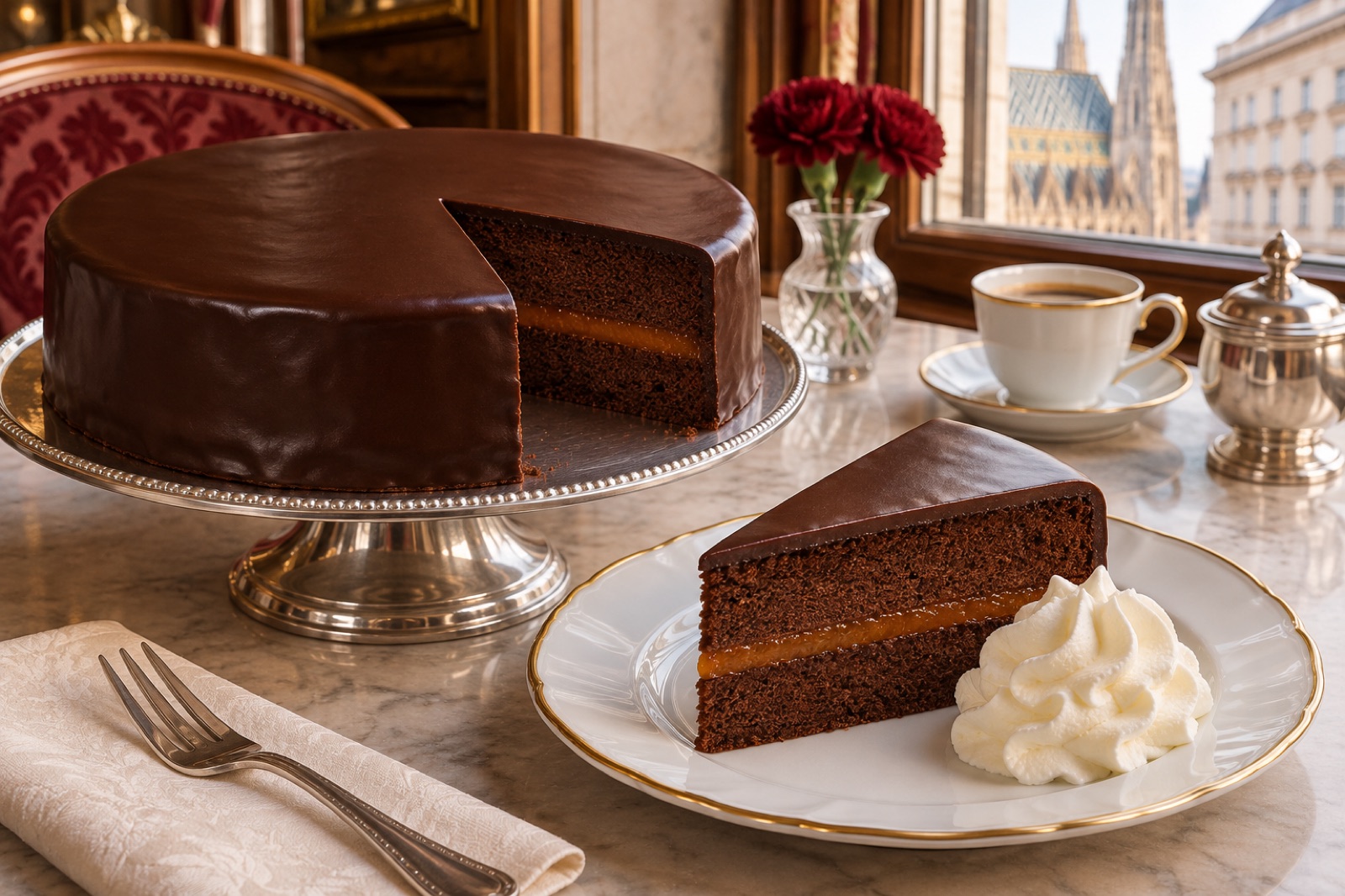
Sachertorte is associated with 16-year-old Franz Sacher in Vienna in 1832. Austria’s traditional-food register defines the cake with flour, butter, eggs, sugar, chocolate, apricot jam, and chocolate glaze. Hotel Sacher keeps the exact formula secret; these measurements follow its published approximate home recipe.
Lift comes from whipped egg whites rather than baking powder. The fully cooled cake is split and thinly apricot-coated; once the surface dries, lukewarm glaze is poured in one motion. Overheating dulls it, while overcooling makes it thick and streaky.
Why this method works
- Room-temperature butter and eggs emulsify smoothly; lukewarm chocolate blends without melting the butter base.
- Medium-stiff egg whites folded in two additions lift the dense chocolate batter without collapsing it.
- Apricot jam seals crumbs and moisture beneath the glaze; about 4 mm coating on a wooden spoon signals proper flow.
Before you start
Prepare an 8½–9-inch springform, parchment, bain-marie, mixer, offset spatula, rack, and thermometer. Bring ingredients to room temperature 45 minutes ahead.
Use chocolate with at least 55% cocoa. Separate eggs into clean dry bowls; fat or yolk weakens the foam.
Warm and strain apricot jam for a smooth coat. Do not present this as the secret Original Sacher-Torte formula; it is a published home approximation.
Step-by-step method
1. Build the chocolate batter without deflating
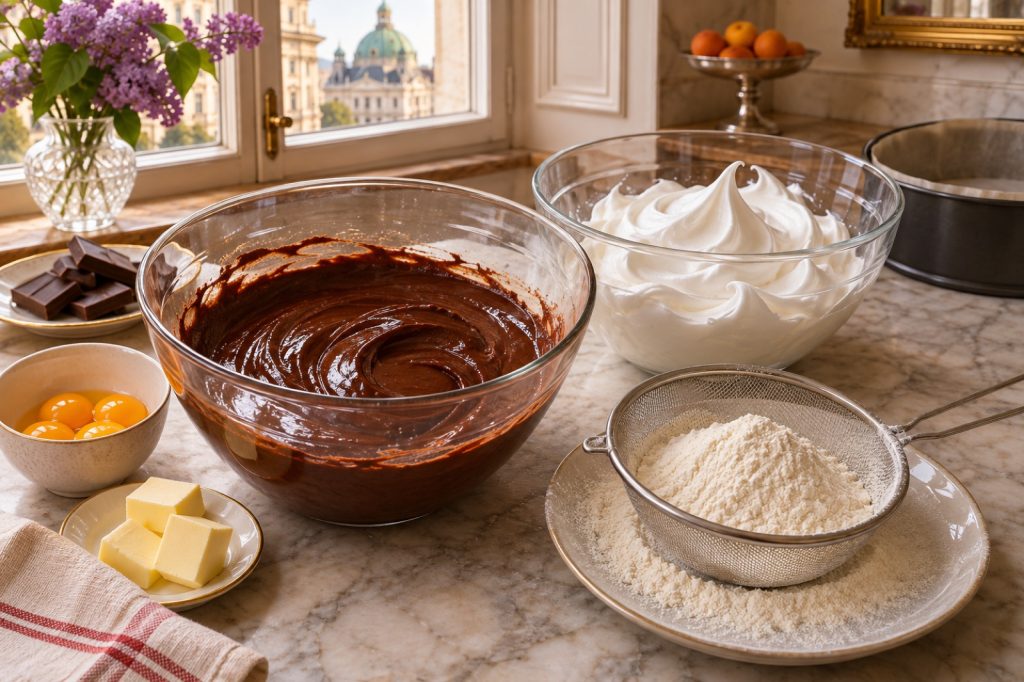
Heat oven to 340°F/170°C; line the base, grease and flour sides. Melt 130 g chocolate over a bain-marie and cool to lukewarm. Beat butter, icing sugar, and vanilla 4 minutes; add yolks one by one, then chocolate. Whip whites, gradually adding 100 g sugar, to glossy medium-stiff peaks. Fold one-third into the base, then alternate remaining foam with sifted flour gently.
2. Bake and cool completely
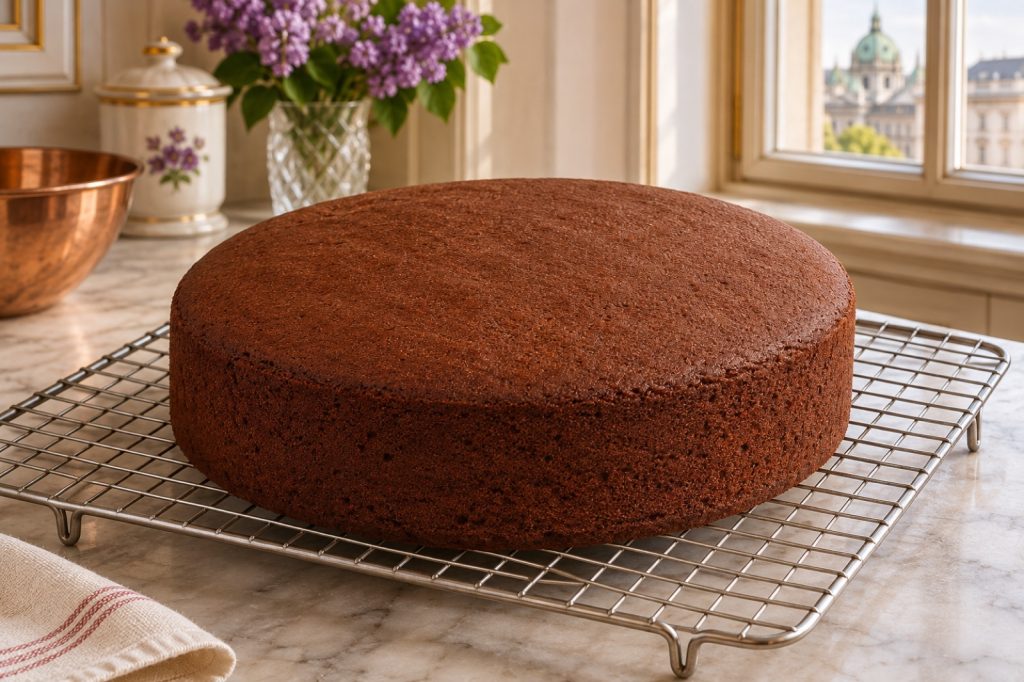
Spread in the pan and bake 50–55 minutes. A skewer should show a few moist crumbs, not liquid batter, and the center should spring lightly. Cool 15 minutes in the pan, then completely on a rack. Do not split while warm.
3. Fill and seal with apricot jam
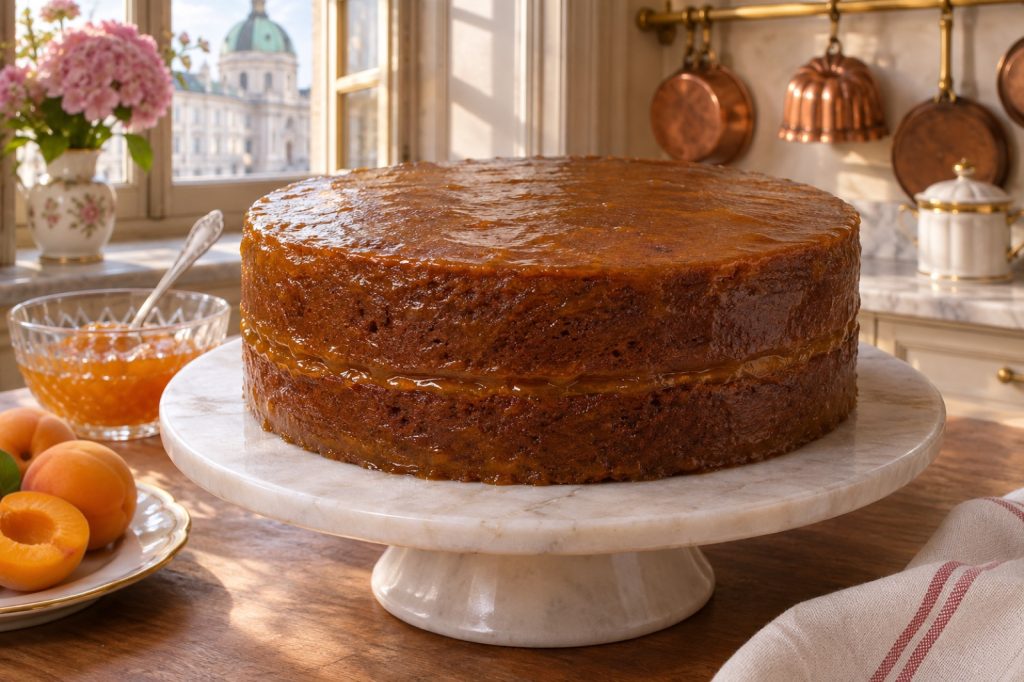
Split the cold cake horizontally. Spread half the jam inside; close and coat top and sides very thinly with remaining warm strained jam. Leave on a rack 30–45 minutes until no longer tacky. Smooth the edges as evenly as possible.
4. Test glaze at 4 mm and pour once
Boil 200 g sugar with ½ cup plus 1 teaspoon/125 ml water over high heat about 5 minutes; remove and cool 2 minutes. Stir in 150 g chocolate until smooth. Glaze should leave about a 4 mm layer on a wooden spoon. Thin drop by drop with hot syrup if needed. Pour all over the center and spread in only 2–3 strokes; set 2–3 hours at room temperature.
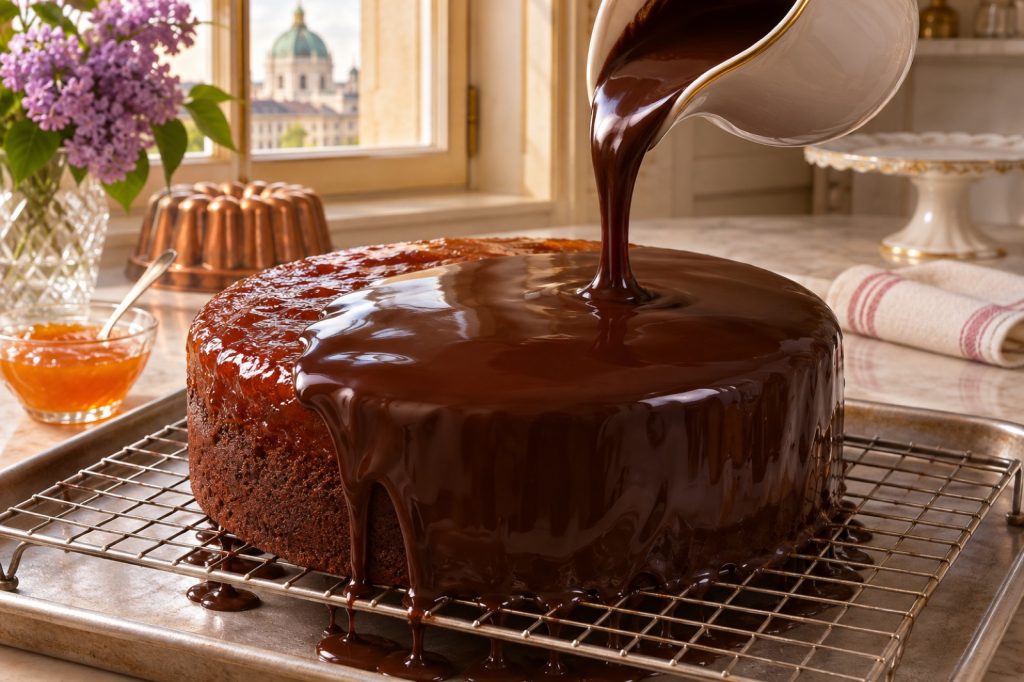
Sachertorte
A Viennese chocolate cake lifted with egg whites, layered with apricot jam, and finished with a glossy spoon-tested chocolate glaze.
Ingredients
- 130 g dark couverture chocolate — at least 55% cocoa
- 150 g unsalted butter — softened
- 100 g icing sugar
- 1 pod vanilla pod or 1 tsp extract
- 6 large eggs — separated
- 100 g caster sugar
- 140 g all-purpose flour — sifted
- 200 g apricot jam — warmed and strained
- 200 g sugar for glaze
- 125 ml water
- 150 g dark couverture for glaze — finely chopped
- 240 ml unsweetened whipped cream — optional for serving
Instructions
- Heat oven to 340°F/170°C; line the base, grease and flour sides. Melt 130 g chocolate over a bain-marie and cool to lukewarm. Beat butter, icing sugar, and vanilla 4 minutes; add yolks one by one, then chocolate. Whip whites, gradually adding 100 g sugar, to glossy medium-stiff peaks. Fold one-third into the base, then alternate remaining foam with sifted flour gently.
- Spread in the pan and bake 50–55 minutes. A skewer should show a few moist crumbs, not liquid batter, and the center should spring lightly. Cool 15 minutes in the pan, then completely on a rack. Do not split while warm.
- Split the cold cake horizontally. Spread half the jam inside; close and coat top and sides very thinly with remaining warm strained jam. Leave on a rack 30–45 minutes until no longer tacky. Smooth the edges as evenly as possible.
- Boil 200 g sugar with ½ cup plus 1 teaspoon/125 ml water over high heat about 5 minutes; remove and cool 2 minutes. Stir in 150 g chocolate until smooth. Glaze should leave about a 4 mm layer on a wooden spoon. Thin drop by drop with hot syrup if needed. Pour all over the center and spread in only 2–3 strokes; set 2–3 hours at room temperature.
Notes
- Cake is level to gently domed with a fine crumb that slices without crumbling. The apricot layer is thin and even. Glaze is dark, smooth, softly glossy, and set without shattering or sticking.
- A sunken cake may mean overwhipped whites, rough folding, or an underbaked center. Dull glaze was too hot; streaky glaze too cool. Jam other than apricot changes the Sacher profile. Use quality 55–65% dark chocolate if couverture is unavailable. 125 ml is about ½ cup plus 1 teaspoon.
- Serve at 72–75°F/22–24°C with unsweetened whipped cream. Keep covered at cool room temperature 2 days or refrigerate 5 days; bring out 1 hour before serving. Freeze the unglazed cake up to 2 months, thaw in the refrigerator, then add jam and glaze. Contains wheat/gluten, egg, and dairy; chocolate may contain soy lecithin.
Texture and doneness cues
Cake is level to gently domed with a fine crumb that slices without crumbling. The apricot layer is thin and even. Glaze is dark, smooth, softly glossy, and set without shattering or sticking.
Mistakes, substitutions, and measurements
A sunken cake may mean overwhipped whites, rough folding, or an underbaked center. Dull glaze was too hot; streaky glaze too cool. Jam other than apricot changes the Sacher profile. Use quality 55–65% dark chocolate if couverture is unavailable. 125 ml is about ½ cup plus 1 teaspoon.
Serving, storage, and allergens
Serve at 72–75°F/22–24°C with unsweetened whipped cream. Keep covered at cool room temperature 2 days or refrigerate 5 days; bring out 1 hour before serving. Freeze the unglazed cake up to 2 months, thaw in the refrigerator, then add jam and glaze. Contains wheat/gluten, egg, and dairy; chocolate may contain soy lecithin.
Frequently asked questions
Why is Sachertorte dry?
Overbaking and serving refrigerator-cold make dryness more noticeable. Check at 50 minutes and serve at 72–75°F.
Why is the glaze not glossy?
The syrup-chocolate mixture may have overheated. Cool briefly off heat and pour quickly.
Why must the cake be cold before splitting?
Warm chocolate cake is fragile and steamy; layers compress and jam and glaze become uneven.
Leave a Reply