Category: Soups

Discover comforting classics and soups inspired by cuisines around the world. Each recipe explains texture cues, accessible substitutions, storage, reheating, and how to prevent common problems such as curdling, scorching, or over-thickening.

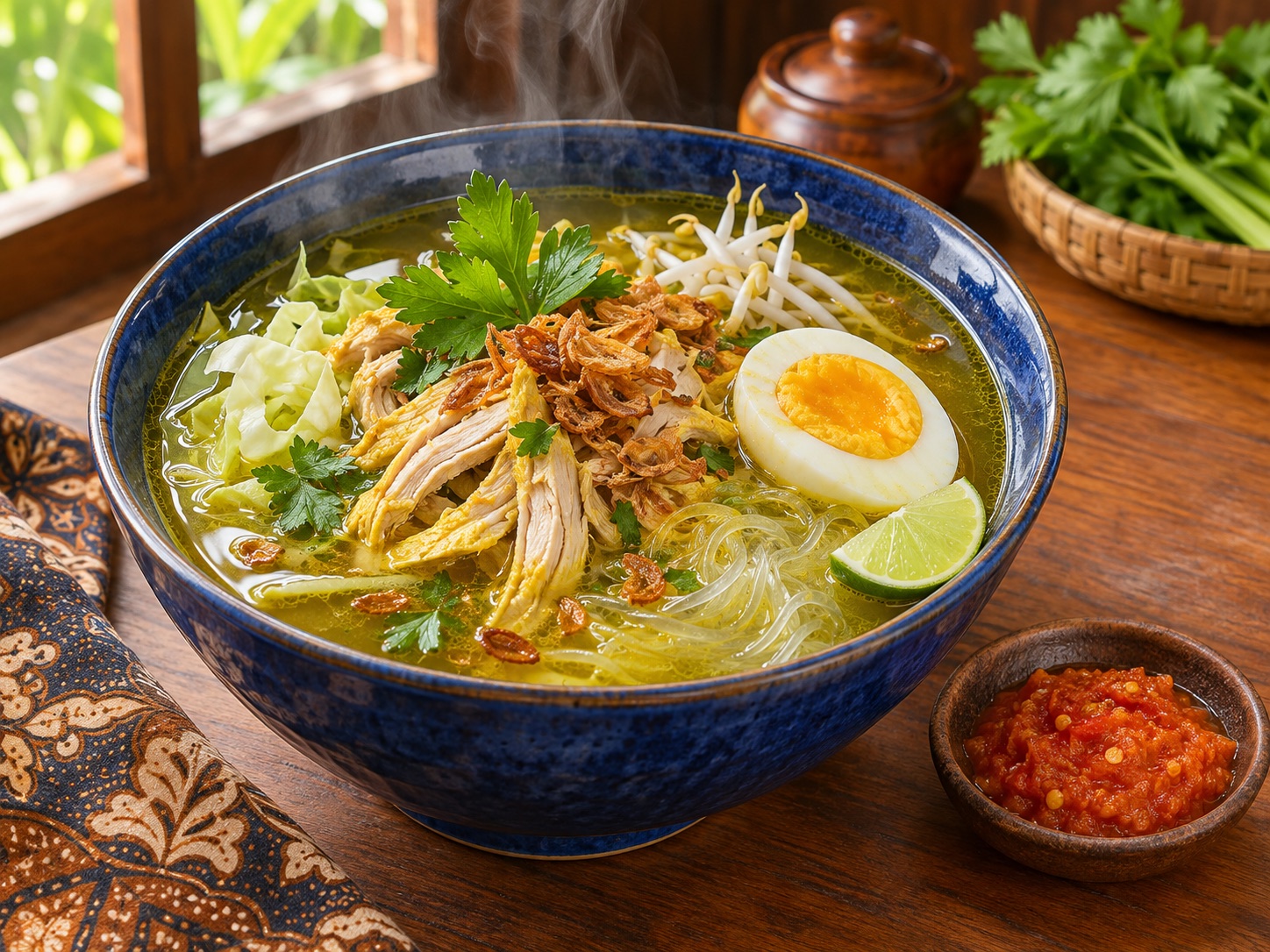
  • Indonesian Soto Ayam: Turmeric Chicken Noodle Soup

    Indonesian Soto Ayam: Turmeric Chicken Noodle Soup

    Indonesia’s official tourism guide notes that soto varies by region, with soto ayam meaning the chicken form and rice or compressed rice commonly served alongside. This is a clear, turmeric-forward home adaptation.

    Broth, chicken, noodles, and garnishes are handled separately so noodles do not swell and every diner can adjust lime and sambal.

    Why this method works

    • Frying the spice paste removes raw shallot and turmeric flavors.
    • A gentle simmer keeps broth clearer than a rolling boil.
    • Checking for 165°F/74°C verifies safe chicken doneness.
    • Building bowls at serving preserves noodle and vegetable texture.

    Before you start

    Fresh turmeric stains; use wood or metal equipment.

    Candlenuts are not eaten raw; here they are fried and simmered. Use cashews if unavailable.

    Prepare eggs, noodles, and toppings while chicken cooks.
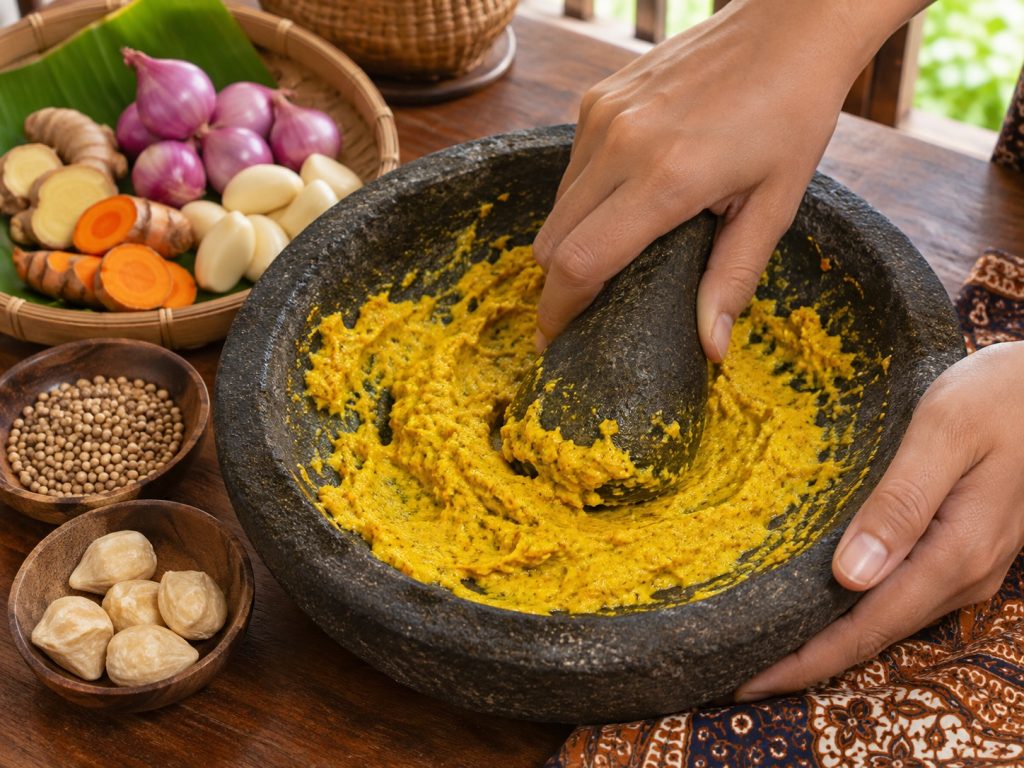
    Make the yellow spice paste
    Pound or blend shallots, garlic, turmeric, ginger, coriander seeds, and candlenuts with 2–3 tbsp water into a thick paste.

    Step-by-step method

    1. Make the yellow spice paste

    Pound or blend shallots, garlic, turmeric, ginger, coriander seeds, and candlenuts with 2–3 tbsp water into a thick paste.

    2. Fry the paste and aromatics

    Heat oil in a large pot over medium. Cook paste with lemongrass, kaffir lime leaves, and galangal for 5–7 minutes, until the raw aroma fades and oil begins to separate; do not brown.
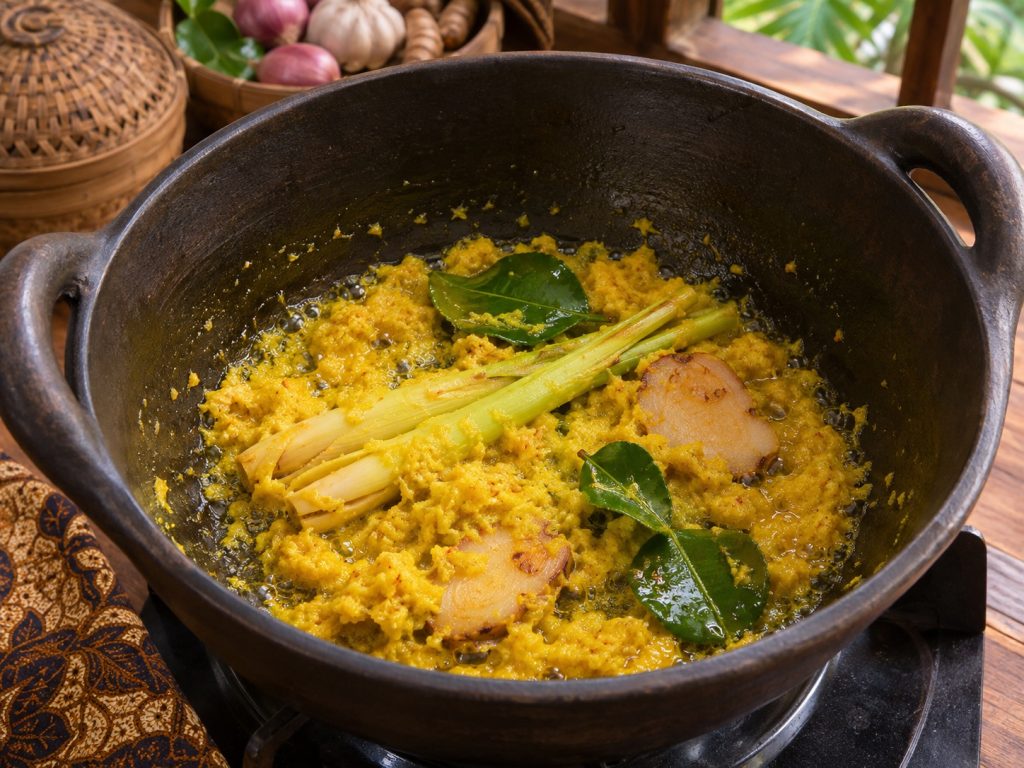
    Fry the paste and aromatics
    Heat oil in a large pot over medium. Cook paste with lemongrass, kaffir lime leaves, and galangal for 5–7 minutes, until the raw aroma fades and oil begins to separate; do not brown.

    3. Cook the chicken safely

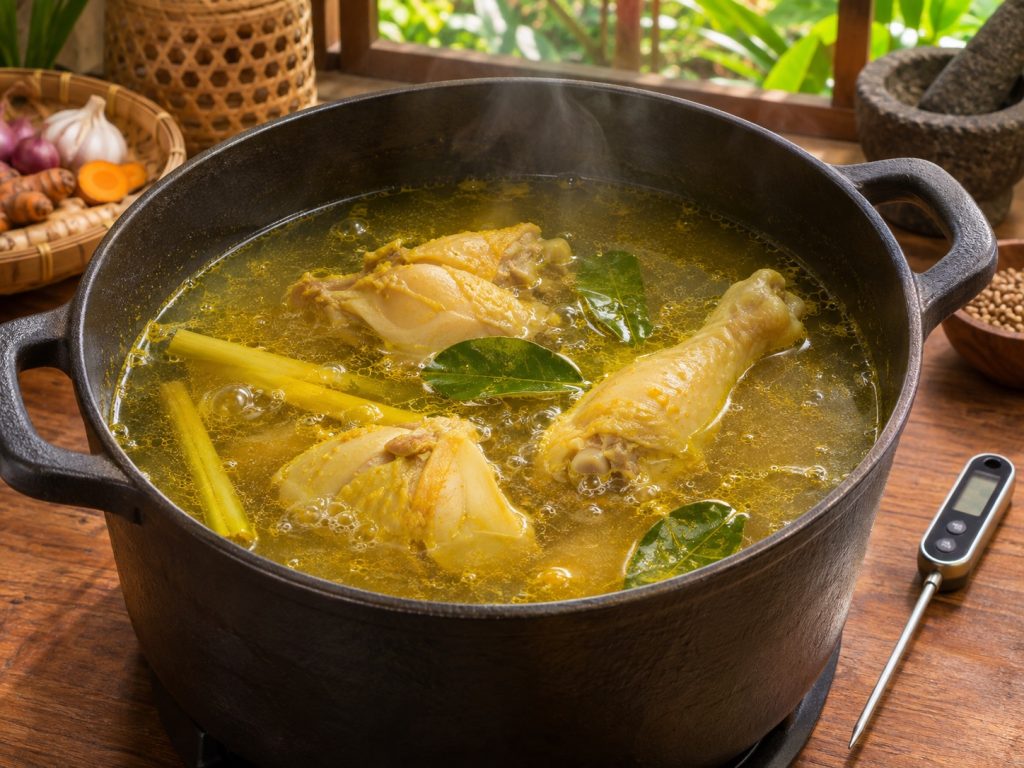
    Add chicken and water and bring to a gentle simmer. Skim foam and cook partly covered for 35–45 minutes. When the thickest piece reaches 165°F/74°C, remove and shred chicken; strain broth and adjust salt and sugar.
    Cook the chicken safely
    Add chicken and water and bring to a gentle simmer. Skim foam and cook partly covered for 35–45 minutes. When the thickest piece reaches 165°F/74°C, remove and shred chicken; strain broth and adjust salt and sugar.

    4. Assemble each bowl

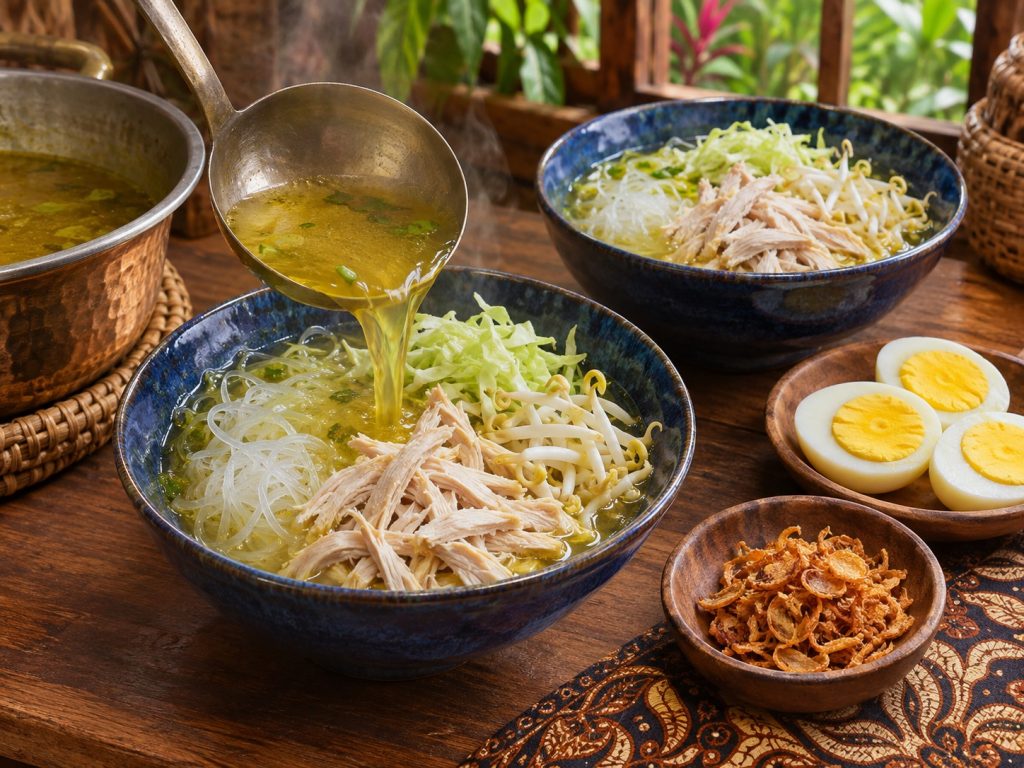
    Prepare noodles per package; blanch sprouts 30 seconds and drain. Divide noodles, cabbage, sprouts, and chicken among bowls. Add piping-hot broth and finish with egg, fried shallots, celery leaves, lime, and sambal.
    Assemble each bowl
    Prepare noodles per package; blanch sprouts 30 seconds and drain. Divide noodles, cabbage, sprouts, and chicken among bowls. Add piping-hot broth and finish with egg, fried shallots, celery leaves, lime, and sambal.

    Common problems and fixes

    Cloudy broth usually means a hard boil; it remains edible, but use only small bubbles next time.

    A bitter paste indicates scorched turmeric; cook over medium and stir constantly.

    Substitutions and shortcuts

    Without galangal, add ⅓ oz/10 g extra ginger, though flavor differs. Use cilantro for celery leaves and thin rice noodles for glass noodles.

    Pre-portion toppings to bring final assembly under 10 minutes.

    Serving, storage, and allergens

    Serve hot with lime, sambal, and fried shallots. Cool broth and chicken in shallow containers within 2 hours; refrigerate 3–4 days and reheat to 165°F/74°C. Store noodles separately. Freeze plain broth up to 2 months.

    Allergens: egg; tree nuts if cashews are used. Check commercial sambal labels.

    Frequently asked questions

    Does Soto Ayam contain coconut milk?

    Some regional soto styles are milky, but this home version uses clear turmeric chicken broth.

    Is galangal essential?

    It gives a distinctive aroma. Extra ginger works in a pinch but does not taste identical.

    Can I use chicken breast?

    Yes, but bone-in thighs produce better broth. Remove breast as soon as it reaches 165°F/74°C.

    Can noodles cook in the broth?

    Not recommended; starch clouds the broth and noodles swell during storage. Cook separately.
  • Ecuadorian Locro de Papa: Creamy Potato and Cheese Soup

    Ecuadorian Locro de Papa: Creamy Potato and Cheese Soup

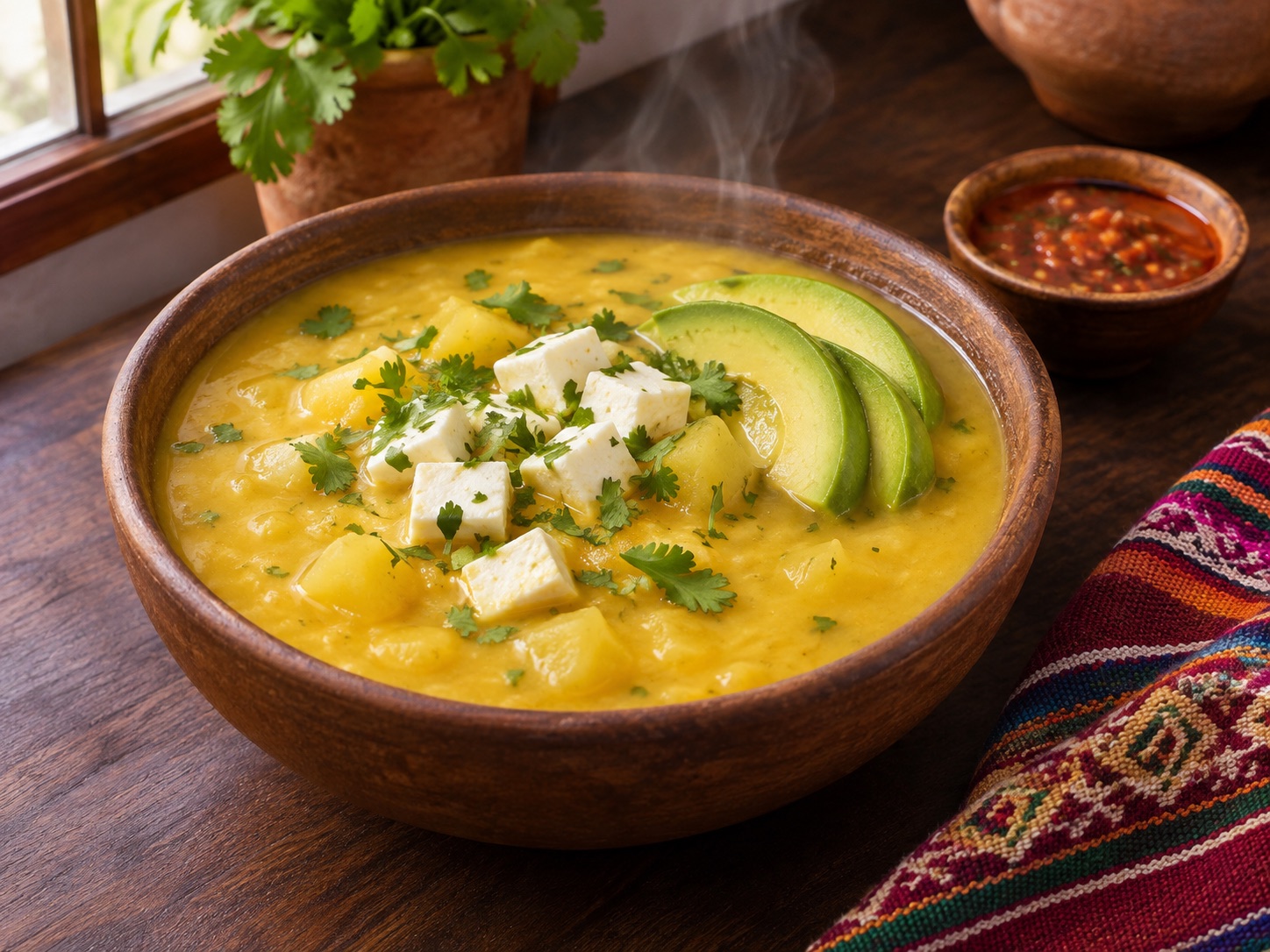
    Ecuador’s official tourism guide describes locro de papa as a thick Sierra-region soup built mainly from potatoes and cheese. This practical home version adds achiote, cumin, milk, and mild fresh cheese.

    Its creamy body comes from mashing part of the potatoes in the pot, not from heavy cream. The remaining cubes stay intact, giving the bowl both richness and texture.

    Why this method works

    • Floury potatoes release enough starch to thicken the broth naturally.
    • Mashing only one-third balances creaminess with distinct potato pieces.
    • Adding milk and cheese at the end over gentle heat reduces splitting.
    • Serving avocado and hot sauce separately keeps each bowl fresh and adjustable.

    Before you start

    Choose floury or all-purpose potatoes; waxy potatoes thicken less.

    If achiote is unavailable, ½ tsp sweet paprika can add color, but the flavor will not be identical.

    Taste the cheese before salting the soup.

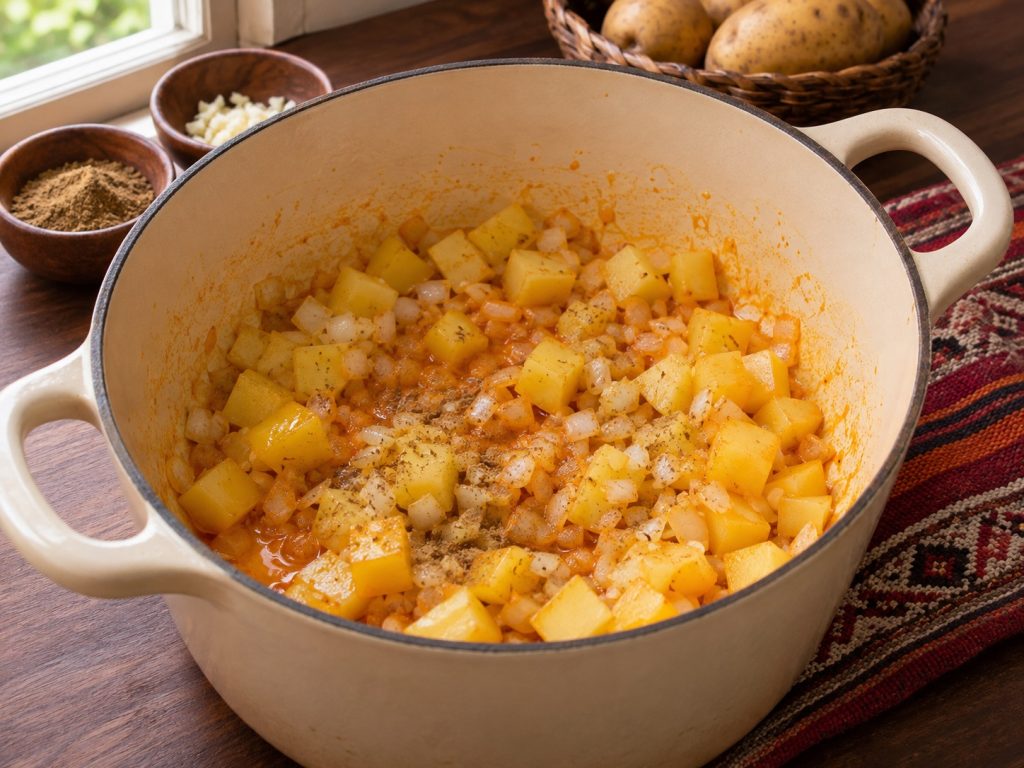
    Sauté onion, spices, and potatoes
    Heat oil in a wide pot over medium. Soften onion for 5 minutes; add garlic, cumin, and achiote and stir 30 seconds. Add potatoes and cook, stirring, for 2 minutes.

    Step-by-step method

    1. Sauté onion, spices, and potatoes

    Heat oil in a wide pot over medium. Soften onion for 5 minutes; add garlic, cumin, and achiote and stir 30 seconds. Add potatoes and cook, stirring, for 2 minutes.

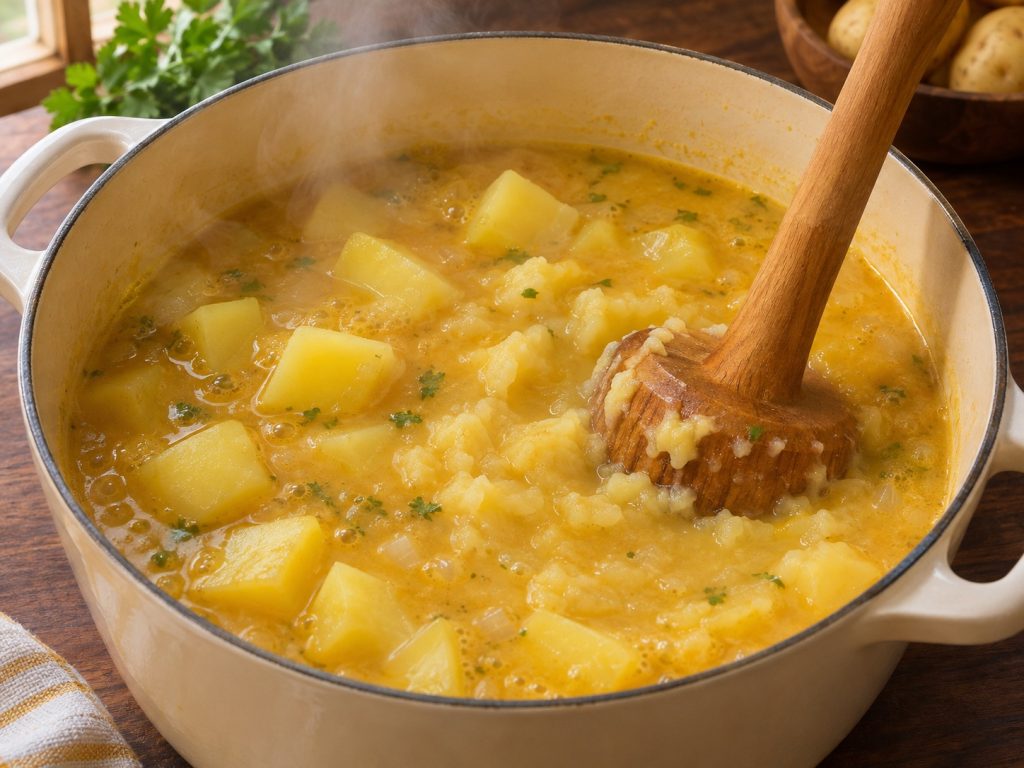
    2. Simmer until the potatoes are tender

    Add stock and 1 teaspoon salt. Once simmering, lower the heat and cook partly covered for 25–30 minutes, until potatoes crush easily with a spoon.

    Simmer until the potatoes are tender
    Add stock and 1 teaspoon salt. Once simmering, lower the heat and cook partly covered for 25–30 minutes, until potatoes crush easily with a spoon.

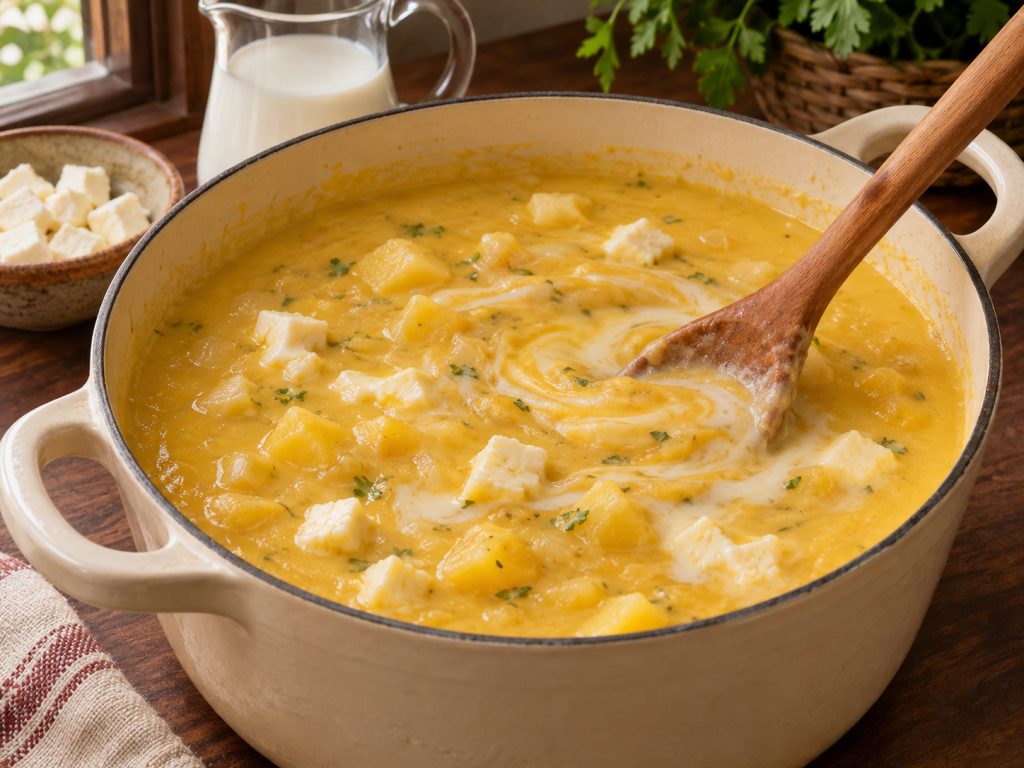
    3. Partly mash, then add milk and cheese

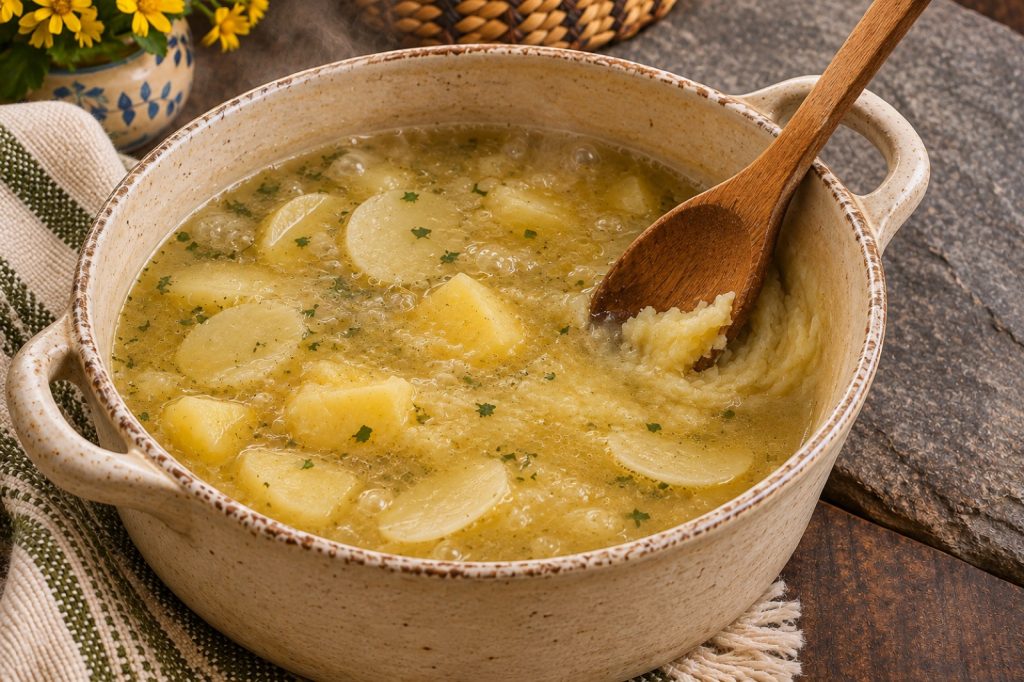
    Mash about one-third of the potatoes in the pot, leaving plenty of cubes. Add milk and heat 3 minutes. Stir in 6 oz/180 g cheese for 2 minutes, just until softened; do not boil hard.

    Partly mash, then add milk and cheese
    Mash about one-third of the potatoes in the pot, leaving plenty of cubes. Add milk and heat 3 minutes. Stir in 6 oz/180 g cheese for 2 minutes, just until softened; do not boil hard.

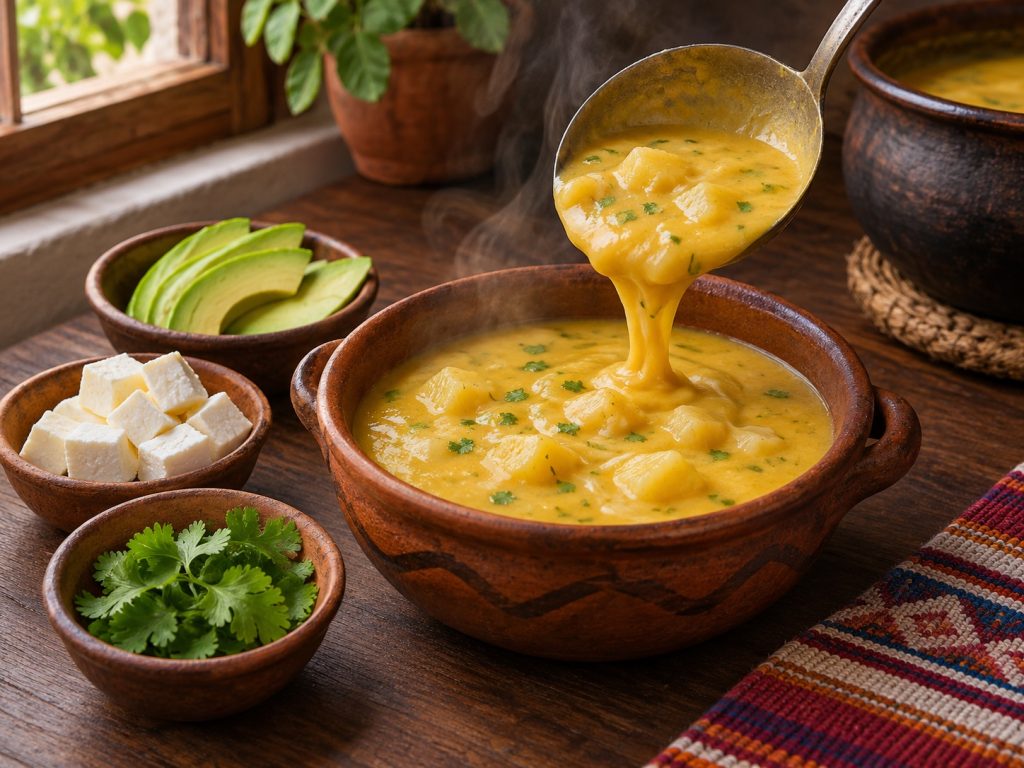
    4. Adjust the texture and serve

    The soup should coat the back of a spoon; loosen with a little hot water if needed. Adjust salt. Ladle into bowls and top with avocado, remaining cheese, cilantro, and optional hot sauce.

    Adjust the texture and serve
    The soup should coat the back of a spoon; loosen with a little hot water if needed. Adjust salt. Ladle into bowls and top with avocado, remaining cheese, cilantro, and optional hot sauce.

    Texture cues and fixes

    If thin, mash a few more potato pieces and simmer uncovered 3–5 minutes. If too thick, add hot water a little at a time.

    If the cheese clumps, the heat was too high; remove the pot from heat and stir gently.

    Substitutions and measurements

    Use queso fresco, farmer cheese, or another mild fresh white cheese. Unsweetened oat drink and a dairy-free cheese can be used, though flavor changes.

    2.6 lb potatoes equals about 1200 g; 1 cup milk equals 250 ml.

    Serving, storage, and allergens

    Serve hot with corn, ají, and lime. Cool in shallow containers within 2 hours; refrigerate 3–4 days and reheat to 165°F/74°C. For freezing, freeze the base before milk and cheese for up to 2 months.

    Allergen: milk. Check the stock label for additional allergens.

    Frequently asked questions

    Do I need heavy cream?

    No. Mashed potato provides the body, while milk and cheese add sufficient richness.

    Can I make it without achiote?

    Yes. It will be paler and taste different; a little sweet paprika can replace color only.

    Which potatoes work best?

    Floury or all-purpose potatoes thicken best. Waxy potatoes hold shape but release less starch.

    Can I make it ahead?

    Yes. Add avocado and fresh garnishes at serving, and reheat gently without a hard boil.

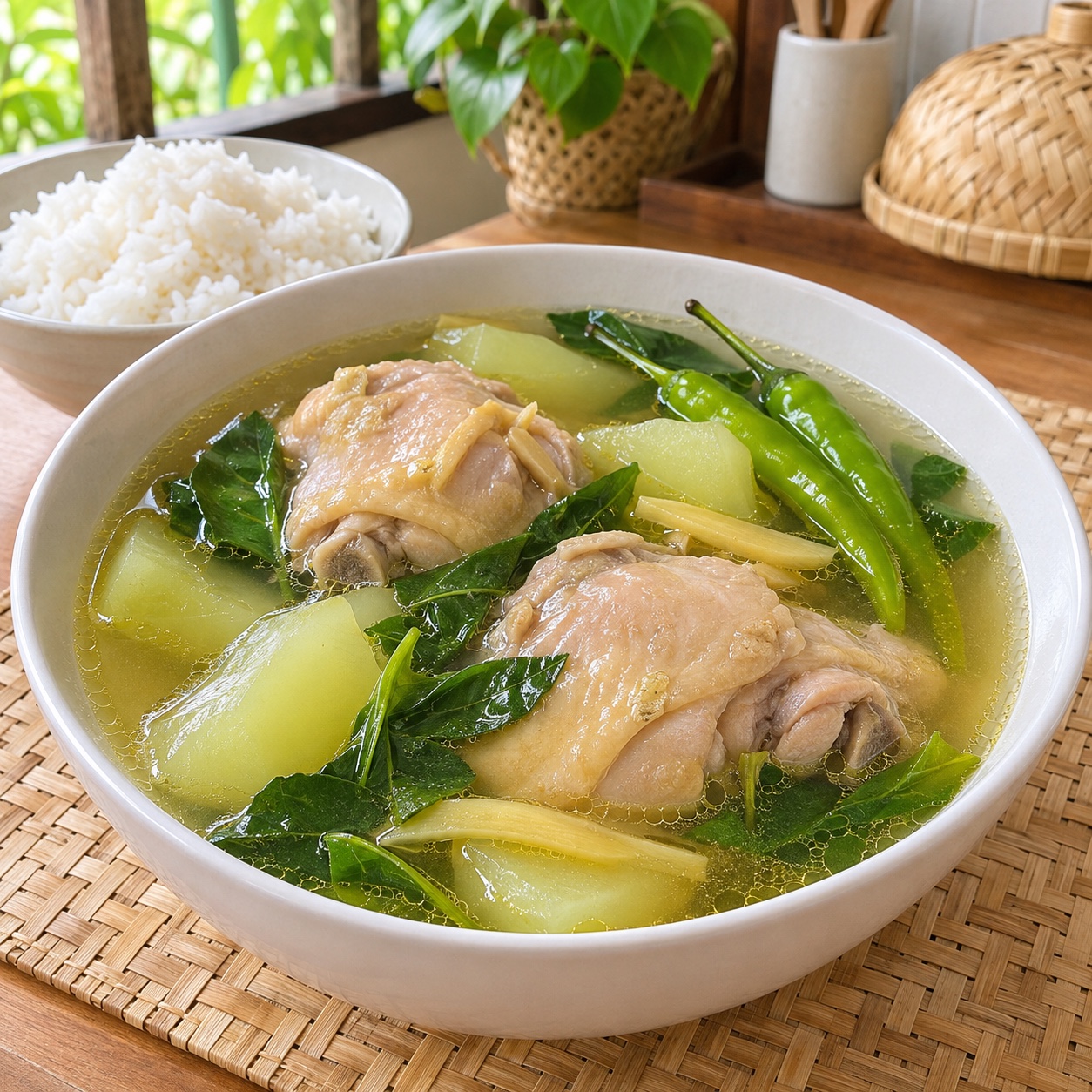
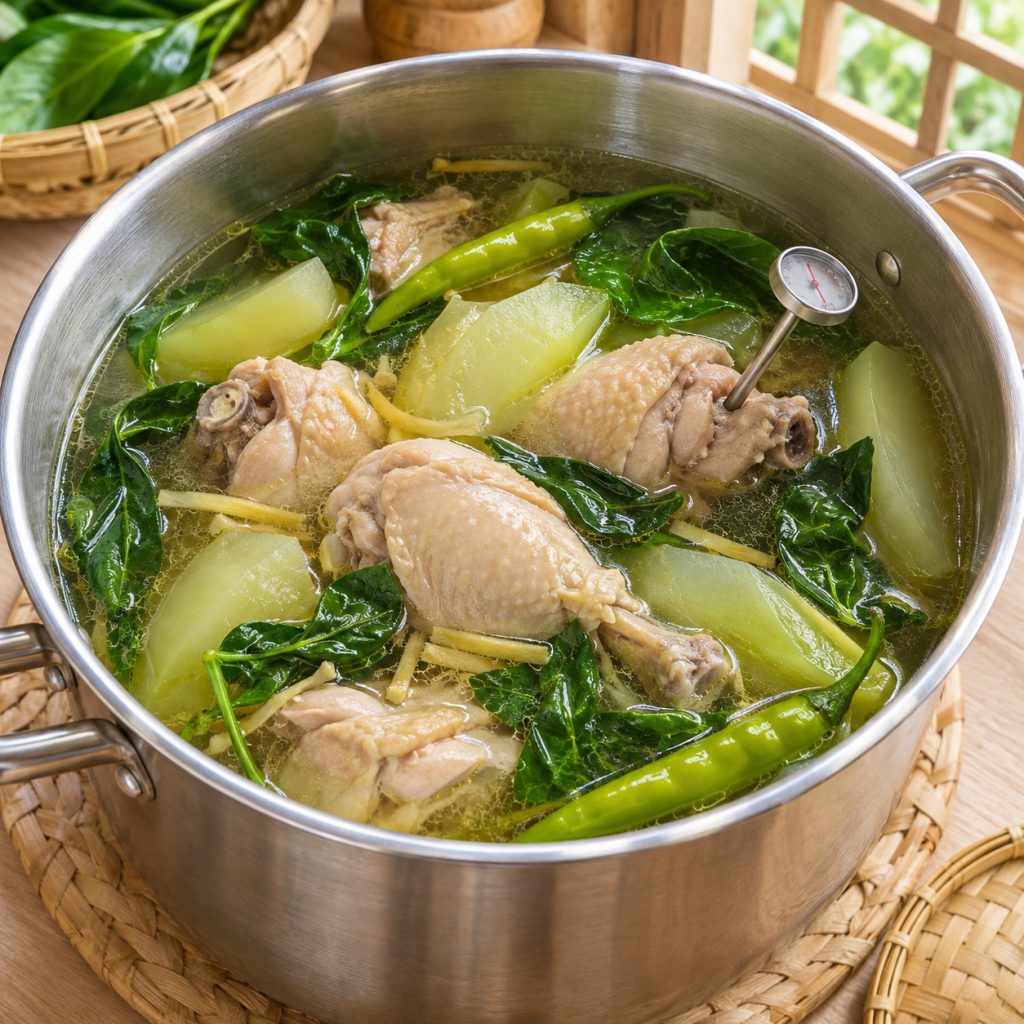
  • Filipino Chicken Tinola: Clear Ginger Chicken Soup

    Filipino Chicken Tinola: Clear Ginger Chicken Soup

    Philippine DOST-FNRI menu guides build tinola with ginger, garlic, onion, chicken, fish sauce, green papaya, and leafy greens. This home version focuses on a clear broth, gentle simmer, and safe chicken temperature.

    Green papaya can be replaced with chayote. Cutting ginger into fine matchsticks releases flavor without muddying the soup.

    Why this method works

    • Briefly sautéing ginger removes raw harshness.
    • Sweating chicken without deep browning keeps broth pale.
    • A gentle simmer reduces protein foam and cloudiness.
    • Adding leaves for the final 2 minutes preserves color and texture.

    Before you start

    Prepare a 4–5 quart pot, fine skimmer, and thermometer.

    Use a separate board for raw chicken; cut vegetables first.

    Peel and seed green papaya; cut into 1-inch/2.5 cm pieces.

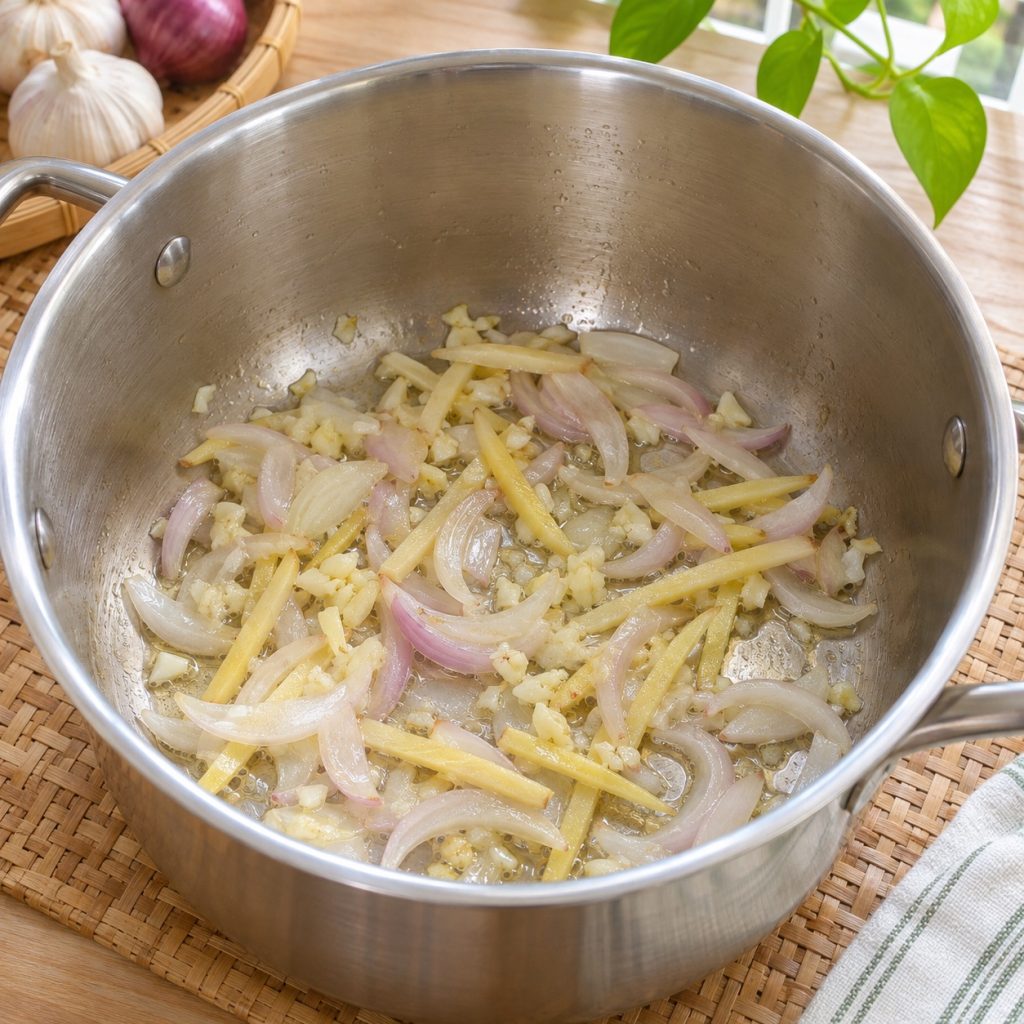
    Sweat ginger and aromatics
    Heat oil over medium. Cook ginger 2 minutes and onion 4 minutes; add garlic for 30 seconds. Do not let them brown.

    Step-by-step method

    1. Sweat ginger and aromatics

    Heat oil over medium. Cook ginger 2 minutes and onion 4 minutes; add garlic for 30 seconds. Do not let them brown.

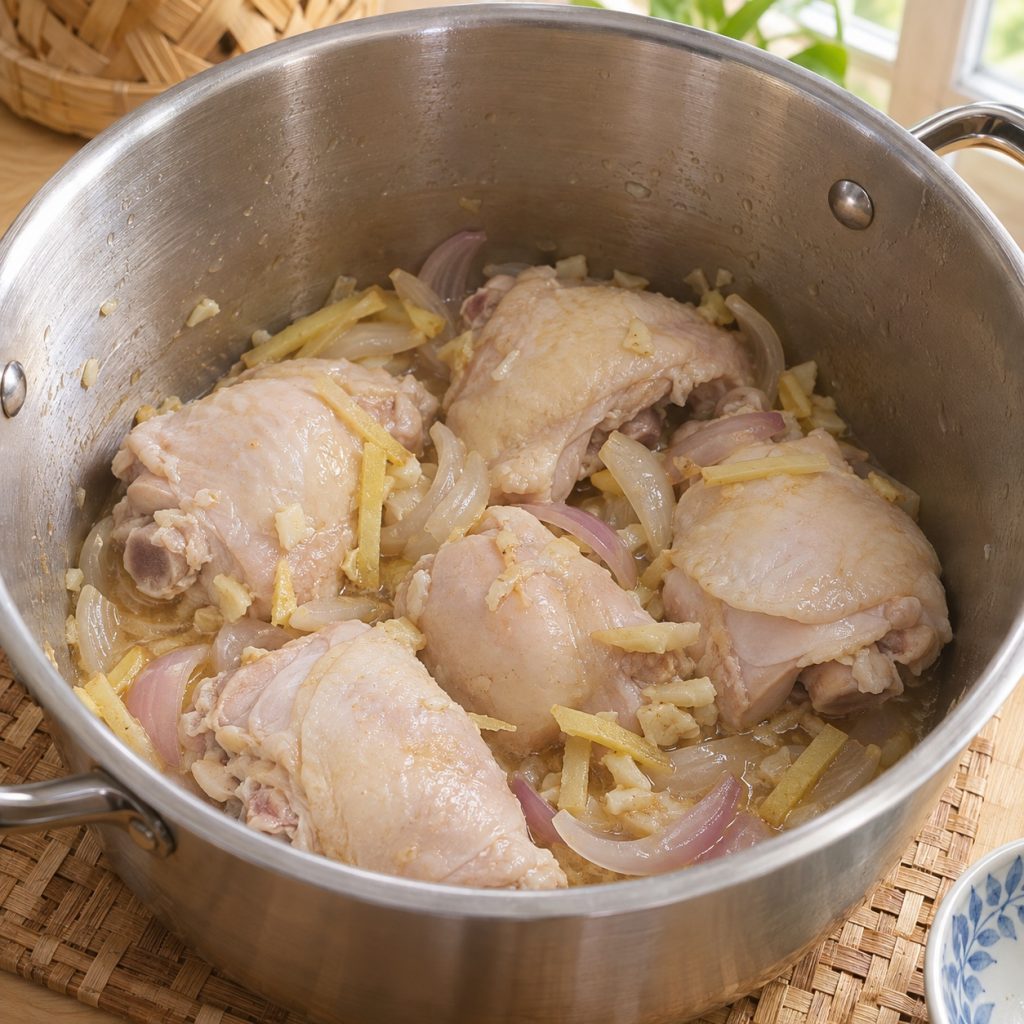
    2. Season chicken with fish sauce

    Add chicken and turn for 5 minutes until the surface turns opaque without deep color. Add fish sauce and cook 1 minute.

    Season chicken with fish sauce
    Add chicken and turn for 5 minutes until the surface turns opaque without deep color. Add fish sauce and cook 1 minute.

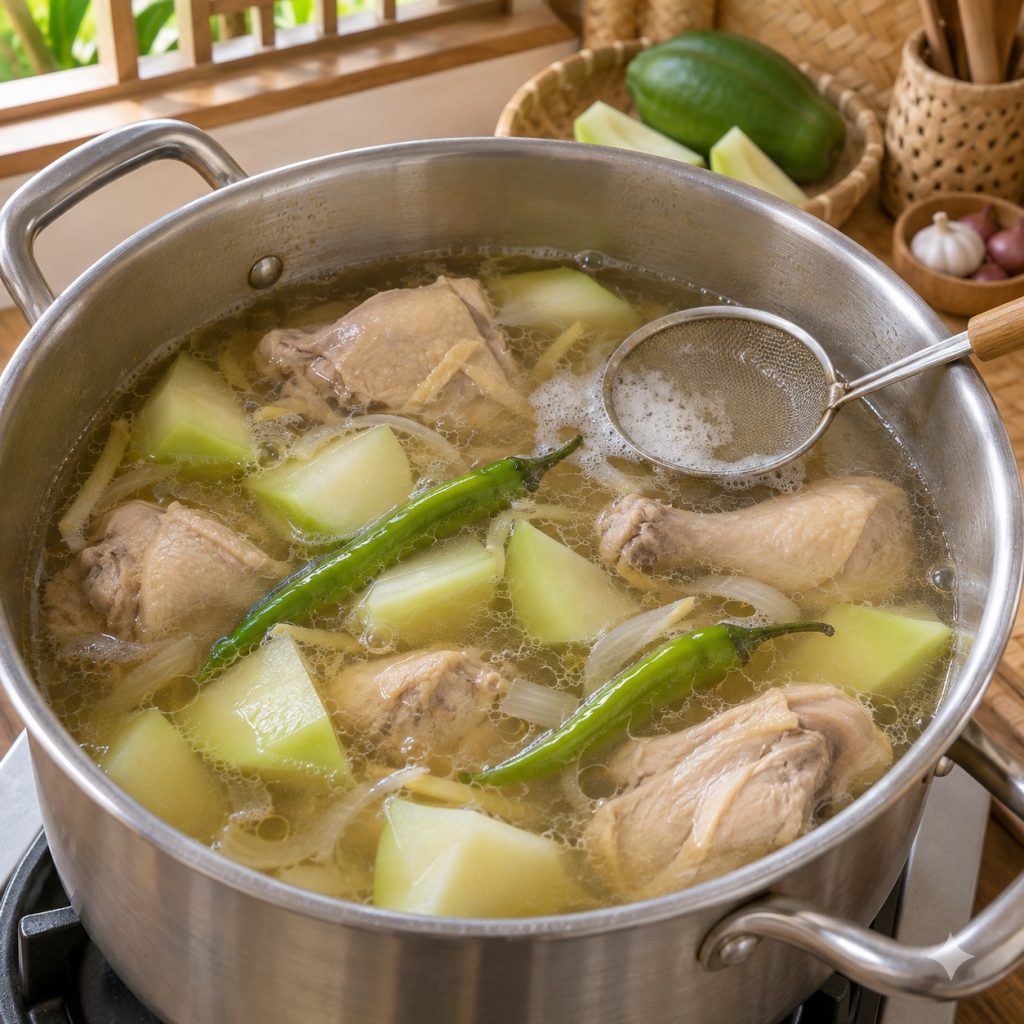
    3. Keep broth clear while cooking papaya

    Add water or stock. As it nears a boil, skim foam and lower heat. Simmer partly covered 20 minutes. Add papaya and chiles; simmer 15–20 minutes more.

    Keep broth clear while cooking papaya
    Add water or stock. As it nears a boil, skim foam and lower heat. Simmer partly covered 20 minutes. Add papaya and chiles; simmer 15–20 minutes more.

    4. Add greens and verify doneness

    When chicken reaches 165°F/74°C near the bone and papaya pierces easily, add leaves. Cook 2 minutes, then adjust with pepper and lime. Serve with rice; chill within 2 hours.

    Add greens and verify doneness
    When chicken reaches 165°F/74°C near the bone and papaya pierces easily, add leaves. Cook 2 minutes, then adjust with pepper and lime. Serve with rice; chill within 2 hours.

    Texture and doneness cues

    Broth is pale gold and clean-tasting without heavy foam or oil slick.

    Chicken reaches 165°F/74°C; papaya turns translucent but holds its edges.

    Mistakes, substitutions, and conversions

    A rolling boil clouds broth and dries chicken; keep only gentle bubbles.

    Replace green papaya with chayote and chile leaves with spinach or chard.

    1.5 liters is about 6⅓ cups. Use 1 cup/250 ml less liquid for a stronger broth.

    Serving, storage, and allergens

    Refrigerate 3–4 days. Bring soup to a boil and reheat chicken and liquid to 165°F/74°C. Freeze without greens up to 2 months.

    Allergen: fish. Packaged stock may contain celery or gluten.

    Frequently asked questions

    Why is tinola cloudy?

    It boiled hard or was not skimmed; skim as it heats and lower the flame.

    What replaces green papaya?

    Chayote is closest; firm zucchini also works.

    Can I omit fish sauce?

    Yes; soy sauce changes the flavor. Adjust salt at the end.

    Can it be made ahead?

    Yes. Add the leafy greens on serving day for better texture.

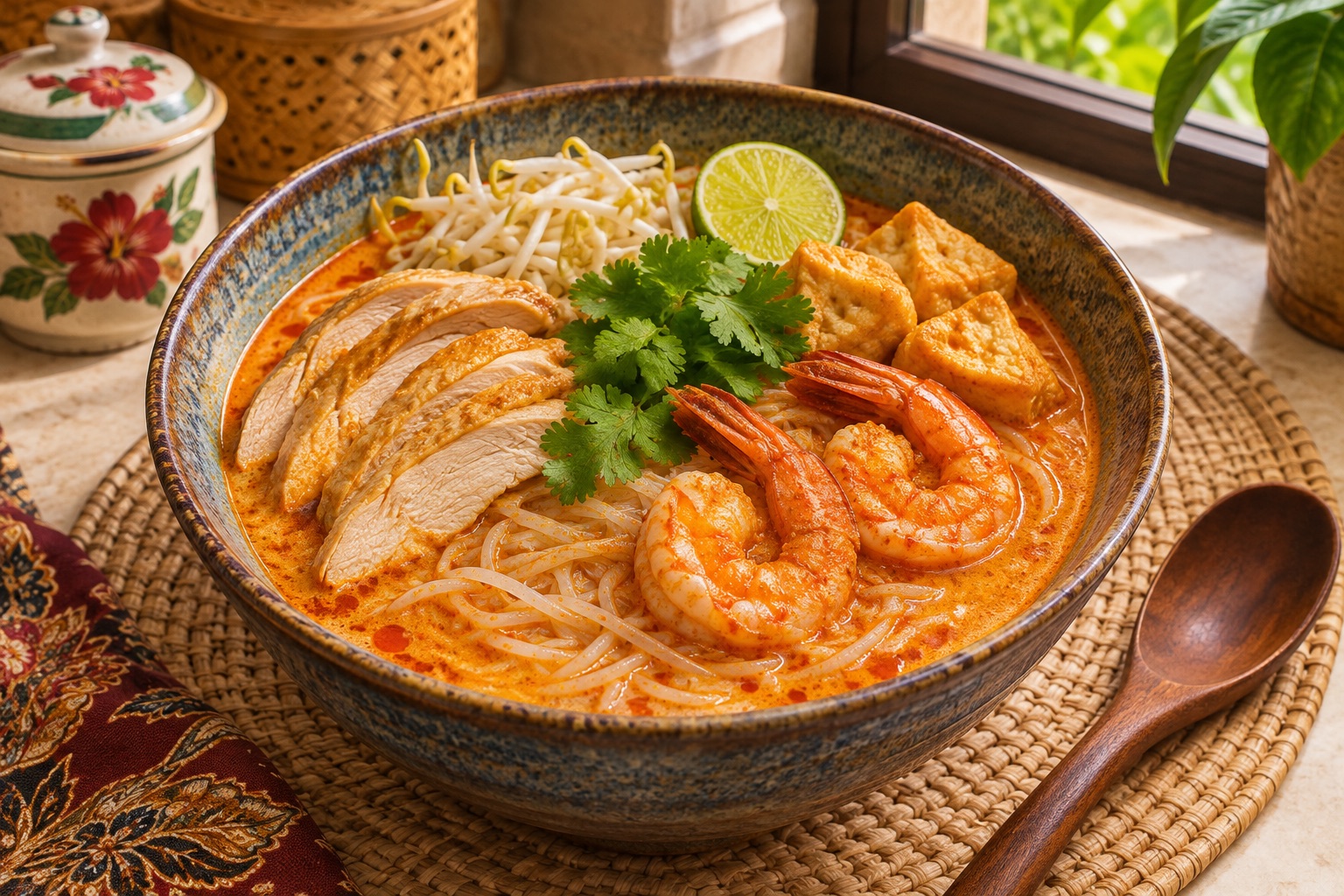
  • Malaysian Curry Laksa: Balanced Coconut Broth

    Malaysian Curry Laksa: Balanced Coconut Broth

    Laksa is a family of Malaysian noodle soups with strong regional variation. Tourism Malaysia describes curry mee/curry laksa as widely enjoyed, while Sarawak laksa has its own shrimp-paste, tamarind, and coconut profile. This is an accessible home curry-laksa adaptation, not a claim of one definitive version.

    Success comes from frying the paste until fragrant oil appears, keeping coconut milk below a hard boil, and cooking noodles separately.
    Why this method works

    • Frying spices and aromatics first removes raw flavors.
    • Adding stock before coconut milk protects the emulsion.
    • Cooking noodles separately keeps the broth from turning starchy.
    • Chicken cooks first and prawns last so both stay properly cooked.

    Before you start

    Prepare a 5-quart pot, blender, small pan, tongs, and digital thermometer.

    Blend shallots, garlic, ginger, lemongrass, and chile to a smooth paste.

    Prepare rice noodles separately according to their package and cut garnishes ahead.

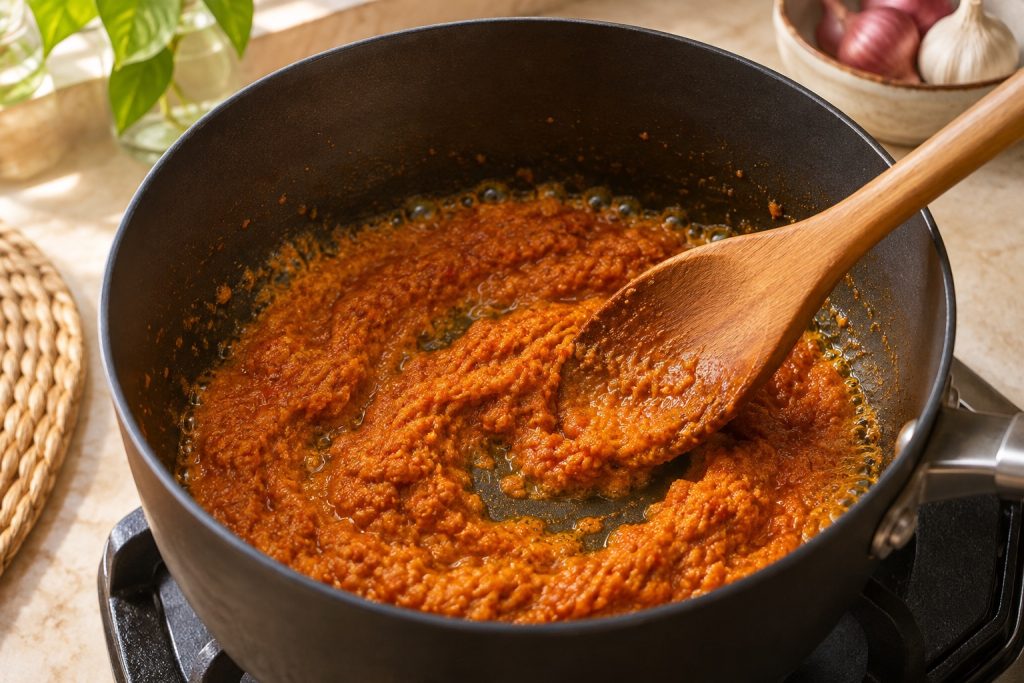
    Fry the paste until aromatic oil appears
    Heat oil over medium. Add blended aromatics, curry powder, turmeric, and sambal. Stir 8–10 minutes until the paste darkens and orange oil appears at the edges.

    Step-by-step method

    1. Fry the paste until aromatic oil appears

    Heat oil over medium. Add blended aromatics, curry powder, turmeric, and sambal. Stir 8–10 minutes until the paste darkens and orange oil appears at the edges.

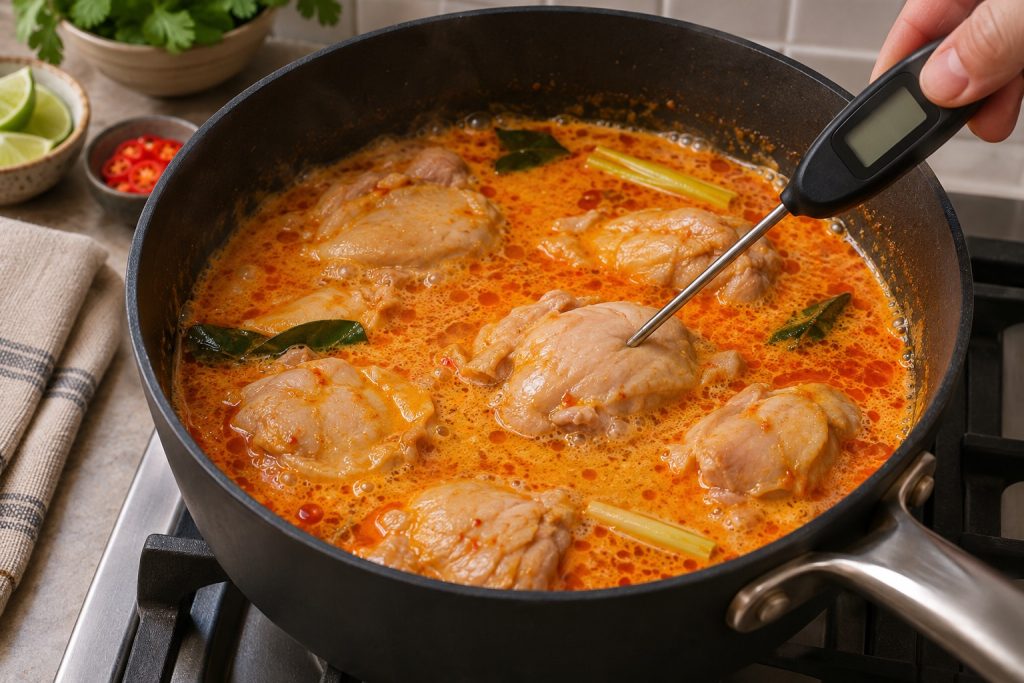
    2. Build the broth and cook the chicken

    Add stock gradually, scraping the pot. Add chicken and simmer gently 12–15 minutes, until the thickest piece reaches 165°F/74°C.

    Build the broth and cook the chicken
    Add stock gradually, scraping the pot. Add chicken and simmer gently 12–15 minutes, until the thickest piece reaches 165°F/74°C.

    3. Add coconut and prawns gently

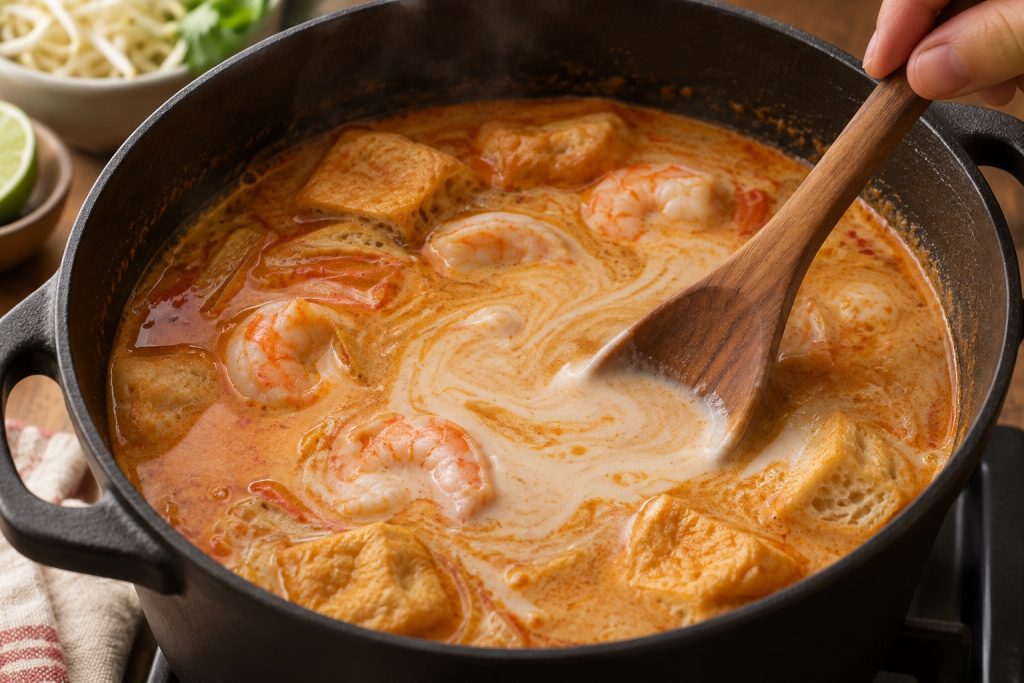
    Lower the heat. Add coconut milk, fish sauce, sugar, and tofu puffs; heat 5 minutes without a hard boil. Add prawns and cook 3–4 minutes until opaque and 145°F/63°C. Balance with lime.

    Add coconut and prawns gently
    Lower the heat. Add coconut milk, fish sauce, sugar, and tofu puffs; heat 5 minutes without a hard boil. Add prawns and cook 3–4 minutes until opaque and 145°F/63°C. Balance with lime.

    4. Assemble noodles in bowls and serve

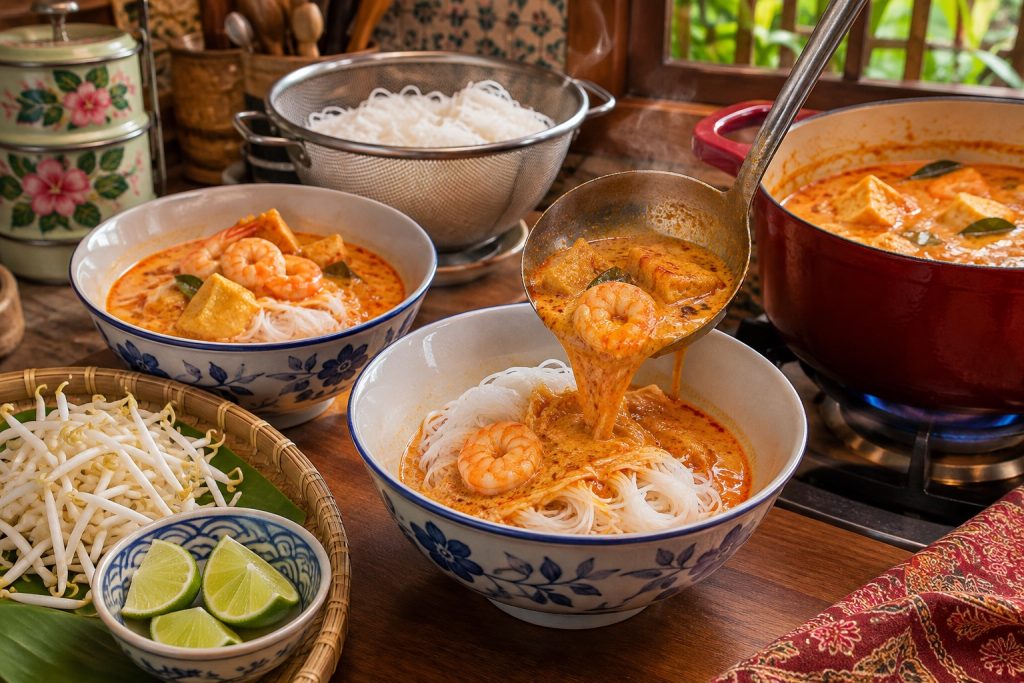
    Cook and drain noodles separately; divide among six bowls. Ladle over hot laksa and finish with sprouts, lime, and cilantro. Chill leftovers in shallow containers within 2 hours.

    Assemble noodles in bowls and serve
    Cook and drain noodles separately; divide among six bowls. Ladle over hot laksa and finish with sprouts, lime, and cilantro. Chill leftovers in shallow containers within 2 hours.

    Texture and doneness cues

    The broth is orange, glossy, and lightly coats a spoon; tiny oil droplets are evenly dispersed.

    Chicken reaches 165°F/74°C, prawns 145°F/63°C, noodles stay springy, and sprouts crisp.

    Mistakes, substitutions, and conversions

    Mistake: a hard boil splits coconut milk; keep it below a rolling boil.

    Substitute firm tofu for tofu puffs, or omit prawns and increase chicken.

    400 ml is about 1⅔ cups. Do not leave noodles soaking in broth before serving.

    Serving, storage, and allergens

    Refrigerate 2–3 days below 40°F/4°C, with noodles separate. Bring the soup to a boil and reheat to 165°F/74°C; reheat the prawn portion once. Freezing can make coconut broth grainy.

    Allergens: crustaceans, fish, soy; some curry blends may contain mustard.

    Frequently asked questions

    Why did the laksa split?

    The heat was too high after adding coconut milk. Use low heat and stir often.

    Can noodles cook in the broth?

    They can, but starch thickens the broth and noodles swell while waiting; separate cooking is more reliable.

    Can I make the paste ahead?

    Yes. Keep raw paste 24 hours or cooked paste 3 days refrigerated.

    When do prawns go in?

    During the final 3–4 minutes, just before serving; longer cooking makes them rubbery.

  • Wonton Noodle Soup: Sealed Dumplings and Clear Broth

    Wonton Noodle Soup: Sealed Dumplings and Clear Broth

    The Hong Kong Tourism Board presents wonton noodles as a signature local bowl with plump shrimp wontons, springy egg noodles, and hot broth. This is a Cantonese-inspired home adaptation using accessible ingredients.

    Stirring the filling in one direction builds a tacky bind. Cooking wontons and noodles away from the broth prevents starch from clouding it; assemble each bowl only at serving time.

    Why this method works

    • Mashing some shrimp while leaving the rest chunky provides both binding and distinct shrimp texture.
    • Keeping the filling cold prevents fat from melting and loosening the parcel.
    • A gentle simmer in ample water reduces collisions and torn wrappers.
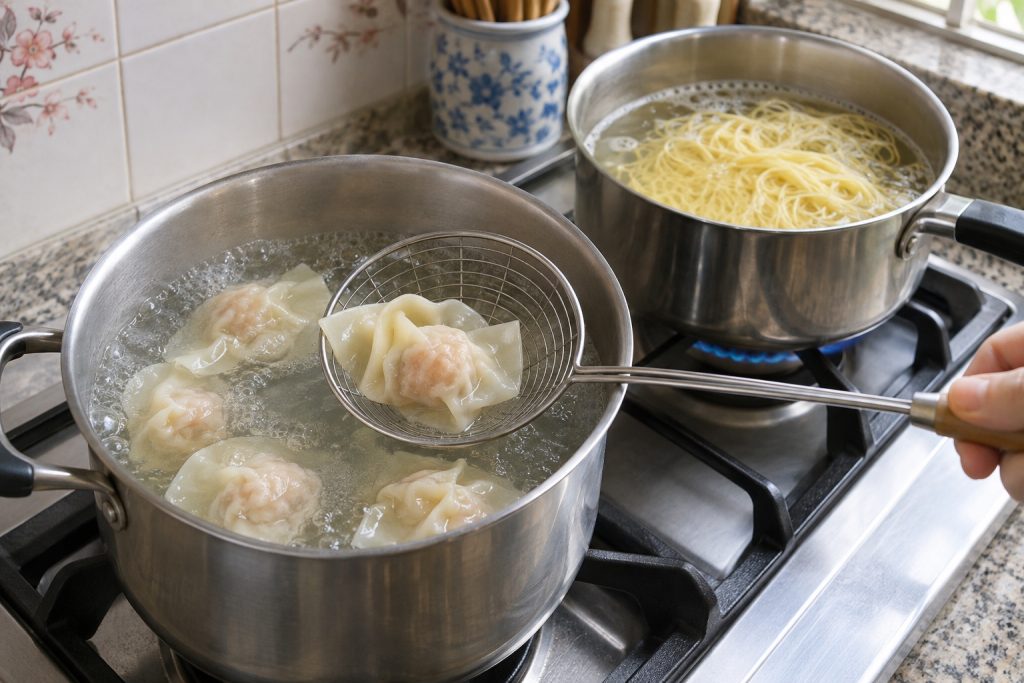
    • Boiling noodles and wontons separately preserves a clear, clean-tasting broth.

    Before you start

    Prepare two pots, a spider strainer, board, small bowl of water, and thermometer.

    Thaw shrimp under refrigeration and pat dry. Wash surfaces immediately after raw pork and shrimp contact.

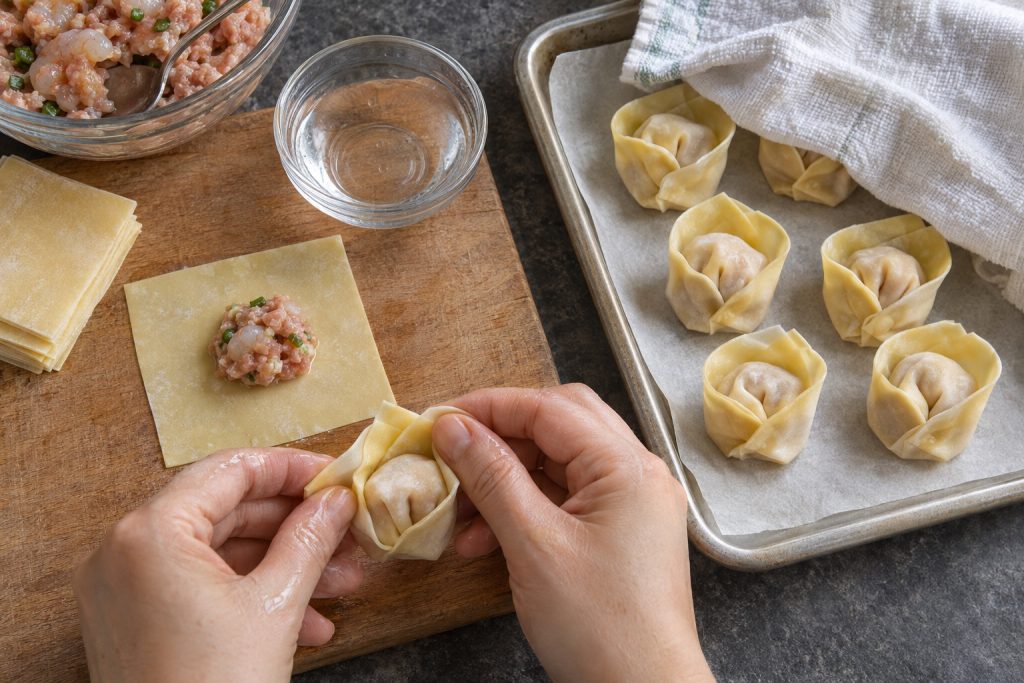
    Keep commercial wonton wrappers under a barely damp towel; exposed edges dry and will not seal.

    Mix the cold filling until tacky
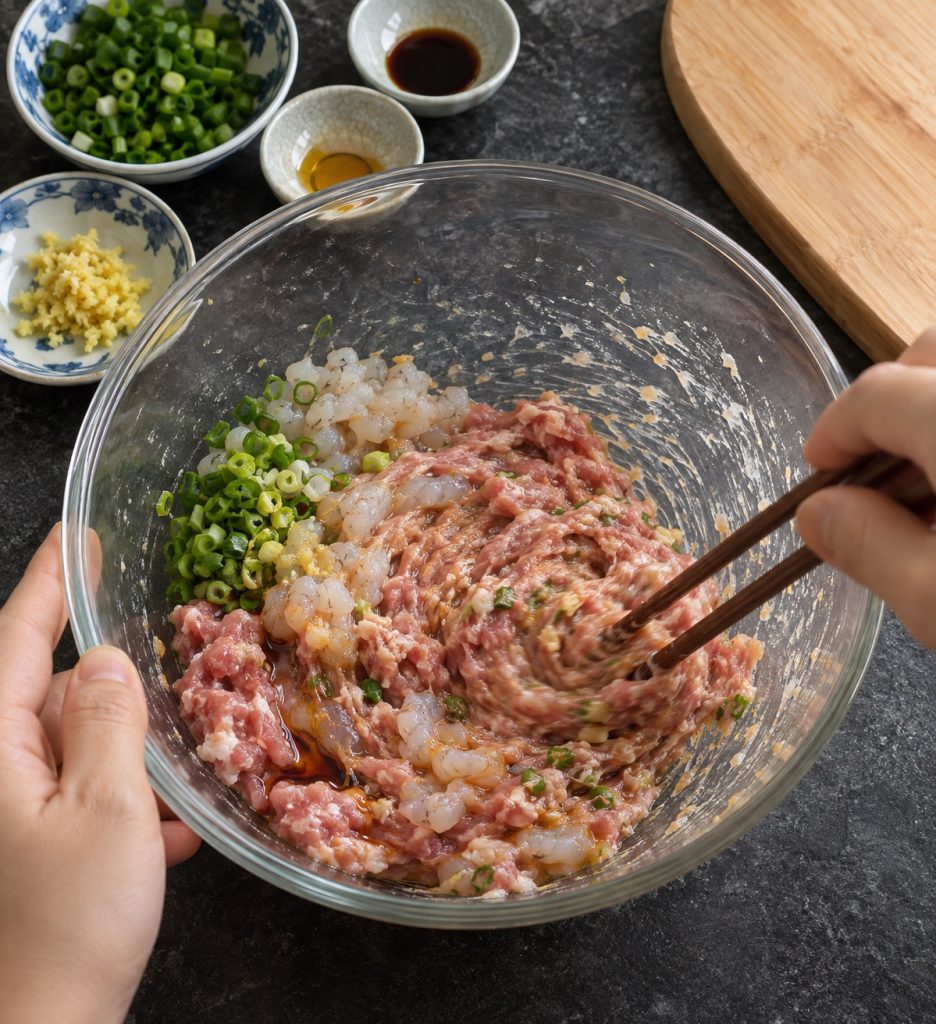
    Mash one third of the shrimp to a paste and chop the rest into ¼-inch pieces. Stir pork, shrimp, ginger, half the scallion, 1 tbsp soy, 1 tsp sesame oil, cornstarch, salt, and pepper in one direction for 2 minutes until the mixture clings to the bowl. Chill 15 minutes.

    Step-by-step method

    1. Mix the cold filling until tacky

    Mash one third of the shrimp to a paste and chop the rest into ¼-inch pieces. Stir pork, shrimp, ginger, half the scallion, 1 tbsp soy, 1 tsp sesame oil, cornstarch, salt, and pepper in one direction for 2 minutes until the mixture clings to the bowl. Chill 15 minutes.

    2. Fill lightly and seal the wontons

    Place slightly less than 2 teaspoons filling on each wrapper. Moisten edges lightly, fold into a triangle while pressing out air, then join the two corners. Space on a tray and cover with a barely damp towel.

    Fill lightly and seal the wontons
    Place slightly less than 2 teaspoons filling on each wrapper. Moisten edges lightly, fold into a triangle while pressing out air, then join the two corners. Space on a tray and cover with a barely damp towel.

    3. Cook broth, wontons, and noodles separately

    Simmer stock with remaining soy, sesame oil, and sugar for 10 minutes. In a separate large pot, cook wontons in two batches for 4–6 minutes, until floating and the filling reaches 160°F. Lift out. Cook noodles according to package in the same water, adding choy sum for the final 60 seconds.

    Cook broth, wontons, and noodles separately
    Simmer stock with remaining soy, sesame oil, and sugar for 10 minutes. In a separate large pot, cook wontons in two batches for 4–6 minutes, until floating and the filling reaches 160°F. Lift out. Cook noodles according to package in the same water, adding choy sum for the final 60 seconds.

    4. Finish each bowl with clear broth

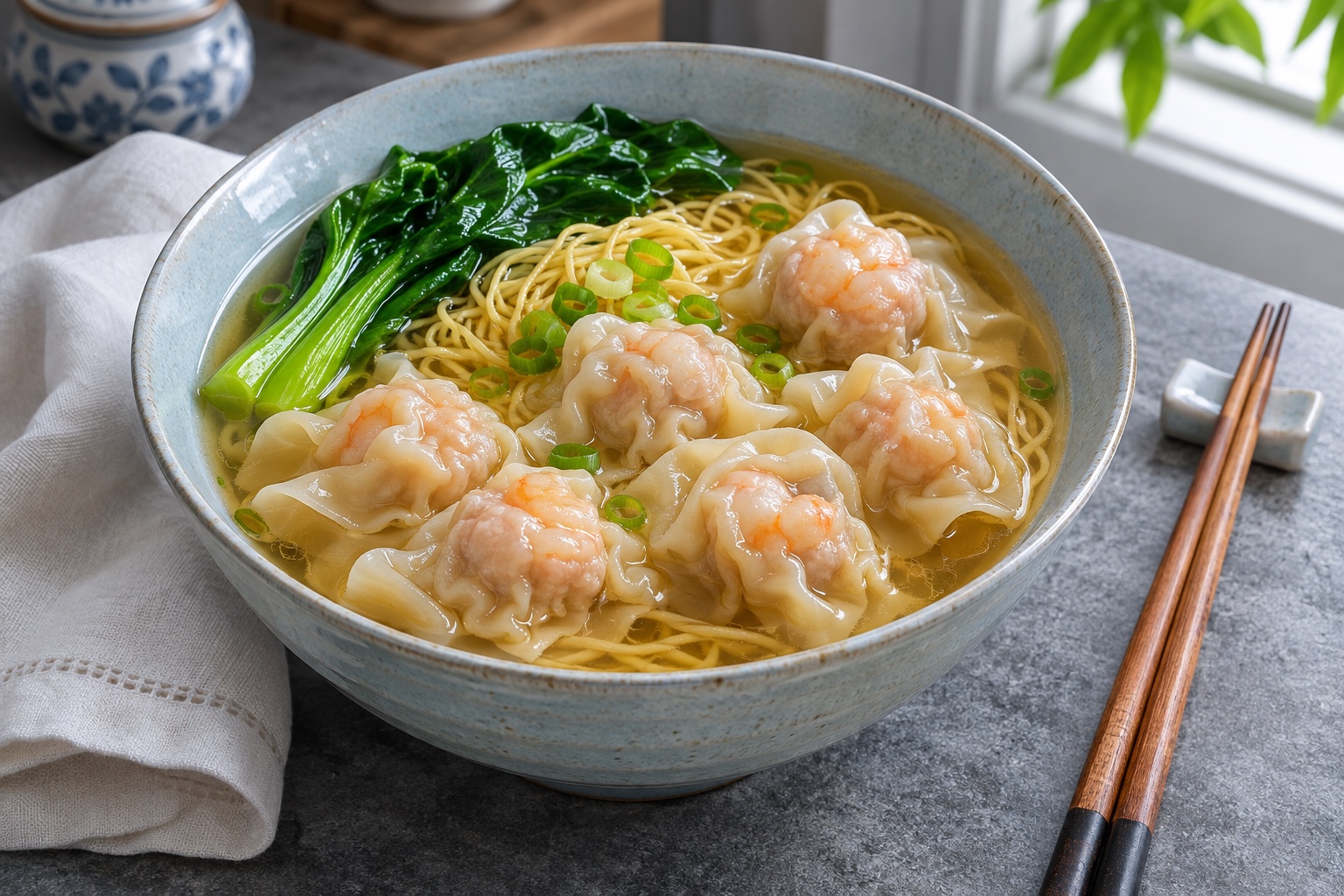
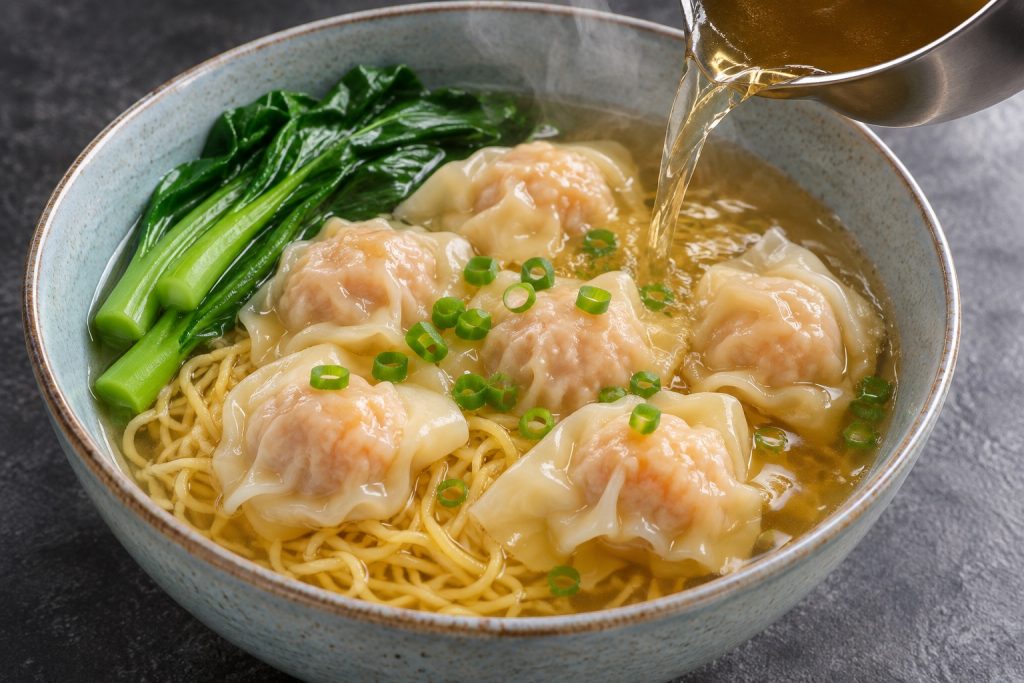
    Drain noodles thoroughly into four warmed bowls. Add greens and seven wontons each. Ladle over boiling broth and finish with remaining scallion. Serve immediately; noodles soften if they wait in broth.

    Finish each bowl with clear broth
    Drain noodles thoroughly into four warmed bowls. Add greens and seven wontons each. Ladle over boiling broth and finish with remaining scallion. Serve immediately; noodles soften if they wait in broth.

    Texture and doneness cues

    Wrappers are translucent and intact; the filling is juicy but reaches 160°F. Broth is amber and clear, while noodles stay springy rather than soggy.

    Mistakes, substitutions, and conversions

    Wontons open when edges are dry, overfilled, or air is trapped. Ground chicken may replace pork but must reach 165°F. Thin wheat noodles replace egg noodles. Omitting shrimp creates a different dumpling rather than the same Hong Kong-style shrimp wonton. 250 g noodles is about 9 oz.

    Serving, storage, and allergens

    Assemble only what will be eaten. Cool broth, wontons, and noodles separately within 2 hours; keep wontons 3 days, broth 4 days, and noodles 2 days. Reheat broth and wontons once to 165°F. Freeze uncooked wontons on a tray for up to 1 month. Contains shellfish, pork, wheat/gluten, soy, sesame, and egg.

    Frequently asked questions

    Why did my wontons open?

    Use only a light film of water, press out air, and keep filling below 2 teaspoons.

    Why is the broth cloudy?

    Starch enters the broth when noodles or wontons boil in it; use a separate pot.

    Can wontons be made ahead?

    Yes. Freeze raw on a tray, bag them, and cook from frozen 1–2 minutes longer.

  • French Onion Soup: Deep Caramelized Onions and Gruyère

    French Onion Soup: Deep Caramelized Onions and Gruyère

    Explore France traces the modern version of onion soup to 18th-century Paris and describes the classic combination of slowly browned onions, beef stock, bread, and Gruyère.

    This home method relies on 45–55 minutes of patient browning, not added sugar. The flavorful fond is loosened with wine or stock, while the bread is broiled only at serving time.

    Why this method works

    • A wide heavy pot evaporates onion moisture efficiently and promotes even browning.
    • Moderate-low heat plus an occasional spoonful of water prevents scorching without washing away the fond.
    • Broiling bread and cheese only before serving keeps the crouton from dissolving into the soup.

    Before you start

    Prepare a 5–6 quart heavy pot, wooden spoon, ladle, six broiler-safe bowls, and broiler. Confirm the bowls are rated for direct broiler heat.

    Slice onions evenly, about ⅛ inch/3 mm. Paper-thin pieces burn early while thick pieces soften too slowly.

    If omitting wine, use the same amount of stock. Check stock salinity and season only after the soup reduces.

    Brown the onions slowly and deeply
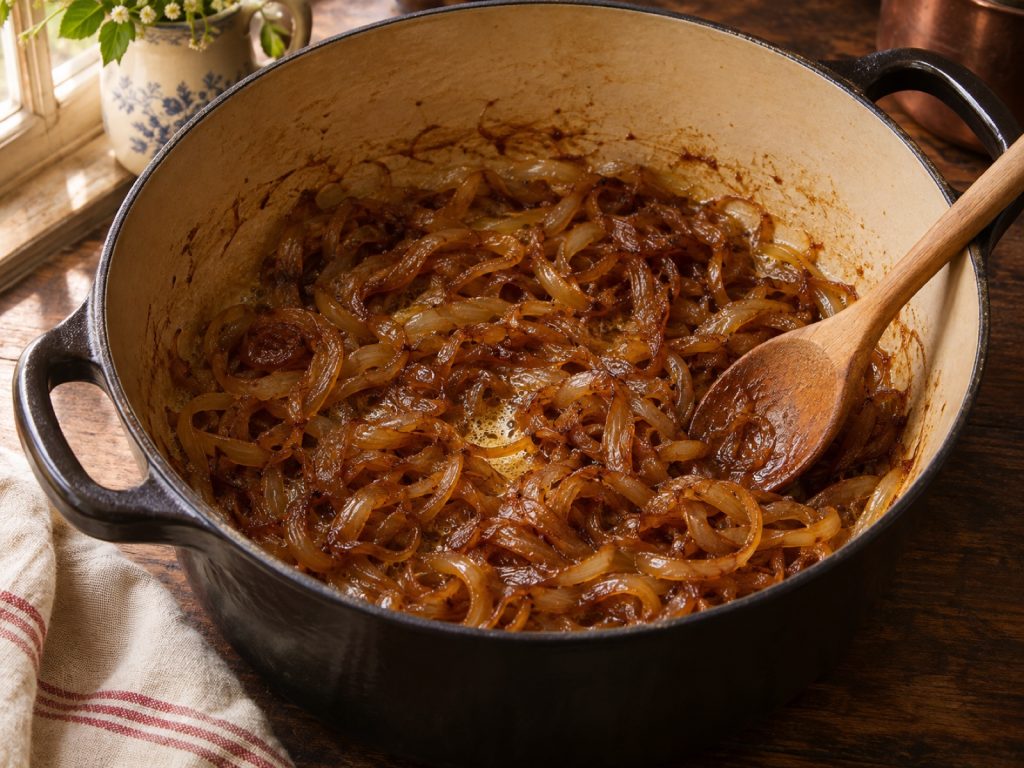
    Melt butter and oil in a wide pot over medium heat. Add onions and ½ teaspoon salt; soften 10 minutes. Reduce to medium-low and cook 35–45 minutes more, stirring every 5 minutes, until deep mahogany. If the bottom darkens quickly, add 1 tablespoon water and scrape.

    Step-by-step method

    1. Brown the onions slowly and deeply

    Melt butter and oil in a wide pot over medium heat. Add onions and ½ teaspoon salt; soften 10 minutes. Reduce to medium-low and cook 35–45 minutes more, stirring every 5 minutes, until deep mahogany. If the bottom darkens quickly, add 1 tablespoon water and scrape.

    2. Add garlic and deglaze the pot

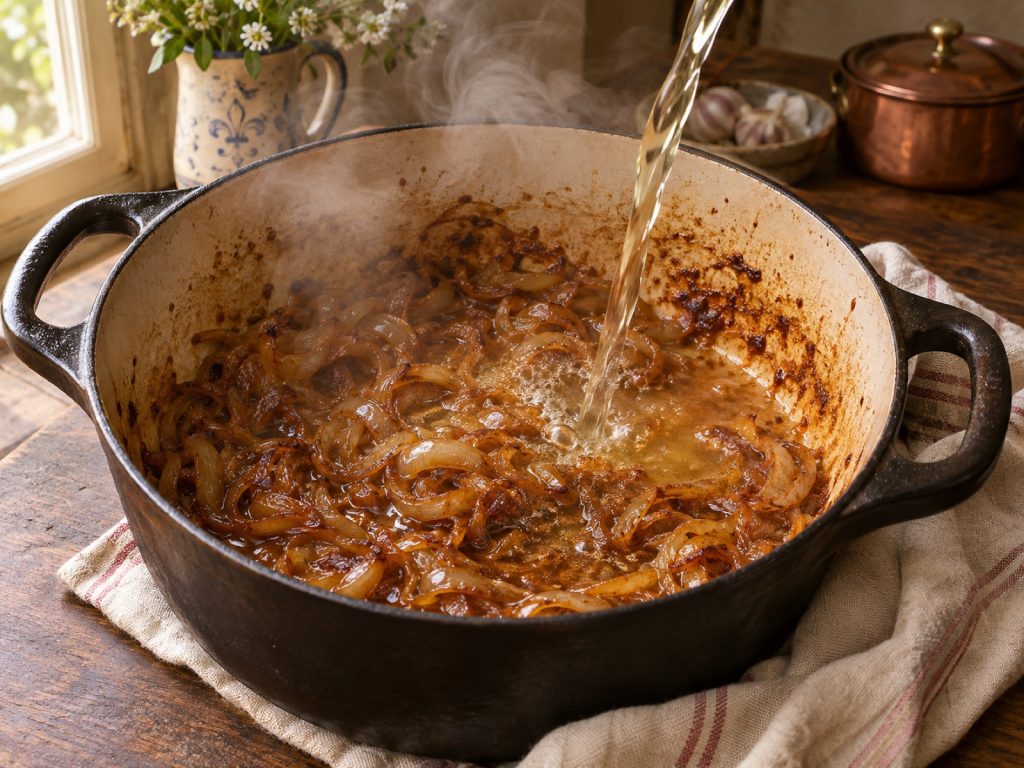
    Add garlic for 30 seconds. Pour in wine or ⅓ cup/100 ml stock, scrape up the browned fond, and boil 3–4 minutes until reduced by half.

    Add garlic and deglaze the pot
    Add garlic for 30 seconds. Pour in wine or ⅓ cup/100 ml stock, scrape up the browned fond, and boil 3–4 minutes until reduced by half.

    3. Simmer with stock and balance the seasoning

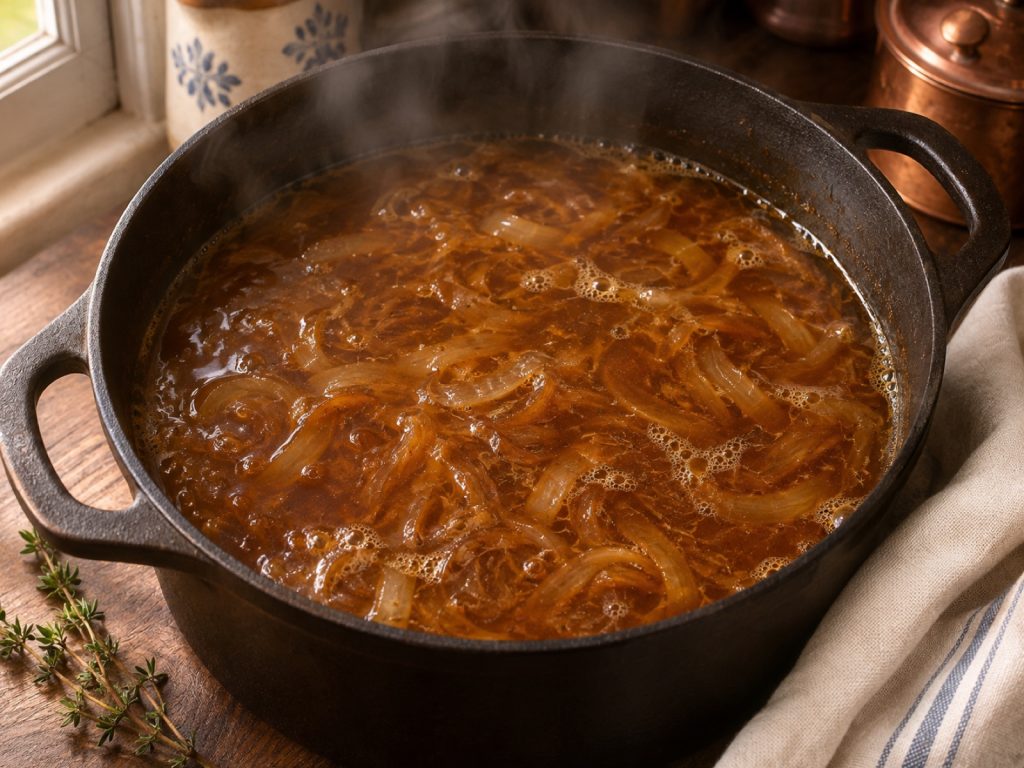
    Add remaining stock, thyme, and bay. Gently simmer 20 minutes. Remove herbs; balance with pepper and remaining salt if needed. The broth should be clear yet full-bodied.

    Simmer with stock and balance the seasoning
    Add remaining stock, thyme, and bay. Gently simmer 20 minutes. Remove herbs; balance with pepper and remaining salt if needed. The broth should be clear yet full-bodied.

    4. Broil with baguette and Gruyère, then serve

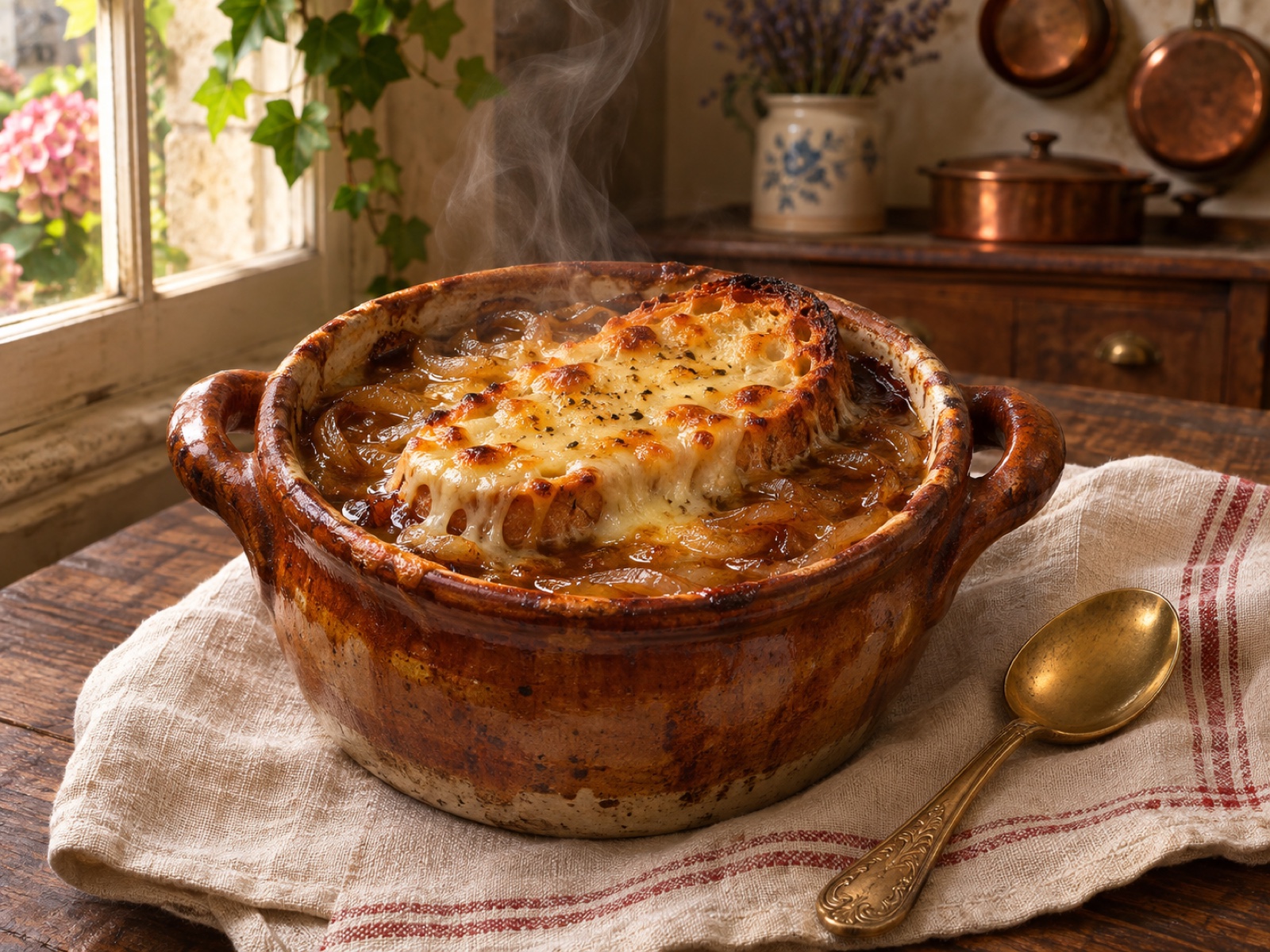
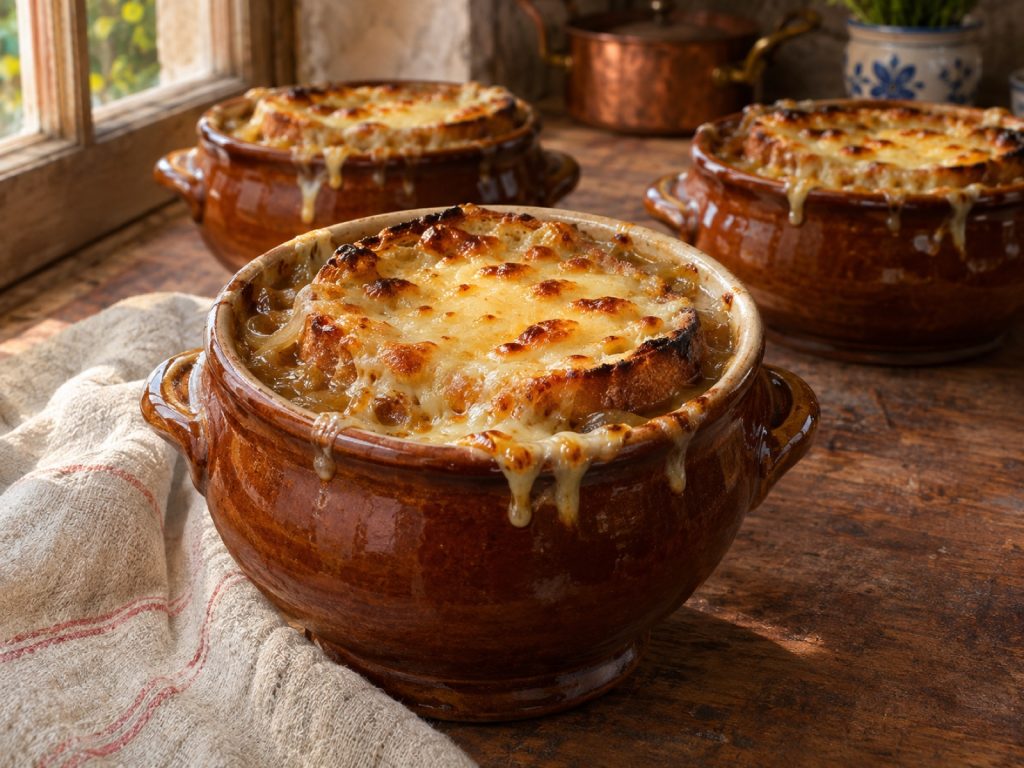
    Toast baguette on both sides until dry and golden. Divide hot soup among broiler-safe bowls, top with bread and Gruyère, and broil 5–6 inches from heat for 2–4 minutes until bubbling and spotty golden. Serve the very hot bowls on trivets.

    Broil with baguette and Gruyère, then serve
    Toast baguette on both sides until dry and golden. Divide hot soup among broiler-safe bowls, top with bread and Gruyère, and broil 5–6 inches from heat for 2–4 minutes until bubbling and spotty golden. Serve the very hot bowls on trivets.

    Texture and doneness cues

    The onions are deep mahogany, never black or bitter. The broth leaves a light glossy coating on a spoon, and the cheese is bubbling with golden spots.

    Mistakes, substitutions, and conversions

    Pale onions usually need more evaporation time; do not compensate with high heat. Comté or another nutty melting cheese can replace Gruyère. Replace wine with ⅓ cup/100 ml stock. 1 kg onions is about 2.2 lb; 180 g cheese is about 6⅓ oz.

    Serving, storage, and allergens

    Store soup separately from bread and cheese. Refrigerate in a shallow container within 2 hours for 3–4 days; reheat soup to 165°F and broil with fresh bread. Freeze the plain soup up to 3 months. Contains dairy and gluten; choose stock instead of wine when alcohol must be avoided.

    Frequently asked questions

    Should I add sugar to caramelize onions faster?

    No. Sugar increases sweetness but cannot replace the depth created by slow browning.

    Why did the soup taste bitter?

    Blackened onions or fond cause bitterness; lower the heat and loosen the bottom with a little water.

    Can I make it without broiling the bowls?

    Yes. Broil the cheese toasts on a tray and place them over the hot soup.

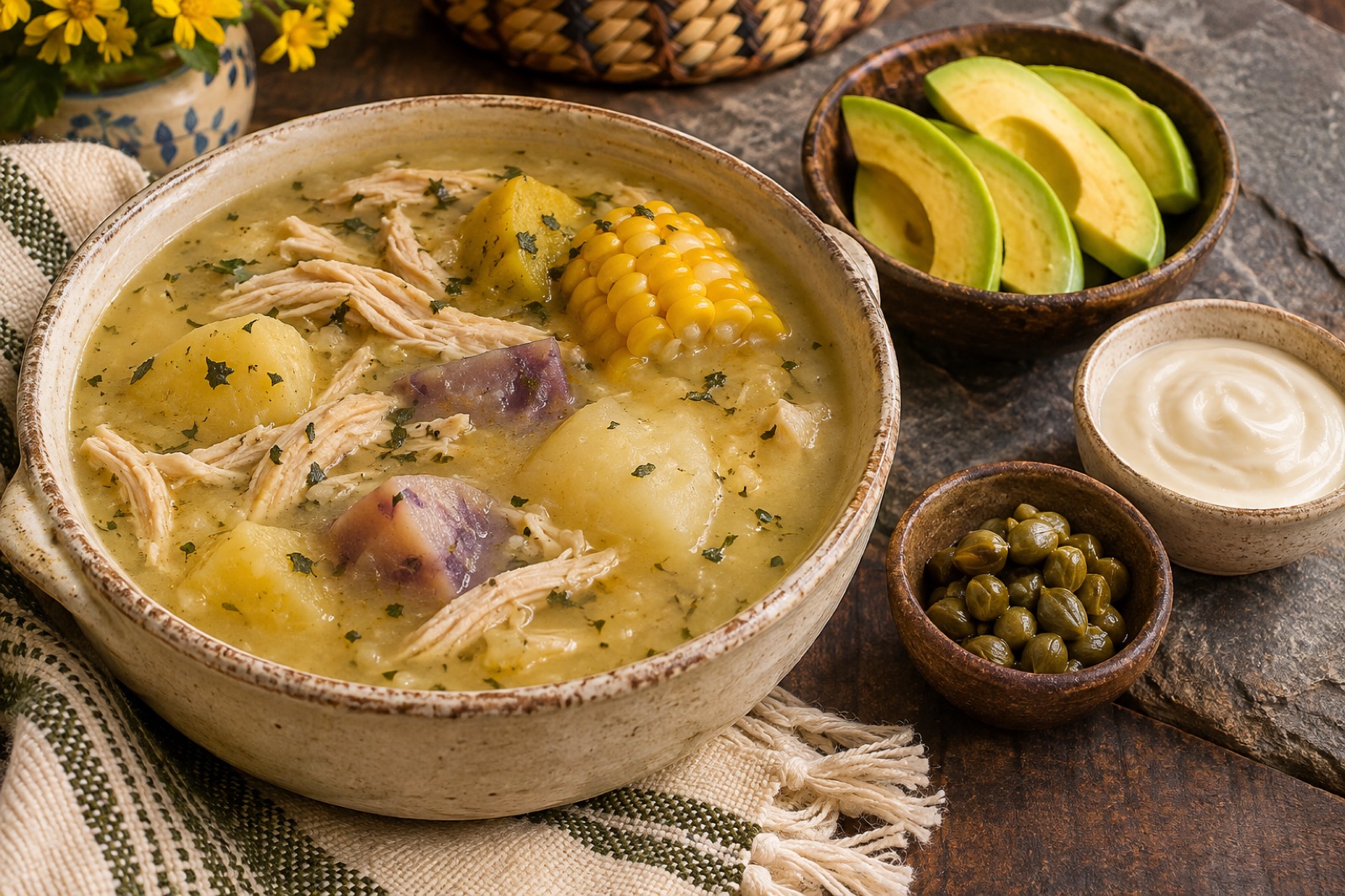
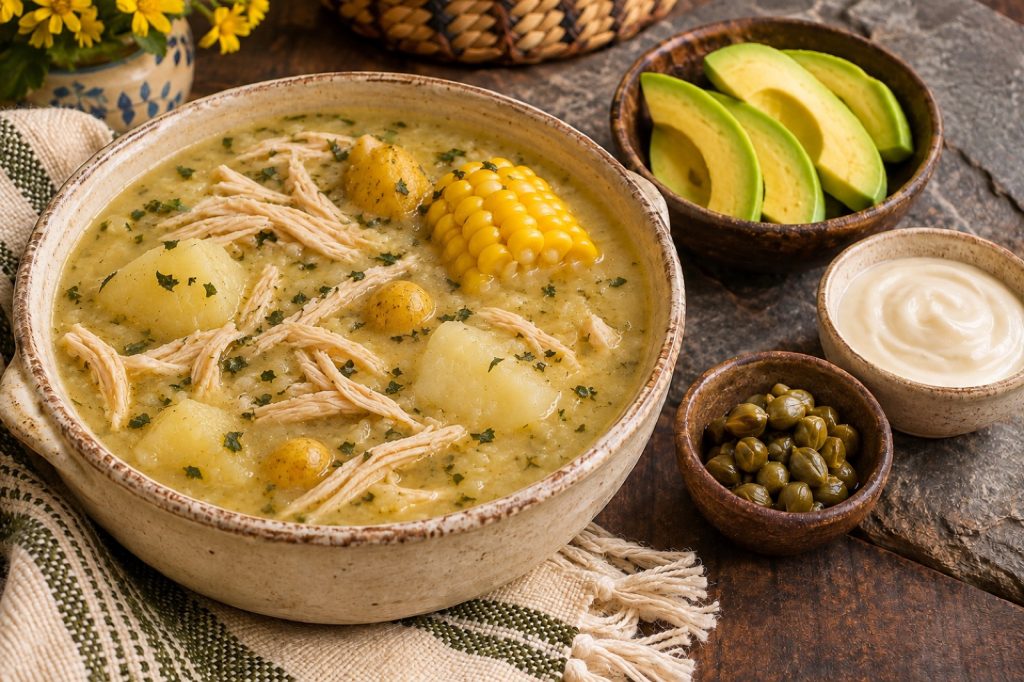
  • Ajiaco Colombiano: Bogotá Chicken and Three-Potato Soup

    Ajiaco Colombiano: Bogotá Chicken and Three-Potato Soup

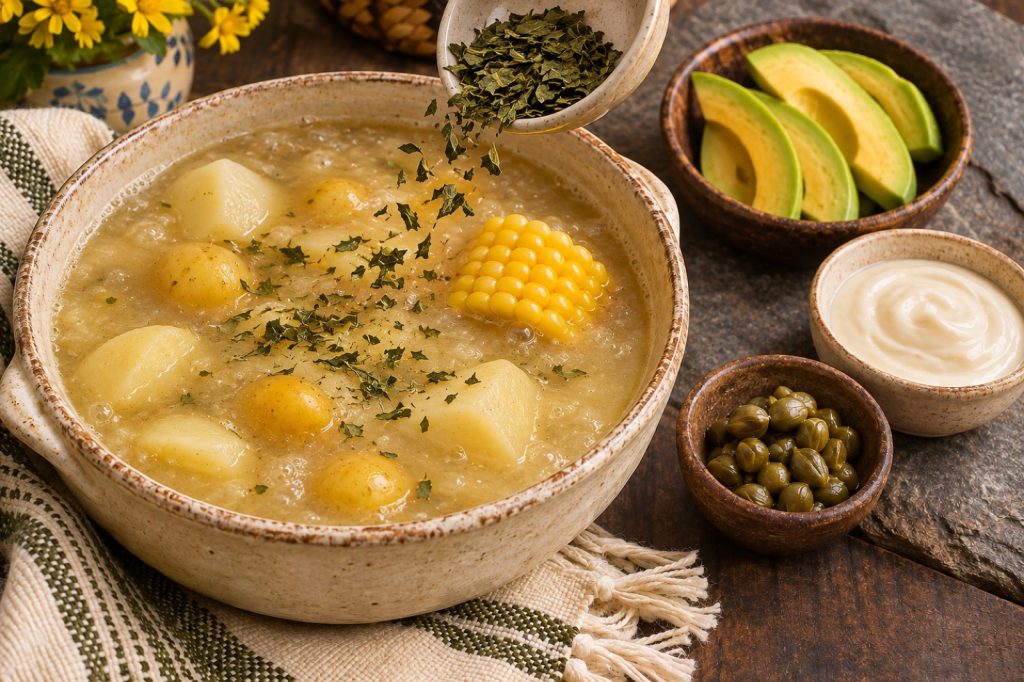
    Ajiaco santafereño is associated with Bogotá and the Cundiboyacense plateau, combining chicken, corn, several potatoes, and guascas. Because papa criolla, pastusa, and sabanera are not available everywhere, this home adaptation chooses substitutes by starch behavior rather than name alone.

    Floury potato goes in first and partly dissolves to thicken the broth. Waxy and small yellow potatoes follow so pieces remain. Chicken comes out at 165°F for shredding; cream, capers, and avocado are served separately.
    Why this method works

    • Staging potatoes by starch level creates body and intact pieces without flour or cream.
    • Removing chicken at a safe 165°F avoids drying during the long simmer; shredded meat returns only to heat through.
    • Guascas provides the defining herbal note. The soup still works without it, but it will not have the same ajiaco character.

    Before you start

    Prepare a 5-quart or larger pot, board, ladle, and instant-read thermometer. Cut avocado only at serving time.

    Sort potatoes into floury, waxy, and small yellow/papa criolla groups. The floury group is the thickener.

    Use 15 g dried or about 30 g fresh guascas. Oregano or bay leaf is not an equivalent substitute.

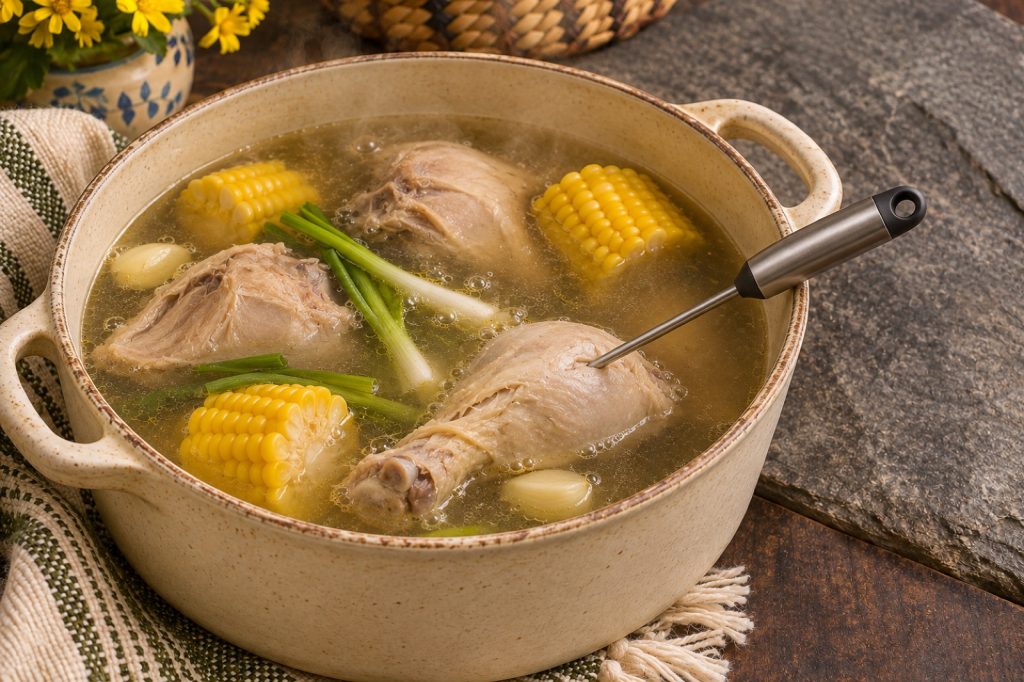
    Poach chicken with corn and aromatics
    Combine chicken, water, scallions, garlic, corn, 1 teaspoon salt, and pepper. Once simmering, skim and cook gently 25–35 minutes until the thickest chicken part reaches 165°F. Remove and rest 10 minutes, then shred and discard bones.

    Step-by-step method

    1. Poach chicken with corn and aromatics

    Combine chicken, water, scallions, garlic, corn, 1 teaspoon salt, and pepper. Once simmering, skim and cook gently 25–35 minutes until the thickest chicken part reaches 165°F. Remove and rest 10 minutes, then shred and discard bones.

    2. Thicken naturally with floury potato

    Add floury potatoes to the hot broth. Simmer partly covered 20–25 minutes, occasionally pressing some against the pot so they dissolve. The broth should visibly thicken without becoming a purée.

    Thicken naturally with floury potato
    Add floury potatoes to the hot broth. Simmer partly covered 20–25 minutes, occasionally pressing some against the pot so they dissolve. The broth should visibly thicken without becoming a purée.

    3. Stage remaining potatoes and guascas

    Add waxy potatoes, small yellow potatoes, and guascas. Simmer gently another 20–25 minutes until waxy pieces are tender but intact. Add hot water if too thick; mash a few floury pieces if thin.

    Stage remaining potatoes and guascas
    Add waxy potatoes, small yellow potatoes, and guascas. Simmer gently another 20–25 minutes until waxy pieces are tender but intact. Add hot water if too thick; mash a few floury pieces if thin.

    4. Return chicken and serve accompaniments separately

    Return shredded chicken for 5 minutes until fully hot. Adjust remaining salt and remove scallion stalks. Ladle with a corn section. Serve avocado, capers, and cream in separate bowls for adding at the table.

    Return chicken and serve accompaniments separately
    Return shredded chicken for 5 minutes until fully hot. Adjust remaining salt and remove scallion stalks. Ladle with a corn section. Serve avocado, capers, and cream in separate bowls for adding at the table.

    Texture and doneness cues

    The soup coats a ladle lightly before cream is added. Some floury potato has dissolved, while waxy and yellow pieces remain identifiable. Chicken stays moist, corn is tender, and the soup is steaming hot.

    Mistakes, substitutions, and measurements

    If thin, mash floury potato and simmer 5 minutes rather than using cream as a thickener. Add hot water if too thick. Baby yellow potatoes replace papa criolla but not its exact earthy flavor. If guascas is unavailable, omit it rather than treating oregano as equivalent. 2.2 liters is about 9¼ US cups.

    Serving, storage, and allergens

    Keep avocado, capers, and cream out of the pot. Cool leftovers in shallow containers within 2 hours, refrigerate 3–4 days, and reheat once to 165°F throughout. Soup without toppings freezes up to 2 months, though potatoes soften. Cream contains dairy; check capers and stock for salt. The base is gluten-free if the stock is certified.

    Frequently asked questions

    Which potatoes are used for ajiaco?

    Colombian versions commonly use papa criolla, pastusa, and sabanera. Elsewhere, combine one floury, one waxy, and one small yellow potato to mimic their functions.

    What replaces guascas?

    There is no exact herb substitute. Omit it if unavailable and expect a different aroma; oregano is not the same.

    Why is my ajiaco not thickening?

    The floury potato may have gone in late or stayed whole. Mash several pieces against the pot and simmer 5–10 minutes longer.

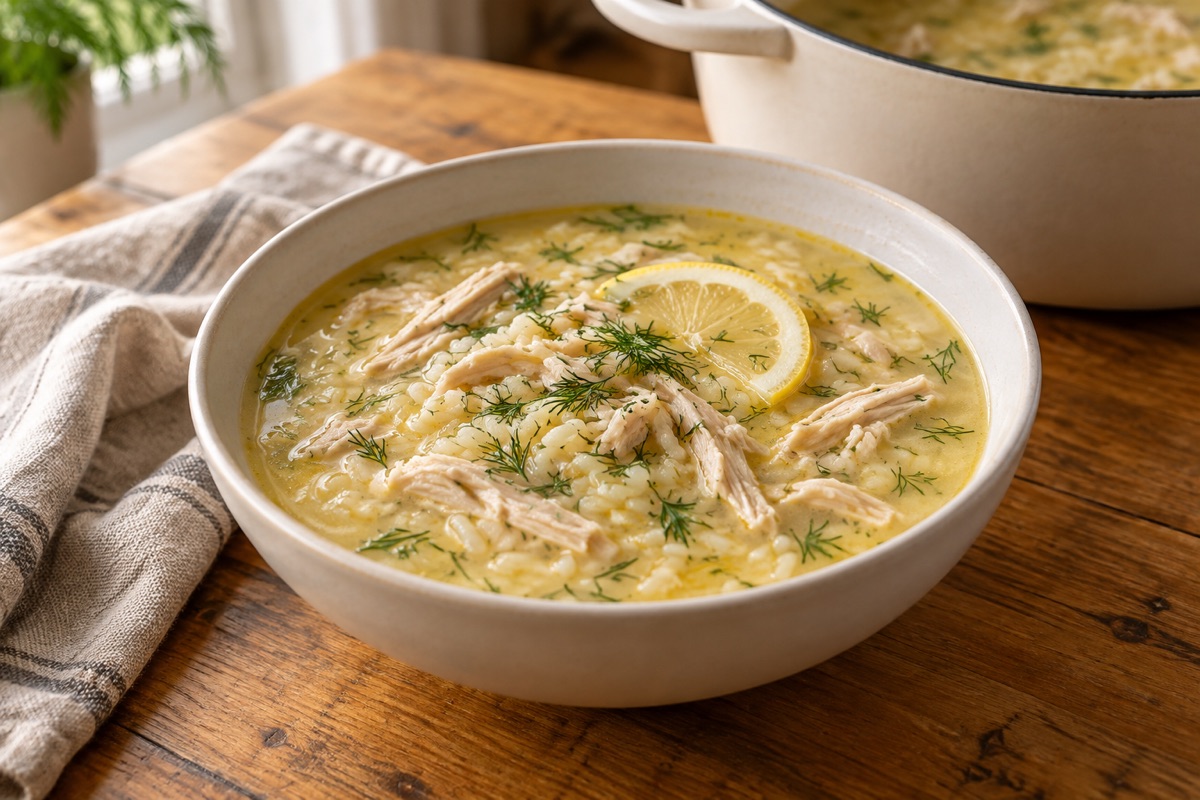
  • Greek Avgolemono Soup: Silky, Safe, and Curdle-Free

    Greek Avgolemono Soup: Silky, Safe, and Curdle-Free

    Avgolemono is the Greek egg-and-lemon mixture used to enrich soups and other dishes. This accessible chicken-and-rice version produces a bright, silky soup without cream.

    The key is to avoid pouring cold eggs into a boiling pot. Gradually temper the mixture with hot broth, remove the pot from the heat before combining, and never boil afterward. The chicken reaches 165°F/74°C and the finished egg-thickened soup reaches 160°F/71°C.

    Why this method works

    • Boneless chicken thighs stay juicy at a gentle simmer; checking for 165°F/74°C is more reliable than timing alone.
    • Rice cooks directly in the broth and releases enough starch to add body without cream.
    • Whisking two ladles of hot broth slowly into the eggs reduces the temperature shock; keeping the finished soup below a simmer prevents curds.

    Before you start: equipment, measures, and swaps

    Use a 4-quart pot, medium bowl, whisk, ladle, tongs, cutting board, and preferably an instant-read thermometer.

    The recipe uses 3/4 cup/150 g long-grain rice and 1/4 cup/60 ml lemon juice. Arborio works but releases more starch, producing a thicker soup.

    Chicken breast may replace thighs; remove it as soon as it reaches 165°F. For a meatless adaptation, use vegetable broth and omit chicken, clearly treating it as an avgolemono-inspired vegetable soup rather than the chicken version.

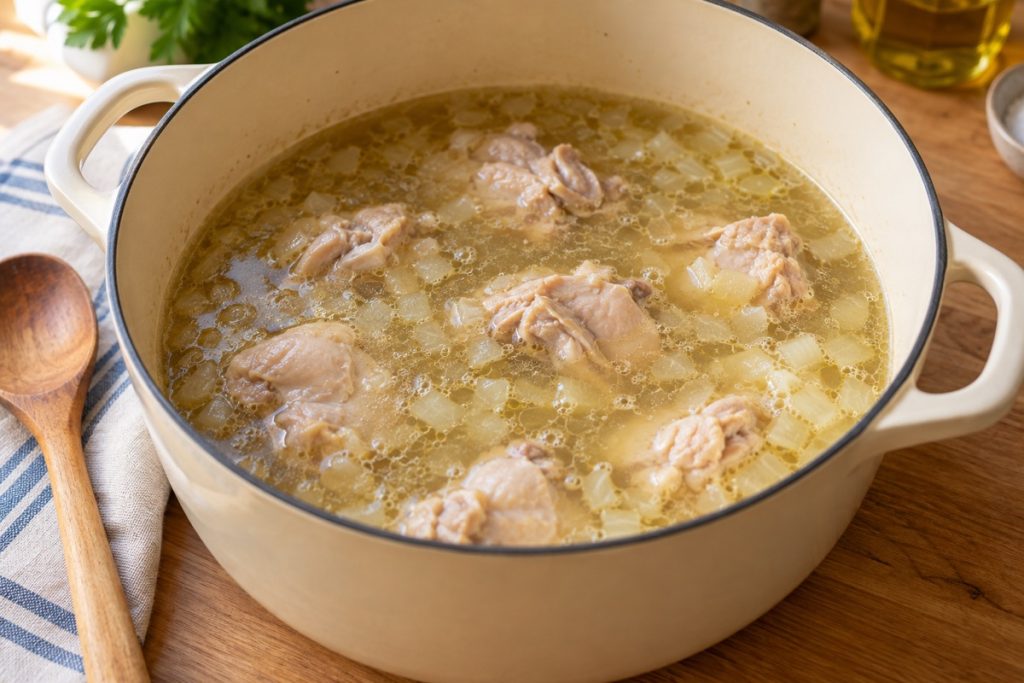
    Chicken pieces simmering in onion broth
    Simmer the chicken gently until it reaches 165°F/74°C.

    How to make chicken avgolemono soup

    1. 1. Soften the onion and poach the chicken

    Heat olive oil in a 4-quart pot over medium. Cook diced onion for 4–5 minutes until translucent without browning. Add stock and chicken; bring just to a simmer, then reduce the heat. Cook 12–15 minutes, until the thickest piece reaches 165°F/74°C. Transfer chicken to a clean plate and shred with two forks.

    2. 2. Cook the rice until fully tender

    Return the broth to a gentle simmer. Add rinsed rice and cook with the lid slightly ajar for 12–15 minutes, stirring twice. A grain should crush easily with no hard center. Return the shredded chicken and warm for 2 minutes.

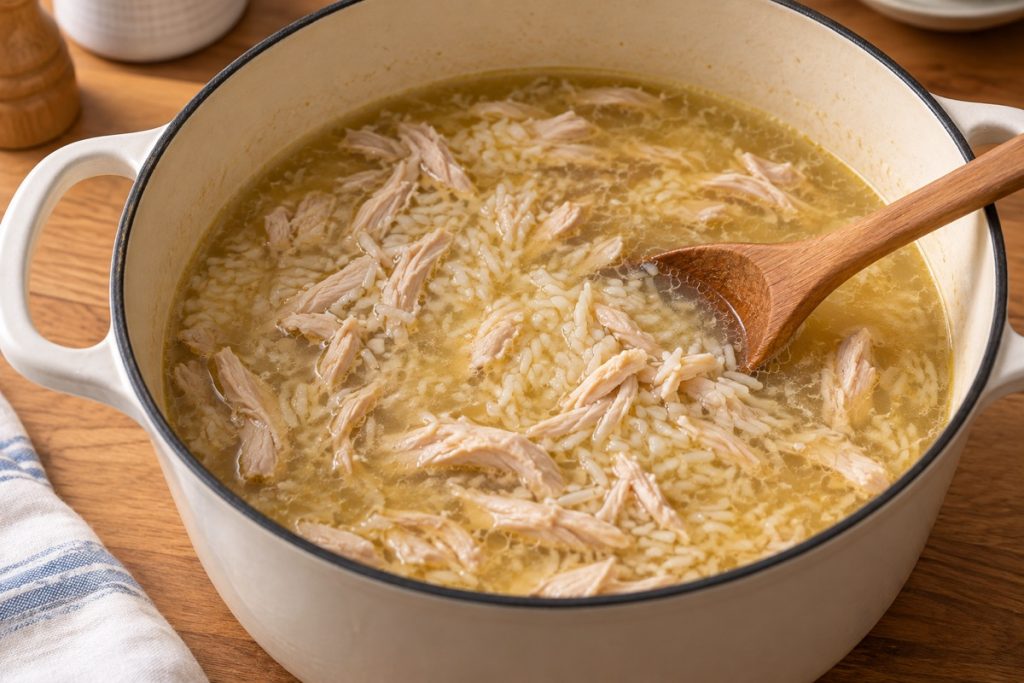
    Rice and shredded chicken cooking in broth
    The rice cooks until tender and lightly thickens the broth.

    3. 3. Temper the egg-lemon mixture

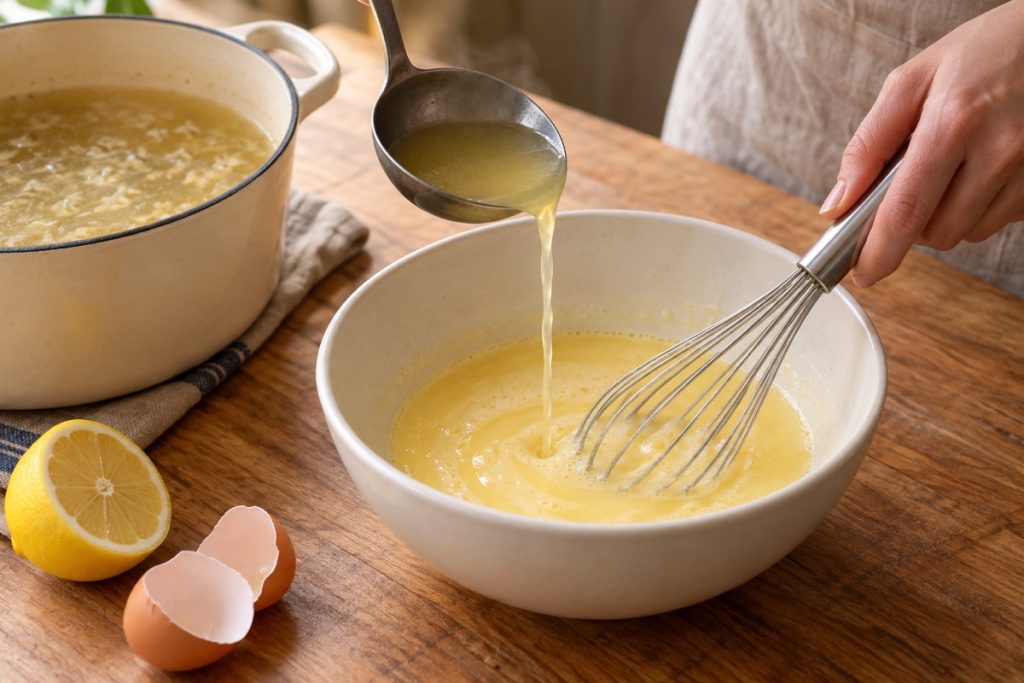
    Whisk eggs and lemon juice in a medium bowl until completely blended. While whisking constantly, add one ladle of hot soup in a very thin stream; repeat with a second ladle. The bowl should feel distinctly warm with no visible egg flecks.

    Hot broth being ladled into whisked egg and lemon
    Whisk constantly while adding hot broth in a thin stream to prevent curdling.

    4. 4. Finish gently without boiling

    Remove the pot from the burner. Pour in the tempered mixture in a thin stream while stirring the soup continuously. Return to low heat and stir for 2–3 minutes without simmering, until the soup lightly coats the back of a spoon and reaches 160°F/71°C. Add salt, pepper, and dill. Thin with hot water if needed and rest 5 minutes before serving.

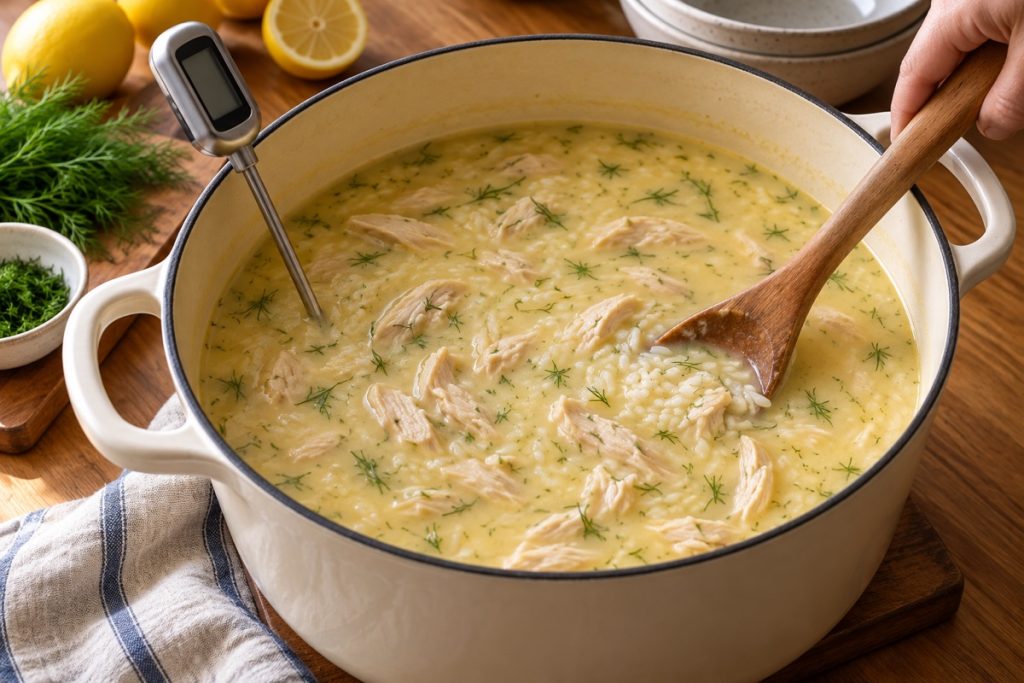
    Creamy avgolemono soup stirred over low heat
    Heat gently to 160°F/71°C without boiling.

    How to recognize the right texture

    The soup should be flowing and silky rather than heavy like cream, leaving a thin film on the back of a spoon. Visible egg flecks signal that the mixture was added too quickly or overheated. Rice should have no hard center and chicken should pull into moist strands.

    Common problems and quick fixes

    Boiling causes curdling; if large bubbles appear after tempering, remove the pot immediately. Thin an overly thick soup with hot water in 1/4-cup/60 ml additions. If the lemon is too sharp, add warm stock; if too mild, add a few fresh drops at the table.
    Make-ahead, serving, and leftovers

    Prepare the chicken-rice base one day ahead and cool it quickly; add egg and lemon only on serving day. Serve with bread, olives, and a simple salad. Loosen thick leftovers with warm stock for an easy next-day meal.

    Frequently asked questions

    Why does avgolemono curdle?

    Adding cold eggs directly to very hot soup or boiling after tempering makes the proteins form curds. Temper slowly with two ladles of broth and keep the final soup below a simmer.

    Does avgolemono need cream?

    No. The silky body comes from egg, lemon, and rice starch; this recipe contains no cream.

    Can I use orzo instead of rice?

    Yes. Use 4 ounces/120 g orzo and cook according to its package timing. The texture will be lighter and more pasta-like.

    Can I freeze avgolemono soup?

    Finished egg-lemon soup may separate after thawing. Freeze the chicken-rice base, thaw and reheat it, then temper in freshly whisked egg and lemon.

  • Portuguese Caldo Verde: Silky Potato and Collard Soup

    Portuguese Caldo Verde: Silky Potato and Collard Soup

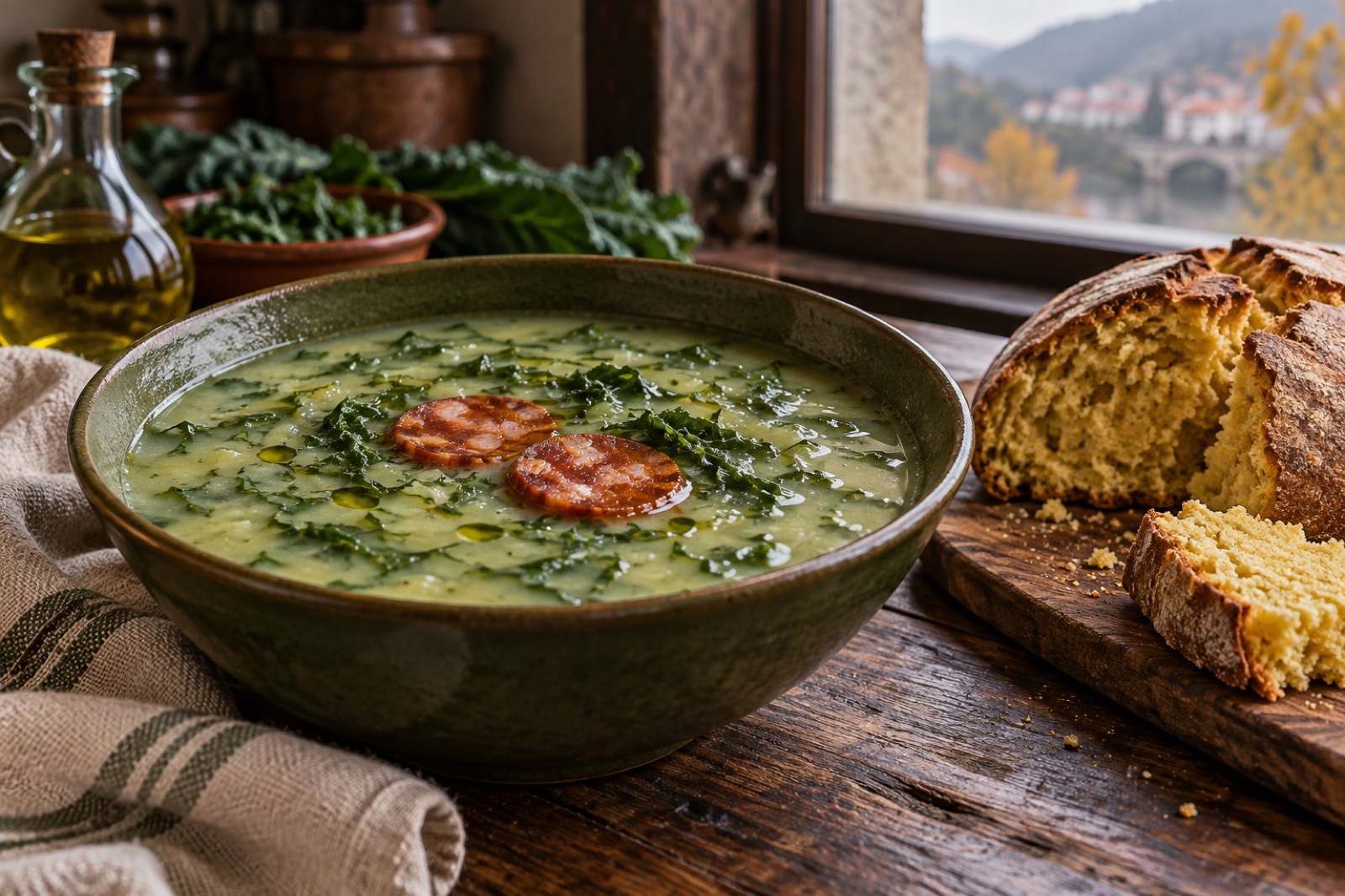
    Caldo verde is one of Portugal’s best-known soups. Visit Portugal’s traditional recipe combines potato, onion, garlic, couve-galega, olive oil and chouriço and serves it with broa corn bread.

    This home version blends the potato base smooth without flour. Adding the greens last and cooking uncovered preserves their fine texture and lively color.

    Three details that matter

    • Flour is unnecessary: starchy potatoes naturally thicken once fully tender and blended.
    • Slice greens into 1–2 mm ribbons so they cook quickly rather than staying fibrous.
    • Chouriço is salty, so season the soup at the end.
    • Equipment: 4-quart pot, sharp knife, board, immersion blender and thermometer.

    Ingredients, substitutions and make-ahead

    If couve-galega is unavailable, use collards or lacinato kale and remove thick ribs. Tough kale may need 2–3 extra minutes.

    Cooked smoked pork sausage can replace Portuguese chouriço. For a vegetarian adaptation, omit it and add smoked paprika.

    Make the potato base one day ahead and add fresh greens when serving for better color.

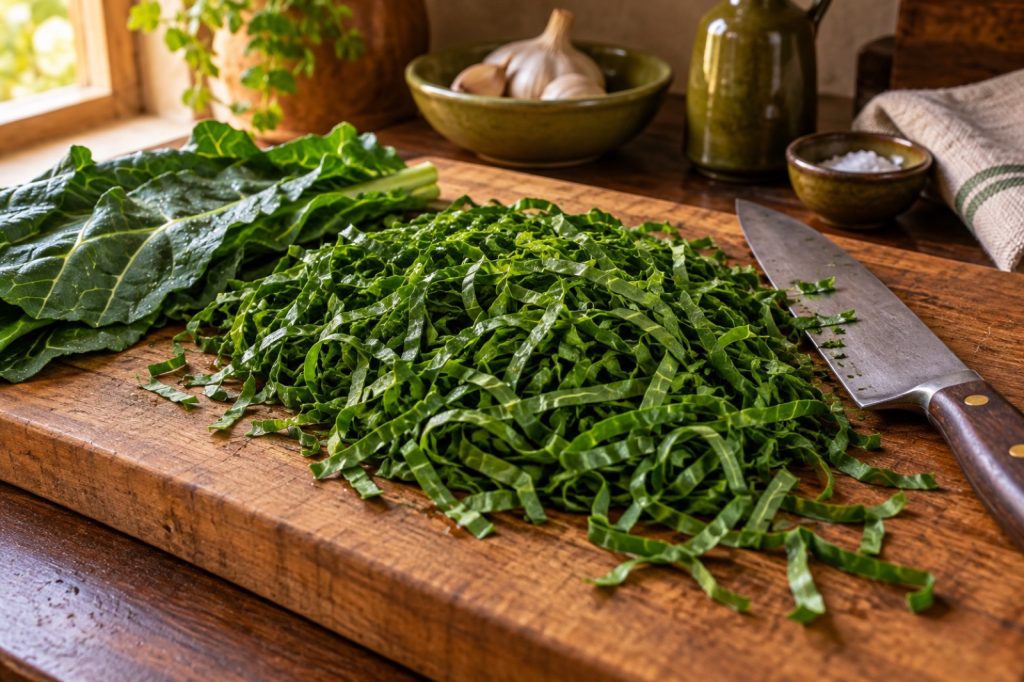
    Collard leaves cut into very fine ribbons.
    Remove thick stems and slice leaves into 1–2 mm ribbons.

    Caldo verde step by step

    1. 1. Slice the greens very finely

    Wash and dry the greens. Remove thick stems, roll leaves tightly and slice into 1–2 mm ribbons. Rinse once more and drain thoroughly; wet greens unnecessarily dilute the soup.

    2. 2. Simmer the potato base

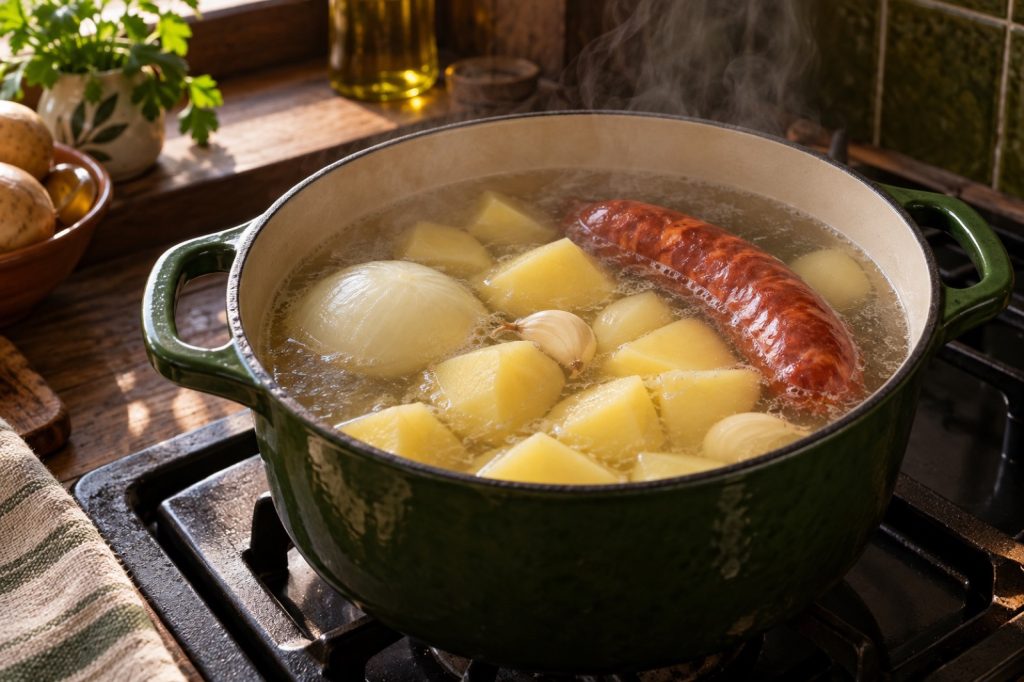
    Combine potatoes, onion, garlic, whole chouriço, water, 1 tablespoon olive oil and a little salt. Bring to a boil, reduce heat and simmer 20–25 minutes until potatoes collapse easily. Remove and reserve chouriço.

    Potatoes, onion, garlic and chouriço gently simmering.
    Simmer gently until the vegetables are completely tender.

    3. 3. Blend until silky

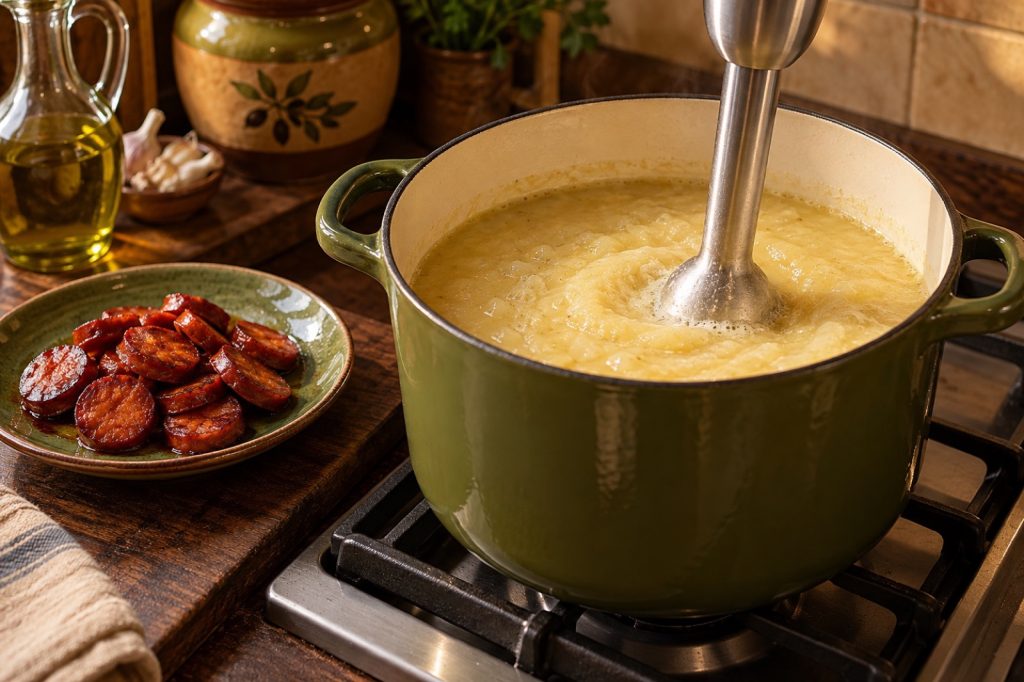
    Take the pot off the heat. Blend potato, onion and garlic until smooth. If too thick, add 1/2–3/4 cup hot water; the soup should coat a spoon but not sit like heavy puree.

    Potato soup base blended smooth after the chouriço is removed.
    Remove chouriço and blend the base until smooth.

    4. 4. Finish with greens and sausage

    Return the soup to a gentle boil. Add greens and cook uncovered 6–10 minutes until tender but vivid. Slice chouriço thinly and return it; when sausage reaches 160°F/71°C, add remaining olive oil and adjust salt.

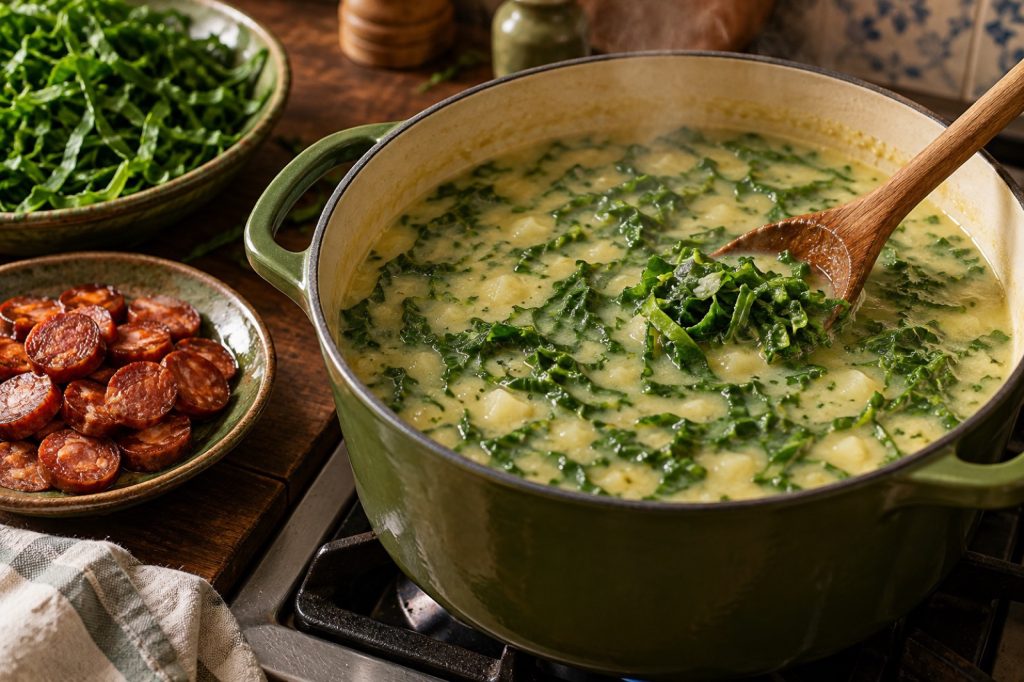
    Fine collard ribbons stirred into the smooth soup.
    Cook uncovered 6–10 minutes to keep the color lively.
    Texture, serving and storage

    If thick, add hot water; if thin, simmer uncovered. If blending made it gluey, the potato starch was overworked—stop blending and loosen with water.

    Serve with a few chouriço slices and broa or toasted corn bread. Adding olive oil at the table preserves its aroma.

    Refrigerate in shallow containers within 2 hours and keep 3–4 days. Freeze up to 2 months, accepting softer greens. Thaw chilled and reheat to 165°F/74°C.

    Frequently asked questions

    Can I make caldo verde with kale?

    Yes. Remove tough ribs and slice very thinly; firm kale may take a few extra minutes.

    Why did the soup turn gluey?

    Overblending releases too much potato starch. Blend only until smooth and loosen gently with water.

    Is chouriço essential?

    It gives classic character but can be omitted. Smoked paprika and good olive oil add depth to a vegetarian version.

  • Turkish Red Lentil Soup: Silky, Bright and Flour-Free

    Turkish Red Lentil Soup: Silky, Bright and Flour-Free

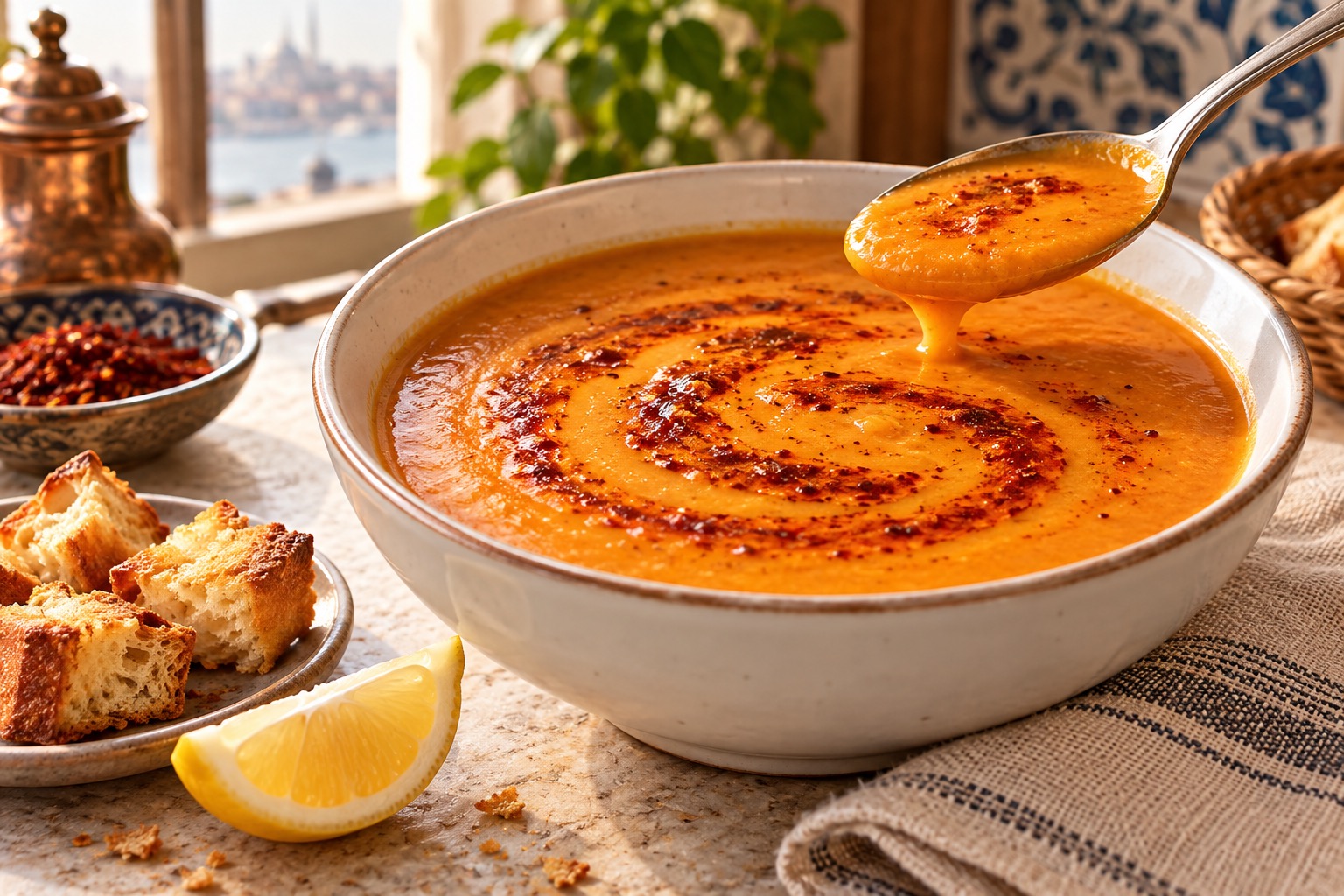
    Red lentil soup appears in many forms across Turkish homes and lokantas. This streamlined version uses lentils and a small potato for body, so no flour roux is needed. Lemon is added at the table, letting each diner control acidity.

    Keep the finished soup slightly fluid while hot because lentil starch continues to absorb water as it stands. Adjust liquid after blending, not before, to avoid a watery result.

    Details that make it work

    • Rinsing until the water is nearly clear reduces foam and raw flavor.
    • Sweating rather than browning vegetables preserves the bright orange color.
    • A five-minute simmer after blending stabilizes the texture and removes any raw vegetable note.
    • Equipment: fine sieve, medium pot, wooden spoon, immersion blender and optional fine-mesh strainer.

    Ingredient and measurement notes

    1 US cup red lentils is about 6.7 oz. Older lentils may take longer to soften.

    Replace the potato with 2 tablespoons rice if needed; omit carrot for a more savory, paler soup.

    If stock is salted, season at the end. For vegan soup, use olive oil instead of butter.

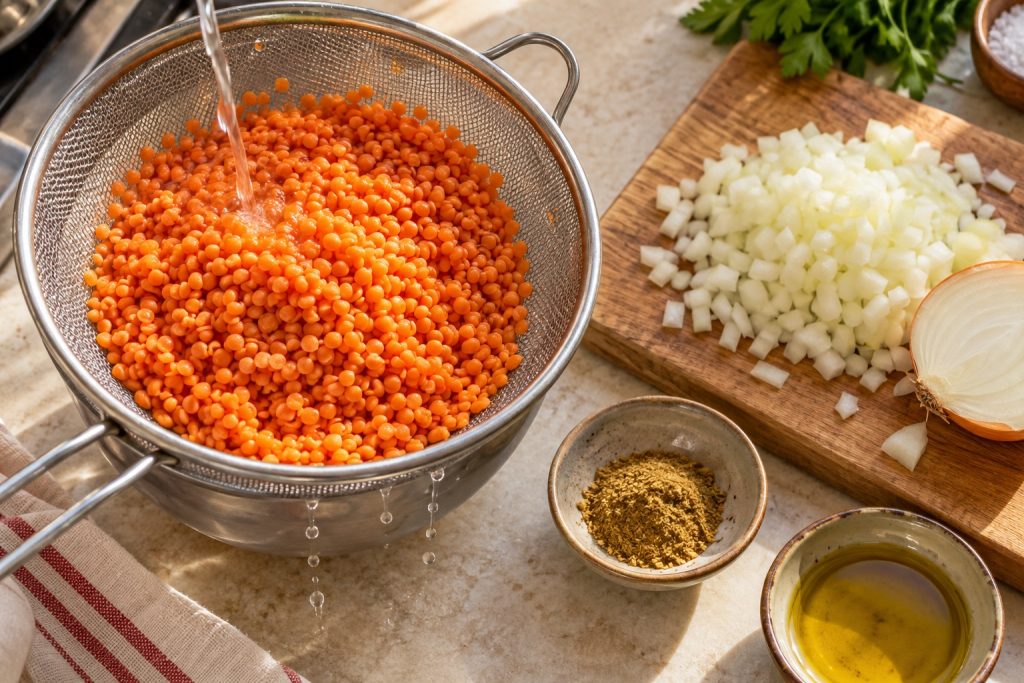
    Red lentils rinsed in a fine sieve until the water runs clear.
    Thorough rinsing reduces foam and gives a cleaner flavor.

    Step-by-step Turkish lentil soup

    1. 1. Prepare the lentils

    Rinse lentils in a fine sieve under cold water until the runoff is mostly clear; drain well. Dice onion, carrot and potato smaller than 1/2 inch so they soften evenly.
    2. 2. Sweat the vegetables

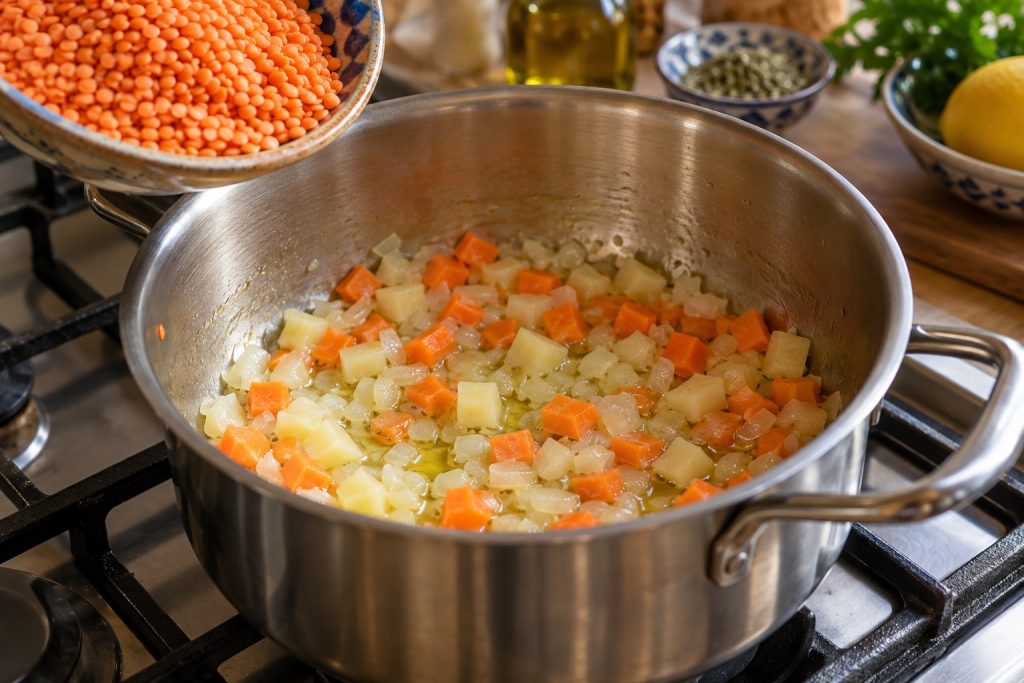
    Warm olive oil over medium-low heat. Cook onion with a pinch of salt for 5 minutes until translucent, not brown. Add carrot, potato, cumin and tomato paste; stir 2 minutes without scorching the paste.

    Onion, carrot and potato softening gently without browning.
    Do not brown the vegetables; translucent onion preserves a clean soup color.

    3. 3. Simmer gently

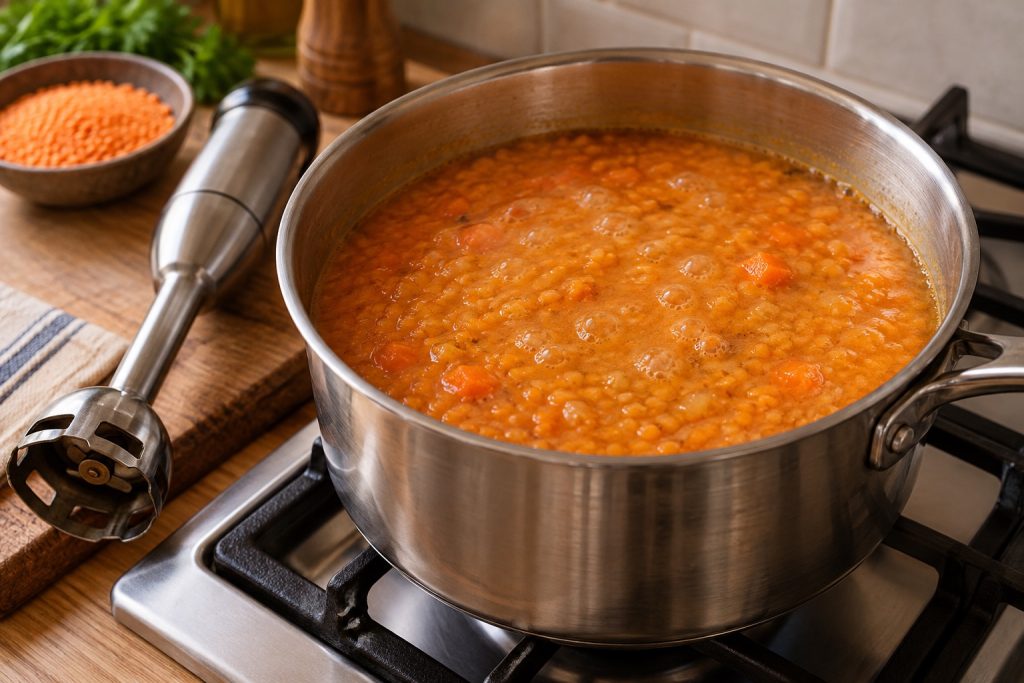
    Add lentils, water or stock and remaining salt. At the boil, skim excess foam. Simmer with the lid ajar for 25–30 minutes until lentils collapse and potato crushes easily with a spoon.

    Lentils and vegetables simmering gently until fully tender.
    Lentils should collapse and the potato should crush easily with a spoon.

    4. 4. Blend and finish

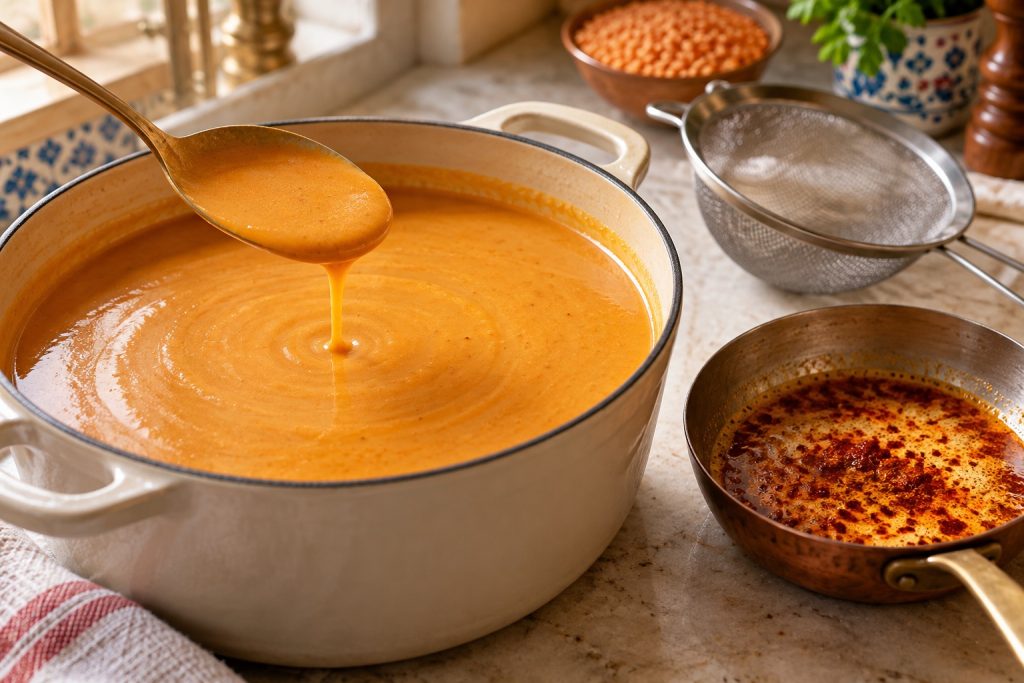
    Blend completely smooth. Add hot water gradually until the soup flows while thinly coating a spoon; simmer 5 minutes. Foam butter in a small pan, add pepper flakes and remove after 10 seconds. Serve with the spiced butter and lemon.

    Smooth soup thinly coats a spoon beside paprika butter.
    Adjust liquid after blending; make the butter sauce gently so the paprika does not burn.

    Texture, storage and reheating

    If the soup stays gritty, the lentils need 5–10 minutes more cooking before reblending. Reduce uncovered if thin; add hot water if thick.

    Cool in shallow containers within 2 hours. Refrigerate 3–4 days or freeze 2–3 months. Reheat thawed soup to a full simmer, loosening with water as necessary, and only reheat the portion needed.

    Serve with lemon, paprika butter and toasted bread. This is not claimed as personally kitchen-tested; method and safety information were cross-checked with official sources.

    Frequently asked questions

    Why did my soup turn brown?

    Browning onion or tomato paste darkens it; sweat the vegetables gently.
    Can I make it without a blender?

    Cook until fully collapsed, then press through a fine sieve; it takes more effort.
    Is potato essential?

    No. Omit it or replace with 2 tablespoons rice; the soup will be slightly lighter.