Greece’s official tourism recipe combines an egg, sugar, fine semolina, and milk custard with buttered phyllo and lemon syrup.
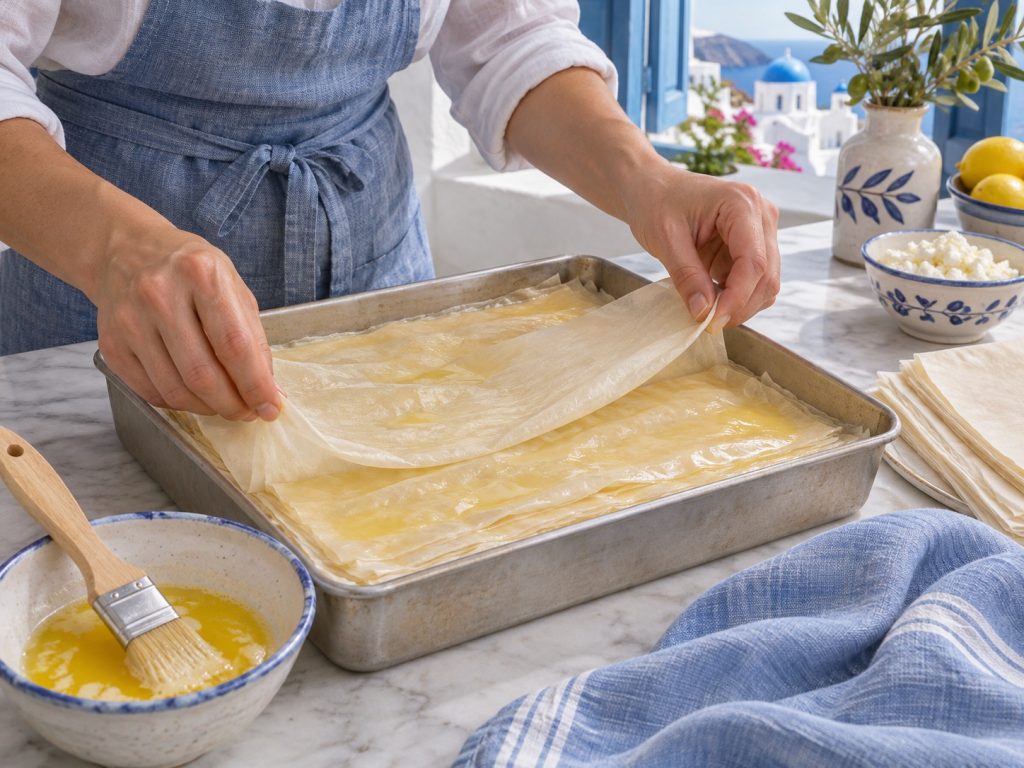
The key sequence here is fully cooled syrup over the hot, crisp pastry. The temperature contrast encourages absorption while reducing a soggy top.
Why this method works
- Fine semolina makes custard sliceable without gelatin.
- Tempering eggs prevents scrambling.
- Thinly buttering every phyllo sheet separates crisp layers.
- Cool syrup over hot pastry limits sogginess.
Before you start
Keep phyllo covered with a barely damp towel; it dries quickly.
Make syrup first so it fully cools.
Let custard become warm, not piping hot, before filling.
Step-by-step method
1. Make and fully cool the syrup
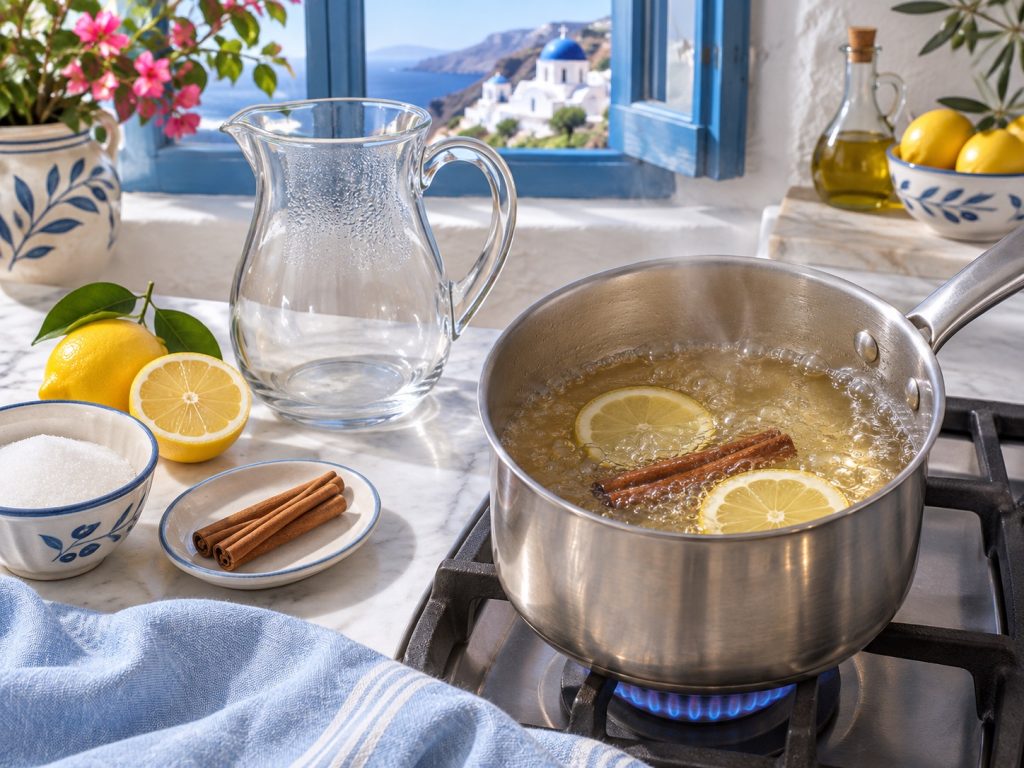
Boil sugar, water, lemon peel, and cinnamon; simmer 5 minutes. Remove from heat and stir in honey. Discard peel and cinnamon, then cool syrup to room temperature.
2. Cook the semolina custard
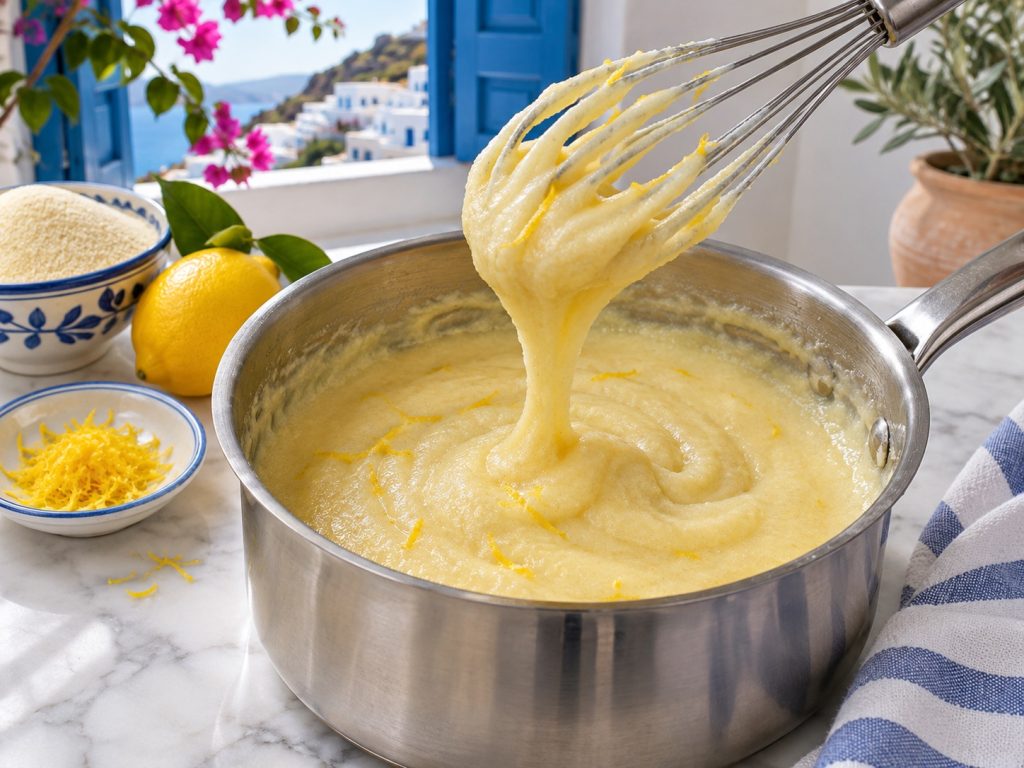
Whisk milk, semolina, sugar, vanilla, and zest over medium heat 8–10 minutes until thick tracks form. Beat eggs separately; temper with hot mixture gradually, return to the pan, and cook 2 more minutes. Stir in butter.
3. Layer phyllo and enclose the filling
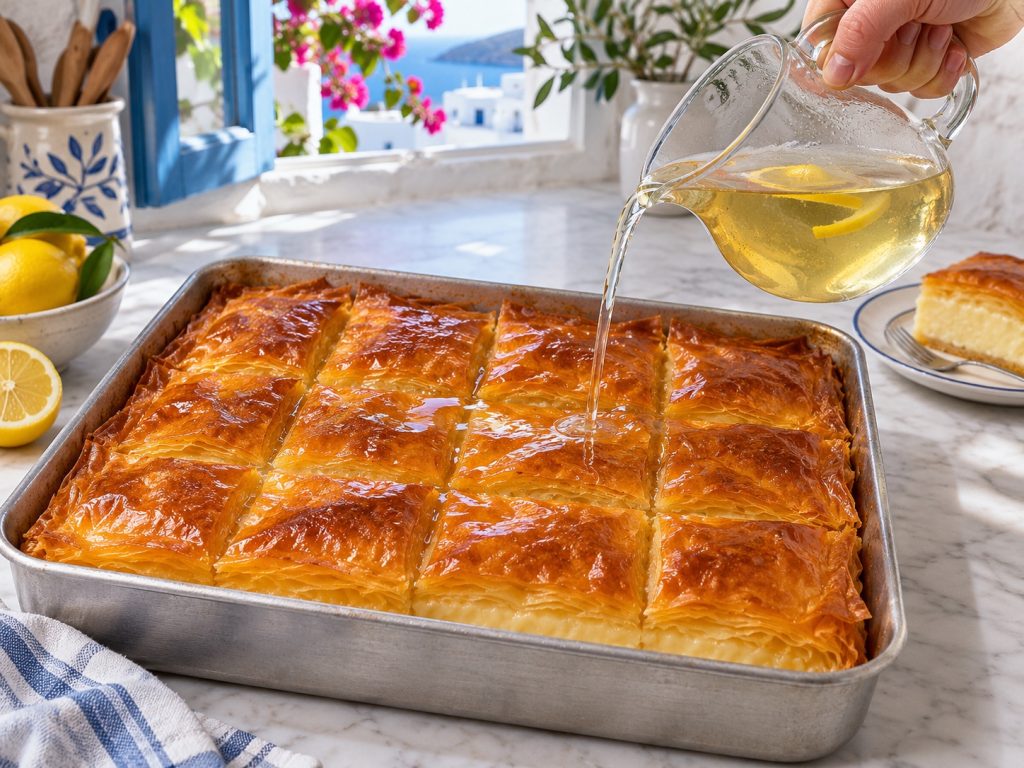
Butter a 9×13-inch/23×33 cm metal pan. Lay in slightly more than half the phyllo, buttering every sheet and leaving overhang. Spread warm filling; fold in edges and top with remaining buttered sheets.
4. Bake, then add cool syrup
Score 12 portions through only the top phyllo. Bake at 350°F/175°C for 50–55 minutes until deep golden. Immediately pour cool syrup evenly over hot pastry; rest at least 3 hours before cutting.
Greek Galaktoboureko: Semolina Custard Phyllo Pie
Crisp phyllo, lemon-scented semolina custard, and controlled syrup for clean slices of Greek Galaktoboureko.
Ingredients
- 4¼ cups whole milk
- ¾ cup fine semolina
- ¾ cup plus 2 tbsp granulated sugar
- 4 large eggs
- 2 large egg yolks
- 4 tbsp unsalted butter — for custard
- 2 tsp vanilla extract
- 1 lemon finely grated zest
- 1 lb phyllo pastry — about 18 sheets
- ¾ cup unsalted butter — melted, for phyllo
- 2 cups granulated sugar — for syrup
- 1¼ cups water — for syrup
- 1 strip lemon peel
- 1 cinnamon stick
- 2 tbsp honey — optional
Instructions
- Boil sugar, water, lemon peel, and cinnamon; simmer 5 minutes. Remove from heat and stir in honey. Discard peel and cinnamon, then cool syrup to room temperature.
- Whisk milk, semolina, sugar, vanilla, and zest over medium heat 8–10 minutes until thick tracks form. Beat eggs separately; temper with hot mixture gradually, return to the pan, and cook 2 more minutes. Stir in butter.
- Butter a 9×13-inch/23×33 cm metal pan. Lay in slightly more than half the phyllo, buttering every sheet and leaving overhang. Spread warm filling; fold in edges and top with remaining buttered sheets.
- Score 12 portions through only the top phyllo. Bake at 350°F/175°C for 50–55 minutes until deep golden. Immediately pour cool syrup evenly over hot pastry; rest at least 3 hours before cutting.
Notes
- Custard should fall in thick ribbons without lumps.
- Top should be deep golden with crisp, lifted edges.
- Rest at least 3 hours before cutting.
Common problems and fixes
Soft phyllo points to warm syrup or underbaking; bake deep golden and cool syrup fully.
Strain lumpy custard; visible egg curds mean it overheated.
Substitutions and measurements
Honey is optional; replace with equal sugar by weight. Do not use coarse semolina; texture becomes gritty.
9×13 inches is about 23×33 cm; 350°F is about 175°C.
Serving, storage, and allergens
Serve near room temperature. Because of the egg-and-milk custard, refrigerate within 2 hours and keep 3–4 days. Freezing is not recommended; thawed phyllo softens. Recrisp briefly at 325°F/160°C if desired.
Allergens: gluten, milk, and egg. Do not serve honey to children under 12 months.
Frequently asked questions
Should the syrup be hot or cold?
Here the syrup is fully cool and the pastry is straight from the oven.
Why did the custard scramble?
Eggs were not tempered or the mixture boiled too fast. Add hot custard to eggs gradually.
Can I make it ahead?
Yes, one day ahead; crispness is highest on day one.
What if phyllo dries out?
Use broken sheets as patches inside and keep the rest under a damp towel.
Leave a Reply