Author: emredikmen1

  • Palak Paneer: Creamy Spinach Curry That Stays Green

    Palak Paneer: Creamy Spinach Curry That Stays Green

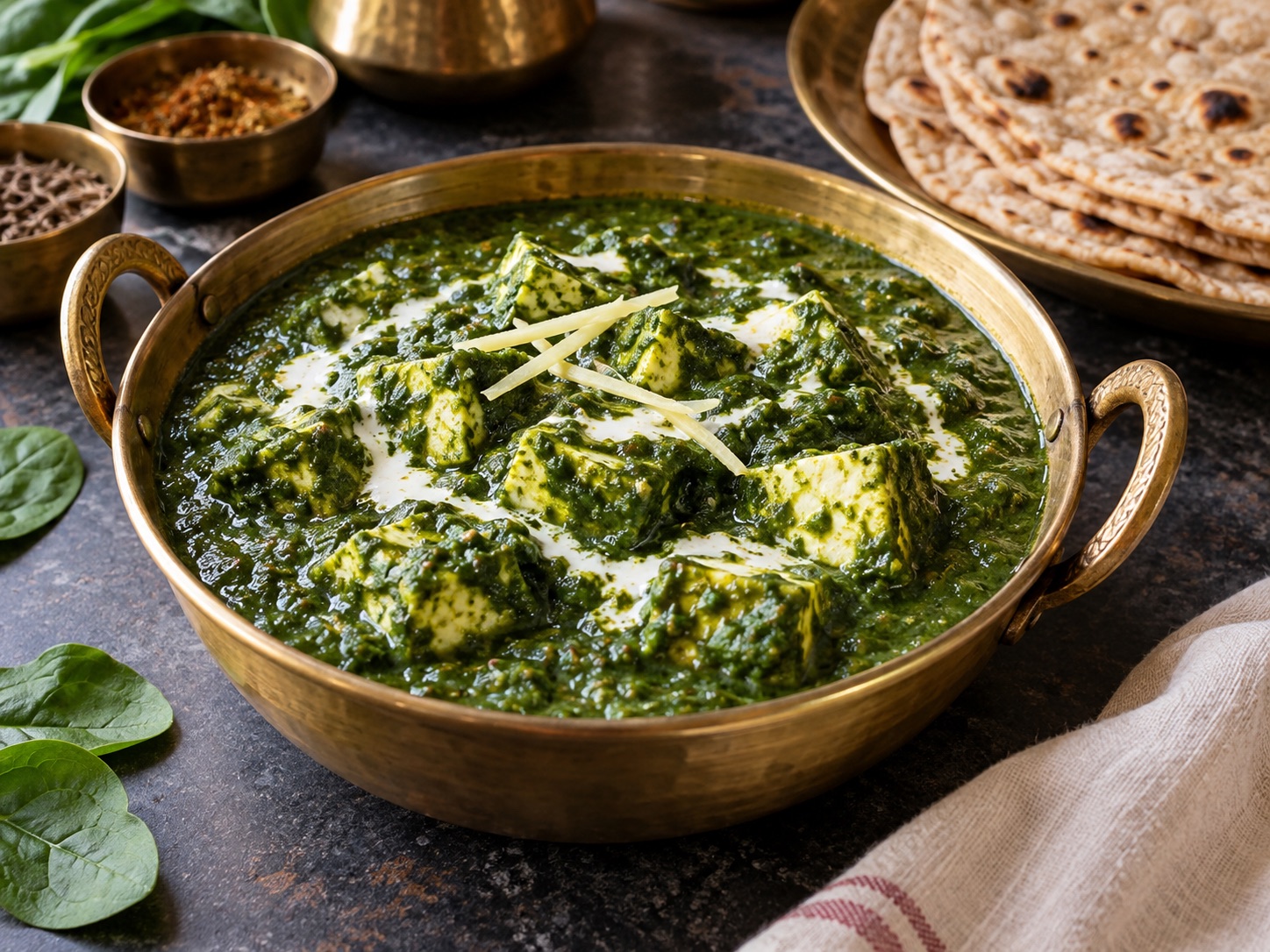
    Palak paneer is a North Indian main combining spinach purée with fresh non-melting paneer, commonly served with roti, naan, or rice.

    This version uses no artificial color: brief blanching, ice water, and a short simmer preserve the natural green.

    Why this method works

    • Brief blanching removes raw flavor without fading the spinach too far.
    • Cooking the onion-tomato base separately avoids a long simmer of the purée.
    • Adding paneer only at the end keeps it tender.

    Before you start

    Use a wide pot, ice-water bowl, blender, and lidded skillet or kadai.

    Wash spinach in several changes of water until no grit remains.

    Do not seal hot purée in a full blender; cool briefly and vent steam.
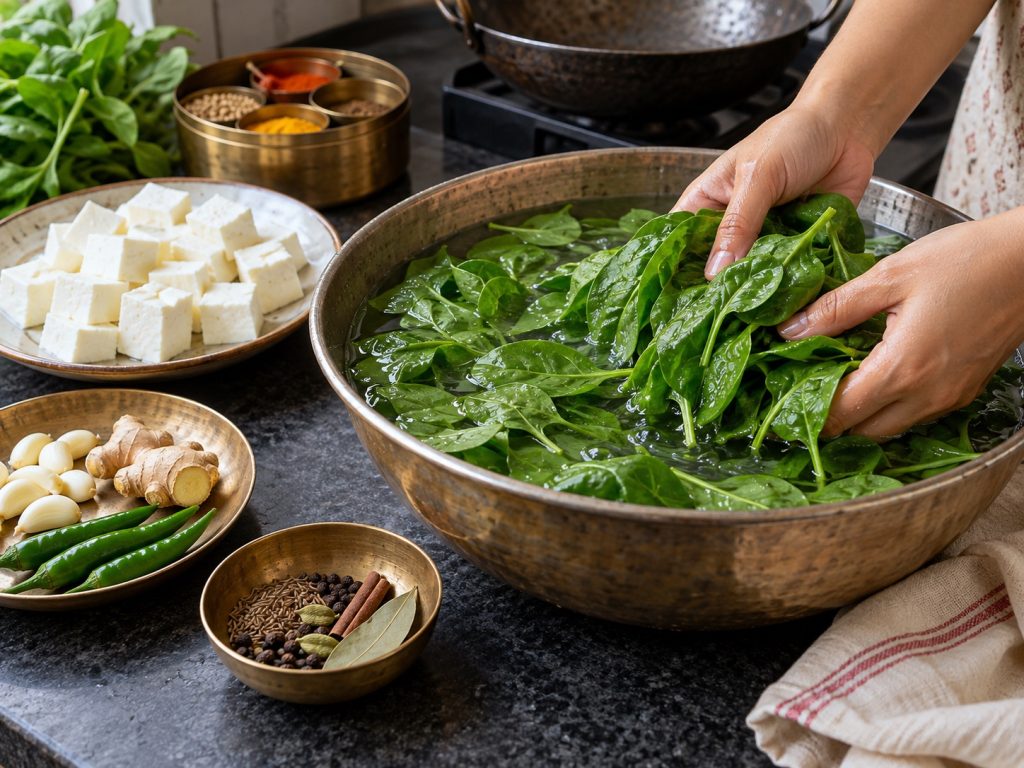
    Wash the spinach thoroughly
    Wash spinach in three changes of water, letting grit settle and lifting leaves out. Cut paneer into ¾-inch cubes. Finely chop ginger, garlic, and chile.

    Step-by-step method

    1. Wash the spinach thoroughly

    Wash spinach in three changes of water, letting grit settle and lifting leaves out. Cut paneer into ¾-inch cubes. Finely chop ginger, garlic, and chile.

    2. Blanch briefly and chill

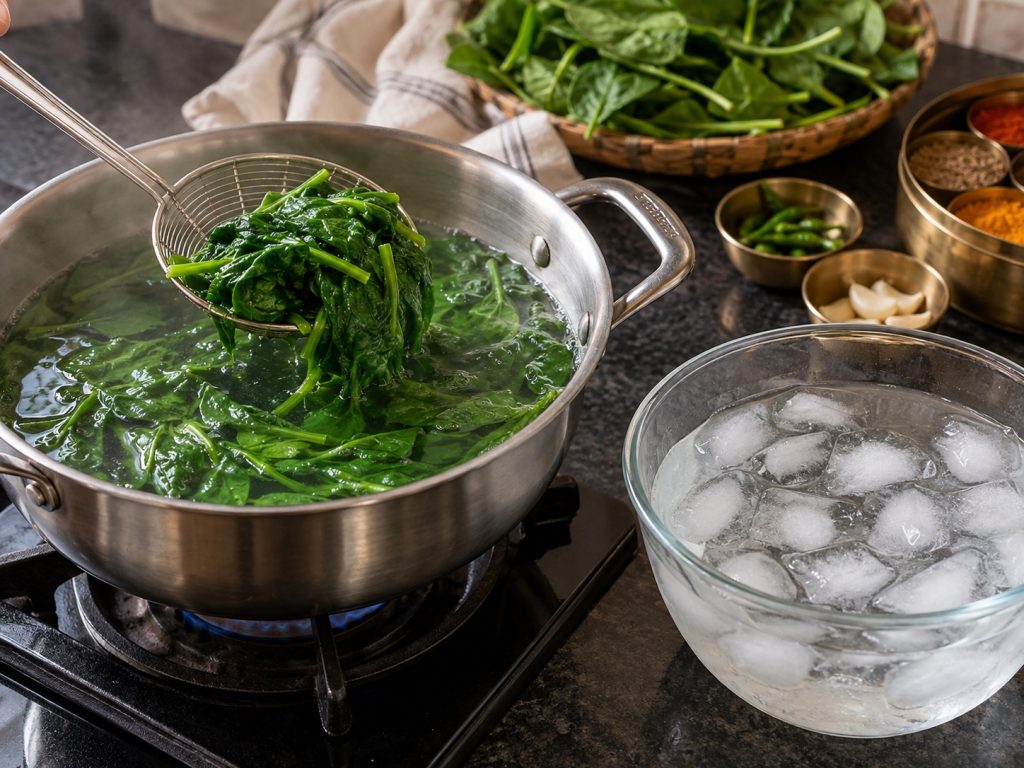
    Boil a large pot of water. Blanch spinach 60–90 seconds, only until collapsed and bright green; move immediately to ice water. Drain without squeezing and blend smooth with ¼ cup water.
    Blanch briefly and chill
    Boil a large pot of water. Blanch spinach 60–90 seconds, only until collapsed and bright green; move immediately to ice water. Drain without squeezing and blend smooth with ¼ cup water.

    3. Cook the spiced base

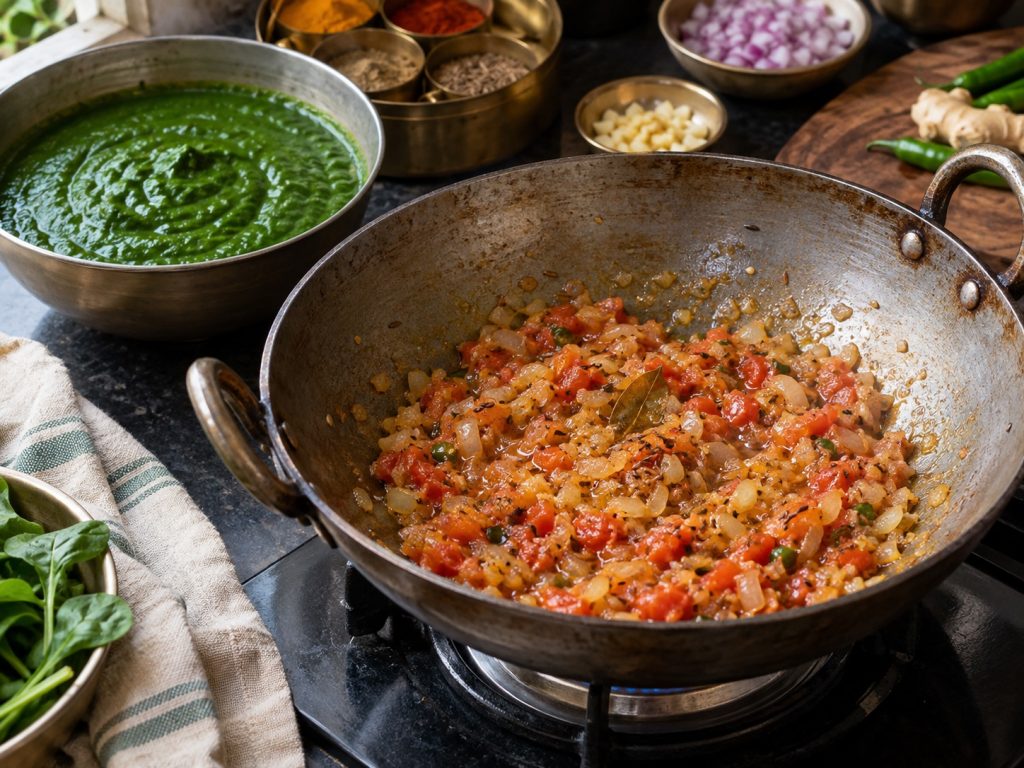
    Heat oil over medium. Stir cumin 20 seconds; soften onion 7–9 minutes. Cook ginger, garlic, and chile 1 minute; add tomato, coriander, and turmeric and cook 6–8 minutes until thick.
    Cook the spiced base
    Heat oil over medium. Stir cumin 20 seconds; soften onion 7–9 minutes. Cook ginger, garlic, and chile 1 minute; add tomato, coriander, and turmeric and cook 6–8 minutes until thick.

    4. Combine purée, paneer, and cream

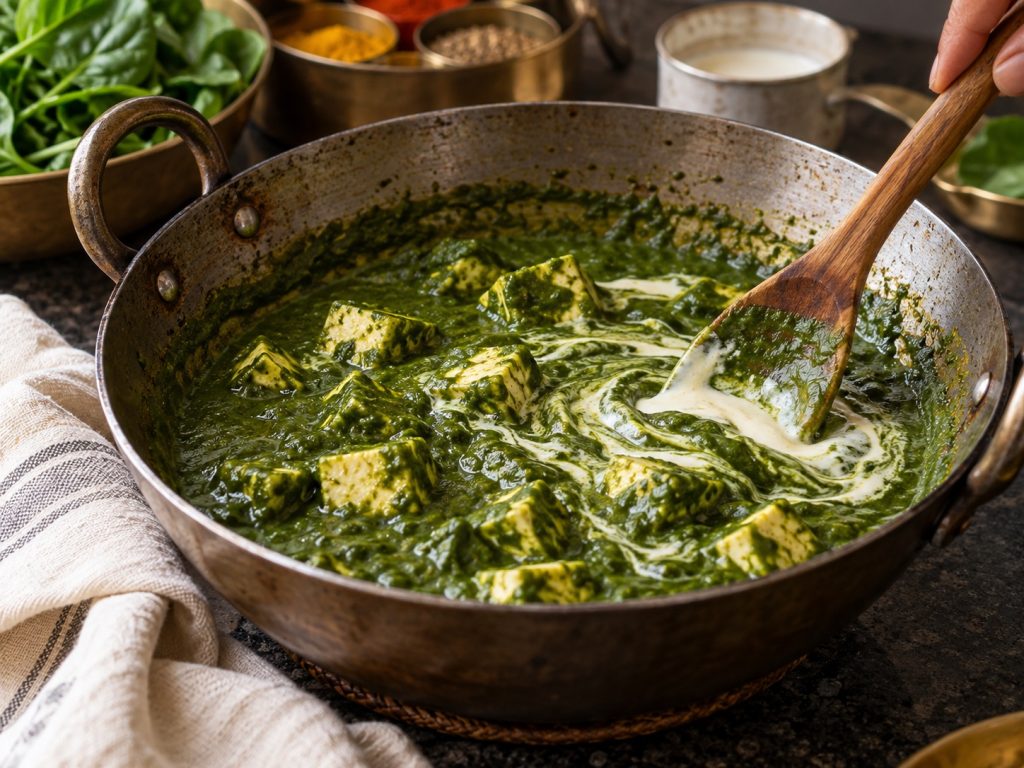
    Add spinach purée and salt; simmer gently 5 minutes, loosening with remaining water as needed. Add paneer for 3–4 minutes. Turn off heat and stir in garam masala and cream; do not hard-boil.
    Combine purée, paneer, and cream
    Add spinach purée and salt; simmer gently 5 minutes, loosening with remaining water as needed. Add paneer for 3–4 minutes. Turn off heat and stir in garam masala and cream; do not hard-boil.

    Texture and doneness cues

    Sauce should coat a spoon, stay naturally deep green, and show no oil puddles; paneer is hot but not spongy or rubbery.

    Mistakes, substitutions, and measurements

    Well-drained firm tofu can replace paneer as an adaptation. For frozen spinach, thaw, squeeze, and skip blanching. Full-fat yogurt can replace cream if stirred in off heat. Contains dairy. 1 cup=240 ml.

    Serving, storage, and allergens

    Serve with roti, naan, or basmati rice. Cool in a shallow container within 2 hours, refrigerate 3–4 days, and reheat gently to 165°F. Freeze up to 1 month, expecting texture changes.

    Frequently asked questions

    Why did it turn dark?

    Spinach was over-blanched or purée simmered too long; blanch 60–90 seconds and simmer only 5 minutes.

    Why is paneer rubbery?

    It hard-boiled too long; add it for only the final 3–4 minutes.

    Why does the spinach taste bitter?

    Mature stems or burnt spices may be responsible; remove thick stems and bloom spices briefly over medium heat.
  • Chinese Scallion Pancakes: Crisp, Flaky Cong You Bing

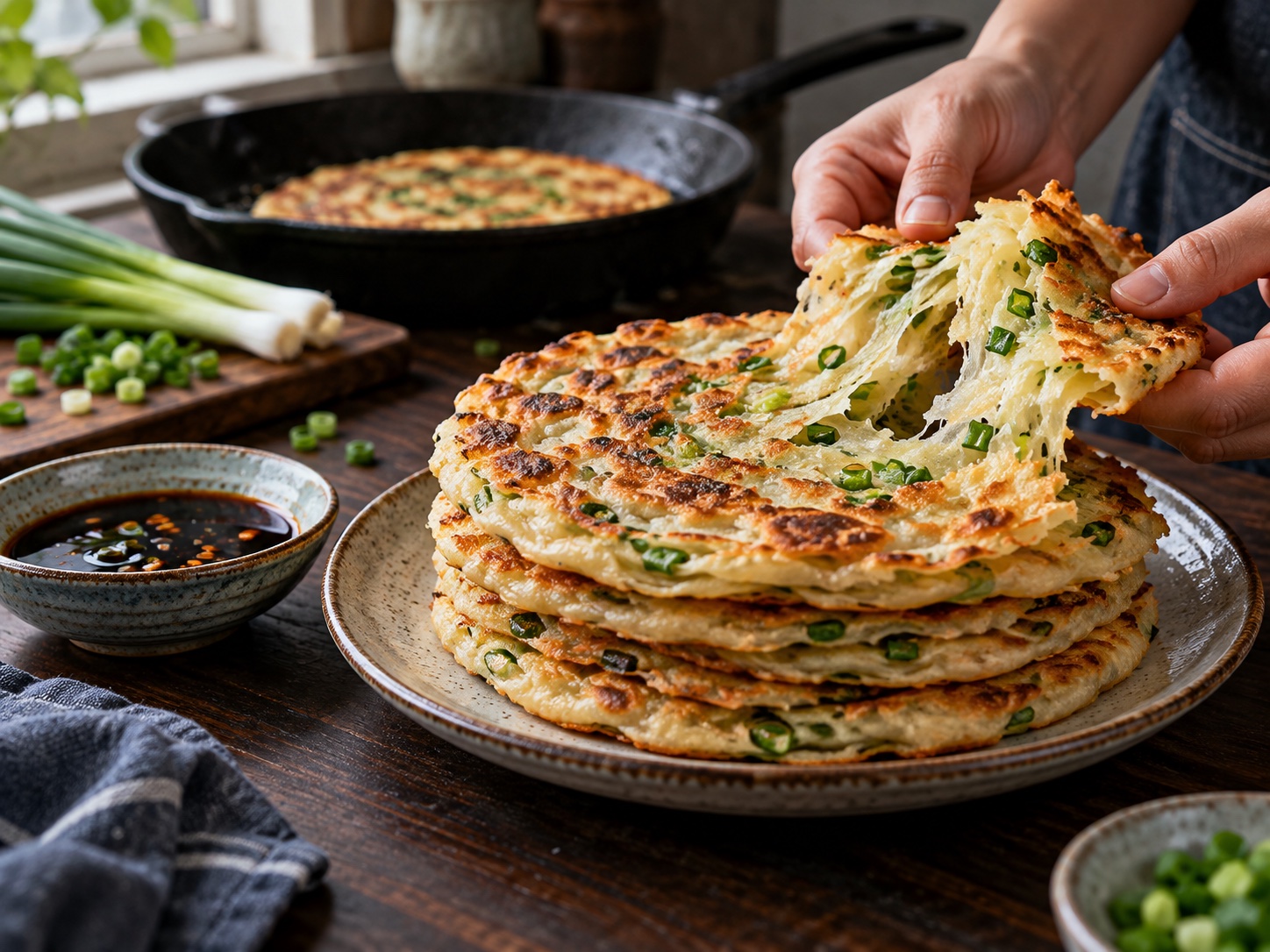
    Chinese Scallion Pancakes: Crisp, Flaky Cong You Bing

    Cong you bing is a Chinese wheat pancake layered with scallions; thickness and folds vary by region.

    Hot water tenderizes the dough while a spiral roll creates distinct flaky layers.

    Why this method works

    • Boiling water limits some gluten and makes rolling easier.
    • Flour-oil paste separates the layers.
    • Medium heat cooks the center before the crust burns.

    Before you start

    Use a skillet, rolling pin, brush, and lid; rest dough at least 30 minutes.

    Slice scallions very thin and dry; wet scallions make layers slip.

    Keep your face away from the pan to avoid oil splatter.

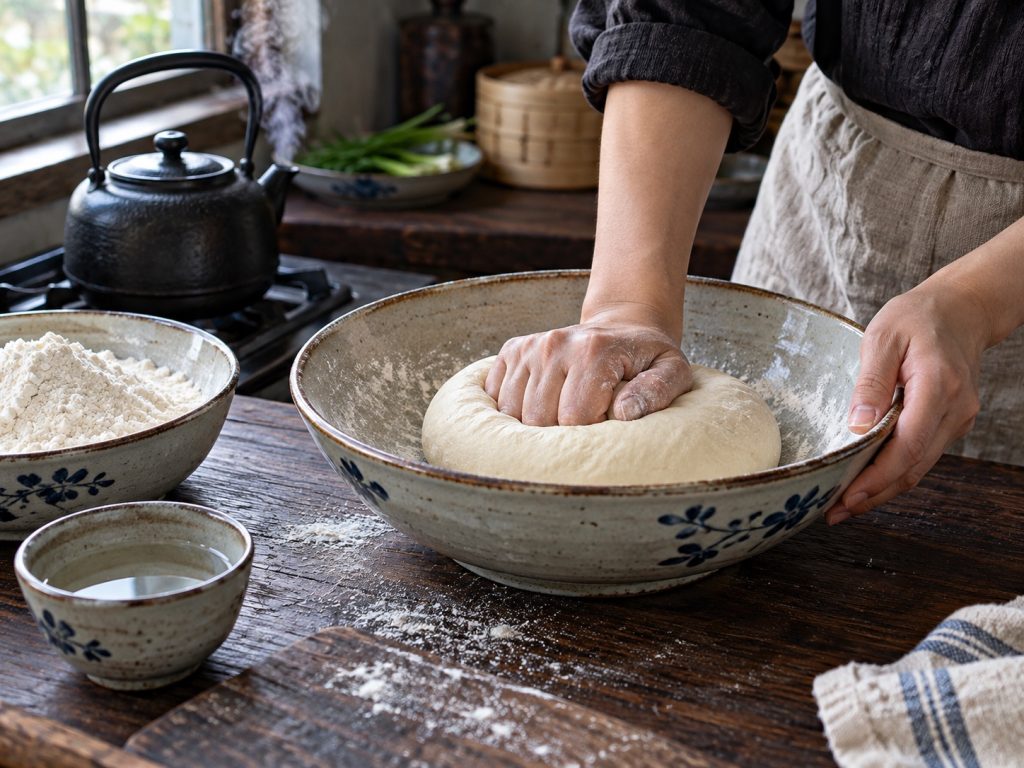
    Make and rest hot-water dough
    Stir boiling water into flour, add cold water, and knead 5 minutes. Cover and rest 30 minutes. Mix ¼ cup flour, 3 tbsp oil, and salt into a smooth paste.

    Step-by-step method

    1. Make and rest hot-water dough

    Stir boiling water into flour, add cold water, and knead 5 minutes. Cover and rest 30 minutes. Mix ¼ cup flour, 3 tbsp oil, and salt into a smooth paste.

    2. Roll thin layers

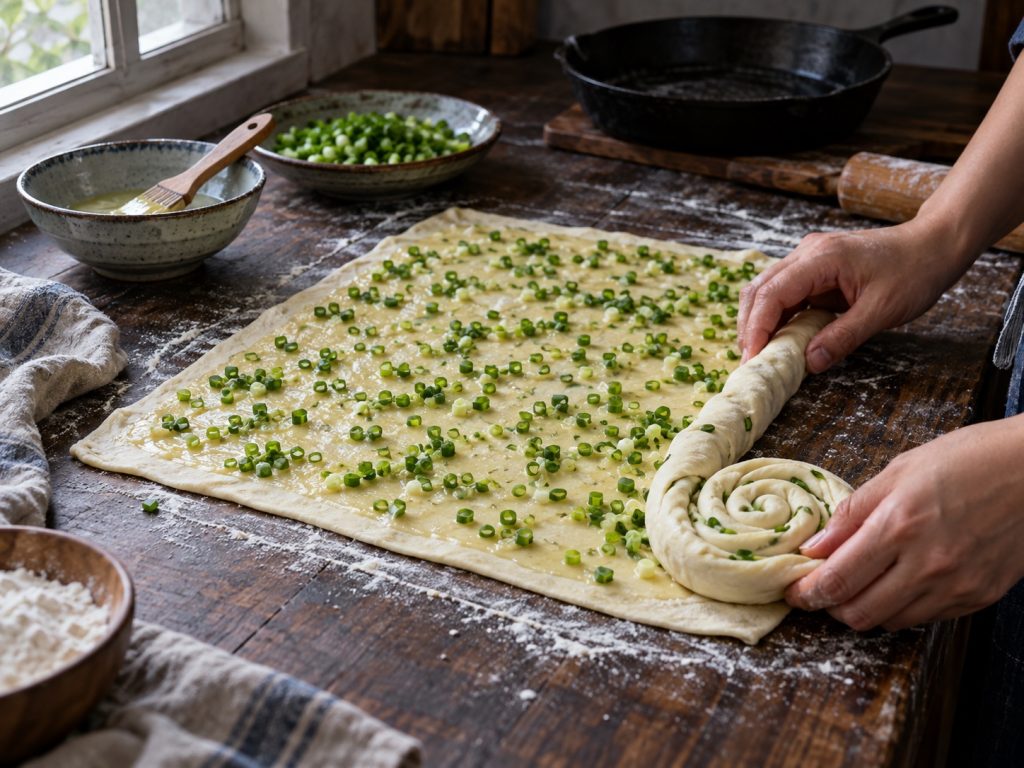
    Divide dough into 8. Roll each into a thin rectangle, brush with a very thin paste layer, scatter scallions, roll into a rope, then coil. Rest 10 minutes.

    Roll thin layers
    Divide dough into 8. Roll each into a thin rectangle, brush with a very thin paste layer, scatter scallions, roll into a rope, then coil. Rest 10 minutes.

    3. Flatten the spirals

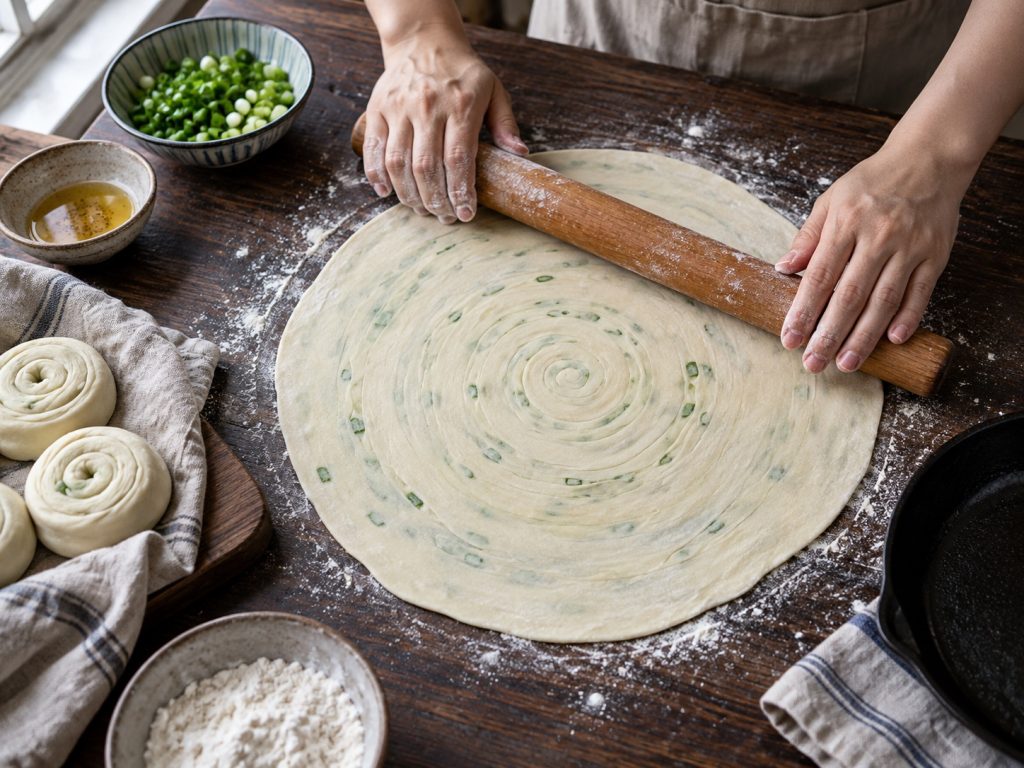
    Gently roll each coil into a 6–7-inch round. Use short center-out strokes so the layers stay distinct.

    Flatten the spirals
    Gently roll each coil into a 6–7-inch round. Use short center-out strokes so the layers stay distinct.

    4. Pan-fry over medium heat

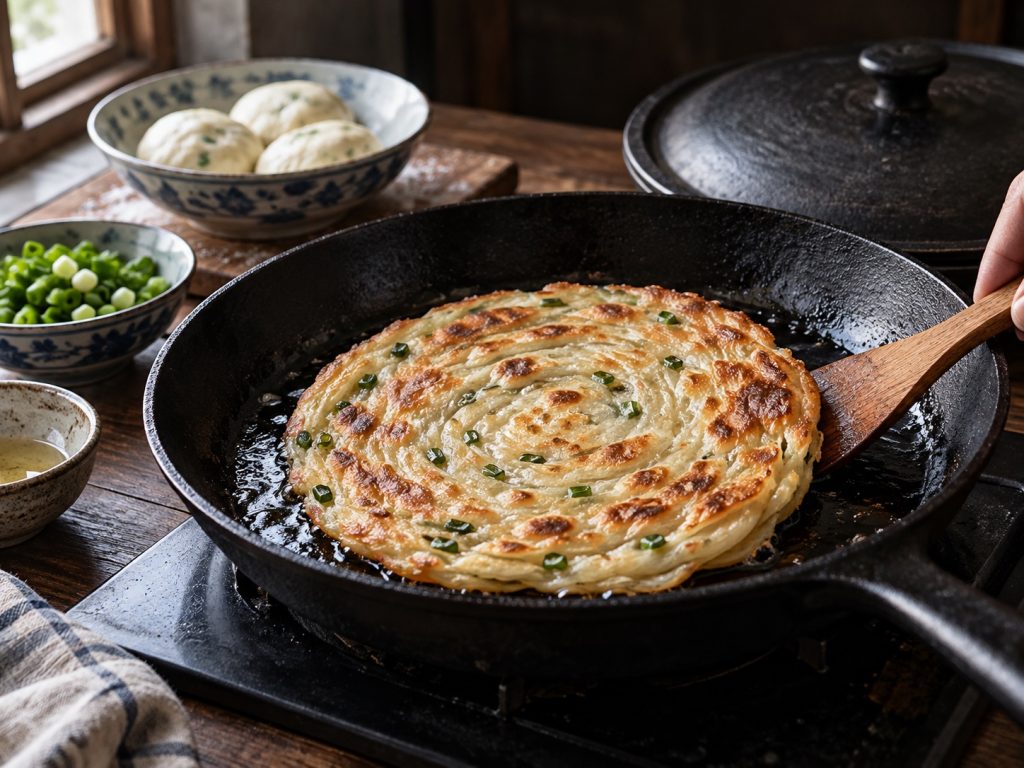
    Heat remaining oil in a skillet over medium. Cook covered 2 minutes, flip, then cook uncovered 2–3 minutes until both sides are golden and crisp; gently fluff the edge.

    Pan-fry over medium heat
    Heat remaining oil in a skillet over medium. Cook covered 2 minutes, flip, then cook uncovered 2–3 minutes until both sides are golden and crisp; gently fluff the edge.

    Texture and doneness cues

    Surface is mottled gold, edges crisp, center flexible but not doughy, and layers pull apart.

    Mistakes, substitutions, and measurements

    Chives can replace scallions; sesame oil is optional. Contains gluten. 1 cup=240 ml.

    Serving, storage, and allergens

    Serve with soy-vinegar dip. Cool within 2 hours; refrigerate 3 days or freeze cooked pancakes 2 months. Re-crisp in a dry skillet.

    Frequently asked questions

    Why are there no layers?

    The paste may be too thick or coils were rolled without resting.

    Why is the center raw?

    Heat was too high or pancake too thick; use medium heat and cover first.

    Can I make ahead?

    Chill coils 24 hours or freeze cooked pancakes 2 months.

  • Venezuelan Arepas: Crisp Outside, Soft Pocket

    Venezuelan Arepas: Crisp Outside, Soft Pocket

    Arepas are everyday Venezuelan corn breads with Indigenous roots, served hot and split for many fillings.

    This method requires precooked white cornmeal; polenta or standard cornmeal will not hydrate the same way.

    Why this method works

    • Adding flour to water reduces lumps.
    • A 10-minute rest evens hydration.
    • The skillet builds crust; the oven sets the pocket.

    Before you start

    Use precooked cornmeal, bowl, skillet, and sheet; preheat to 400°F.

    Dough should feel like soft modeling clay; seal edge cracks with wet fingers.

    For gluten-free service, verify certified flour and fillings.

    Mix in the right order
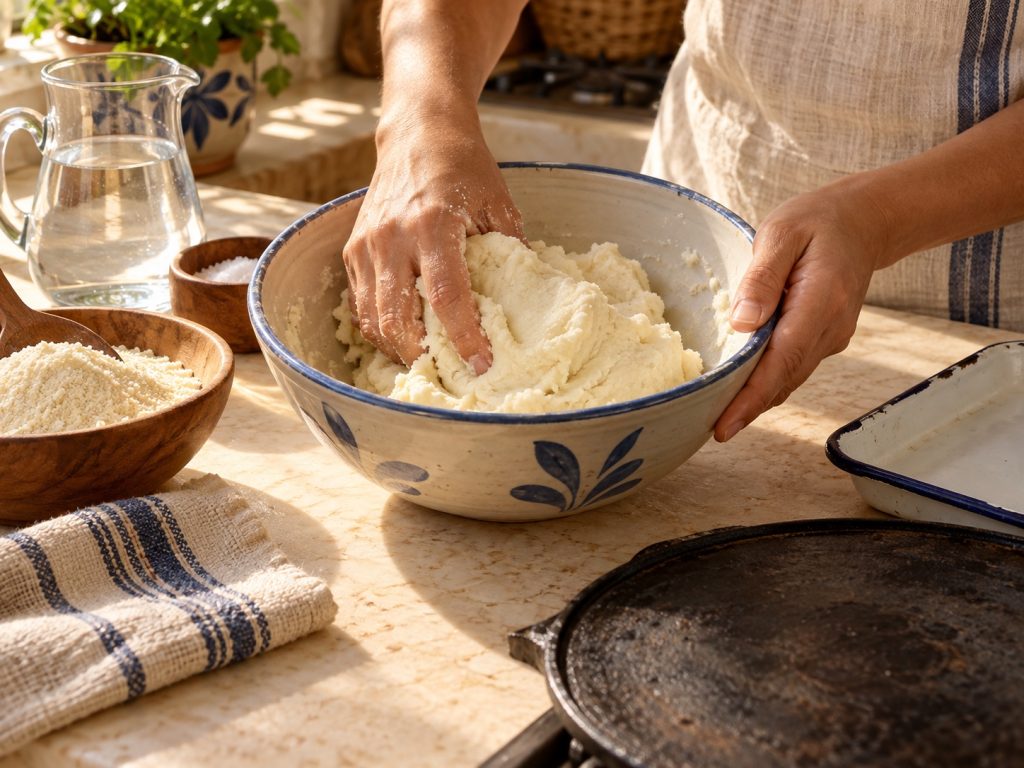
    Mix water and salt. Rain in the flour while mixing by hand; once no dry flour remains, rest 10 minutes.

    Step-by-step method

    1. Mix in the right order

    Mix water and salt. Rain in the flour while mixing by hand; once no dry flour remains, rest 10 minutes.

    2. Shape crack-free disks

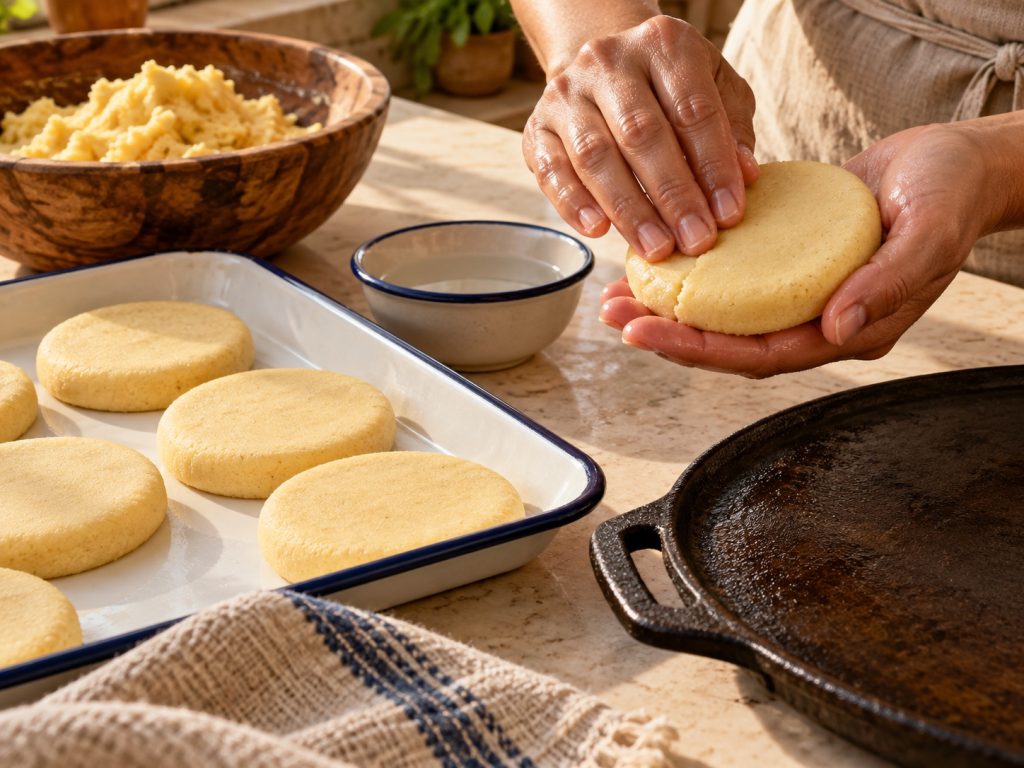
    Make 8 equal balls. Pat into 4-inch disks about ⅝ inch thick; seal cracks with wet fingers.

    Shape crack-free disks
    Make 8 equal balls. Pat into 4-inch disks about ⅝ inch thick; seal cracks with wet fingers.

    3. Build a skillet crust

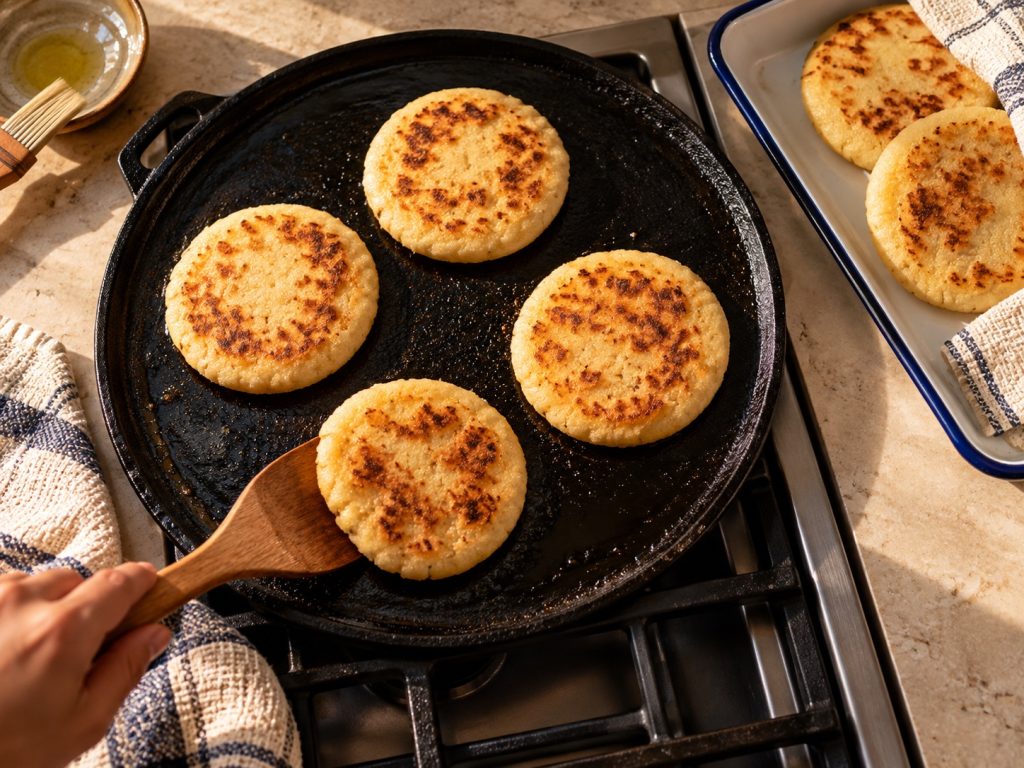
    Cook in a lightly oiled skillet over medium heat 4–5 minutes per side until a deep golden crust forms.

    Build a skillet crust
    Cook in a lightly oiled skillet over medium heat 4–5 minutes per side until a deep golden crust forms.

    4. Finish in the oven and rest

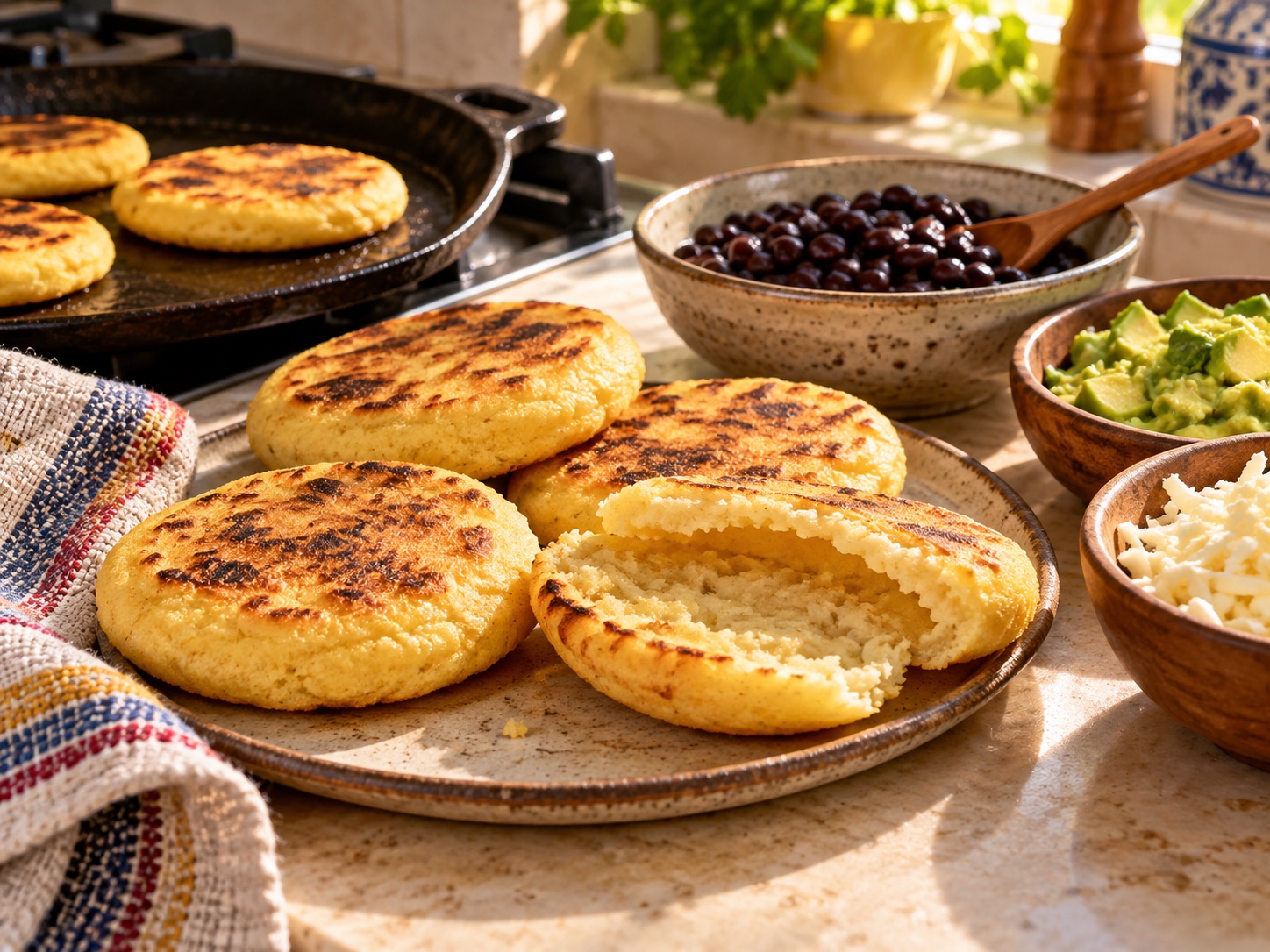
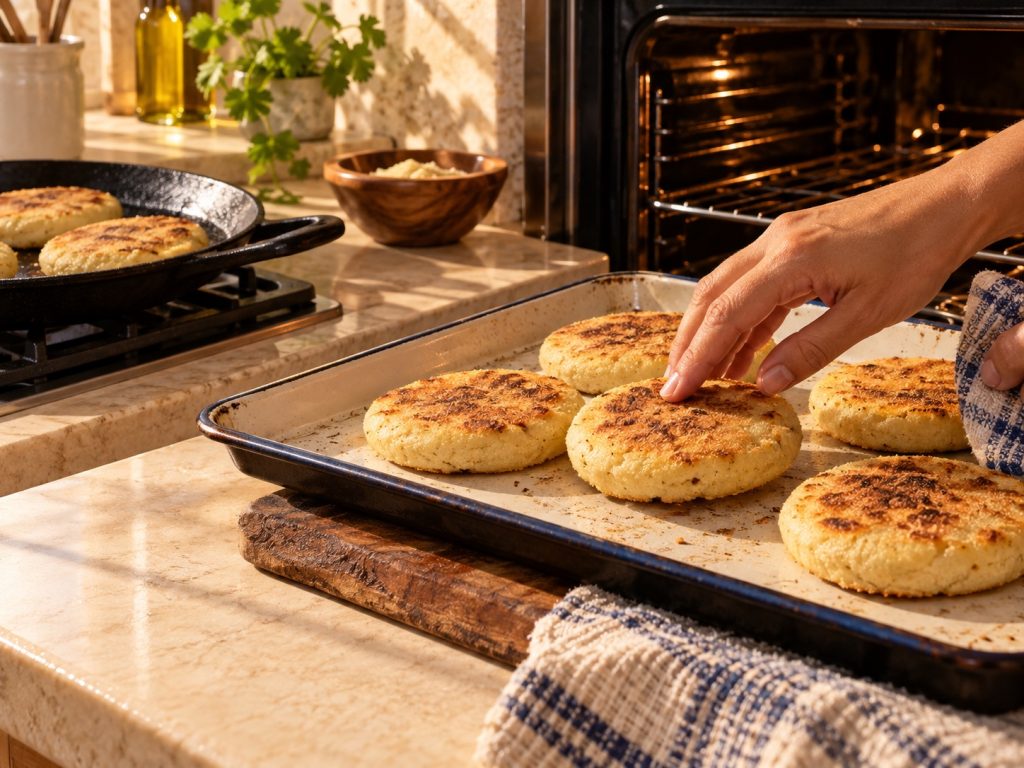
    Transfer to a sheet and bake at 400°F for 15–18 minutes. They should sound slightly hollow when tapped. Rest 5 minutes, then split into pockets.

    Finish in the oven and rest
    Transfer to a sheet and bake at 400°F for 15–18 minutes. They should sound slightly hollow when tapped. Rest 5 minutes, then split into pockets.

    Texture and doneness cues

    Outside is dry and golden, inside moist but not sticky, and it splits without crumbling.

    Mistakes, substitutions, and measurements

    Use only precooked cornmeal; yellow gives stronger corn flavor. Naturally dairy- and egg-free.

    Serving, storage, and allergens

    Fill with cheese, black beans, avocado, or chicken. Cool within 2 hours; refrigerate 3 days or freeze 2 months. Reheat at 375°F for 8–10 minutes.

    Frequently asked questions

    Why did they crack?

    Dough was dry or unrested; add water by the tablespoon.

    Why is the middle sticky?

    Disks were thick or underbaked; shape evenly.

    Can I use only a skillet?

    Yes, with lower heat and longer cooking; oven finishing is more even.

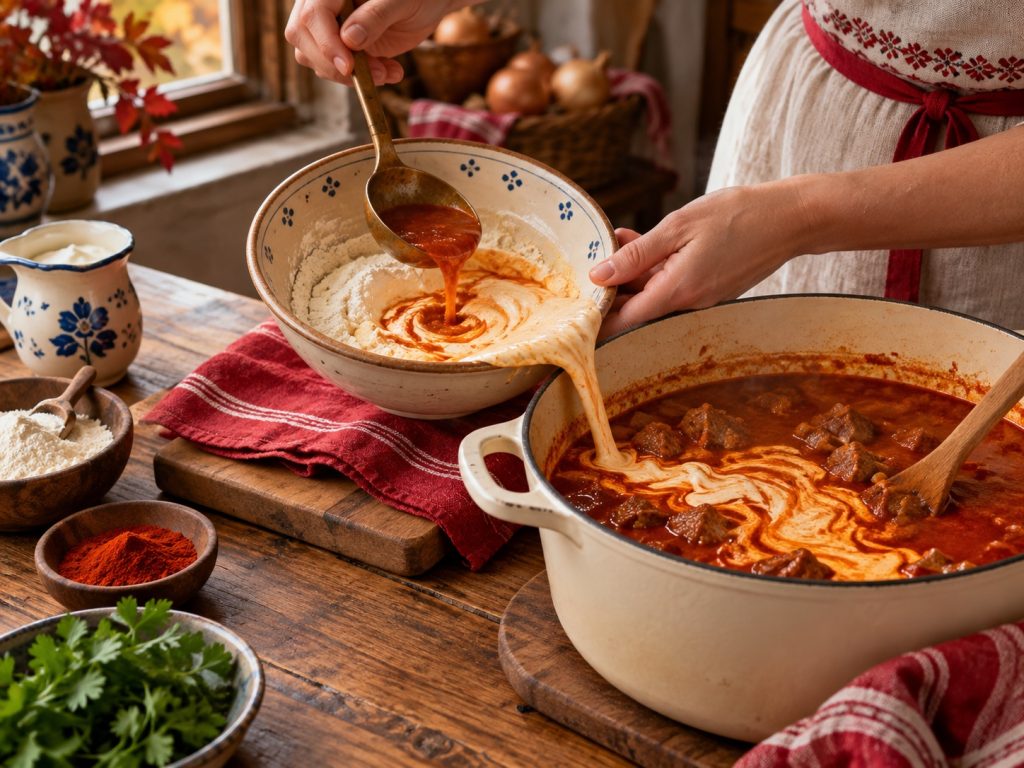
  • Hungarian Chicken Paprikash: Silky Sauce, No Bitter Paprika

    Hungarian Chicken Paprikash: Silky Sauce, No Bitter Paprika

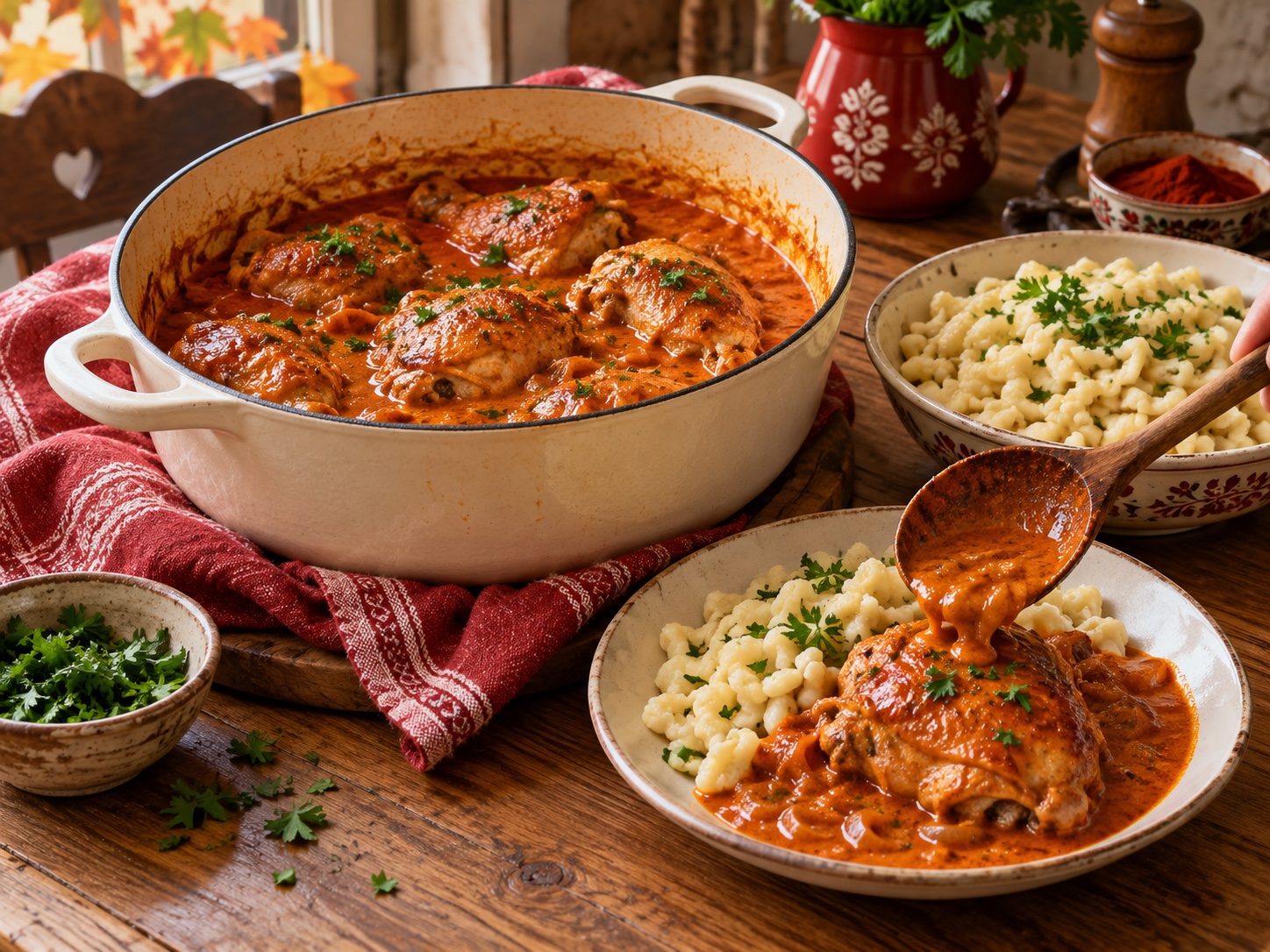
    Paprikás csirke is a signature Hungarian home dish; thighs and drumsticks stay juicier than breast.

    Taking the pot off heat for paprika and tempering sour cream prevent bitterness and curdling.

    Why this method works

    • Batch browning prevents steaming.
    • Long-cooked onion thickens sauce naturally.
    • Tempering sour cream protects the emulsion.

    Before you start

    Use a heavy pot, tongs, and thermometer.

    Take the pot off heat 30 seconds before adding paprika.

    Chicken must reach 165°F in the thickest part.

    Brown chicken in batches
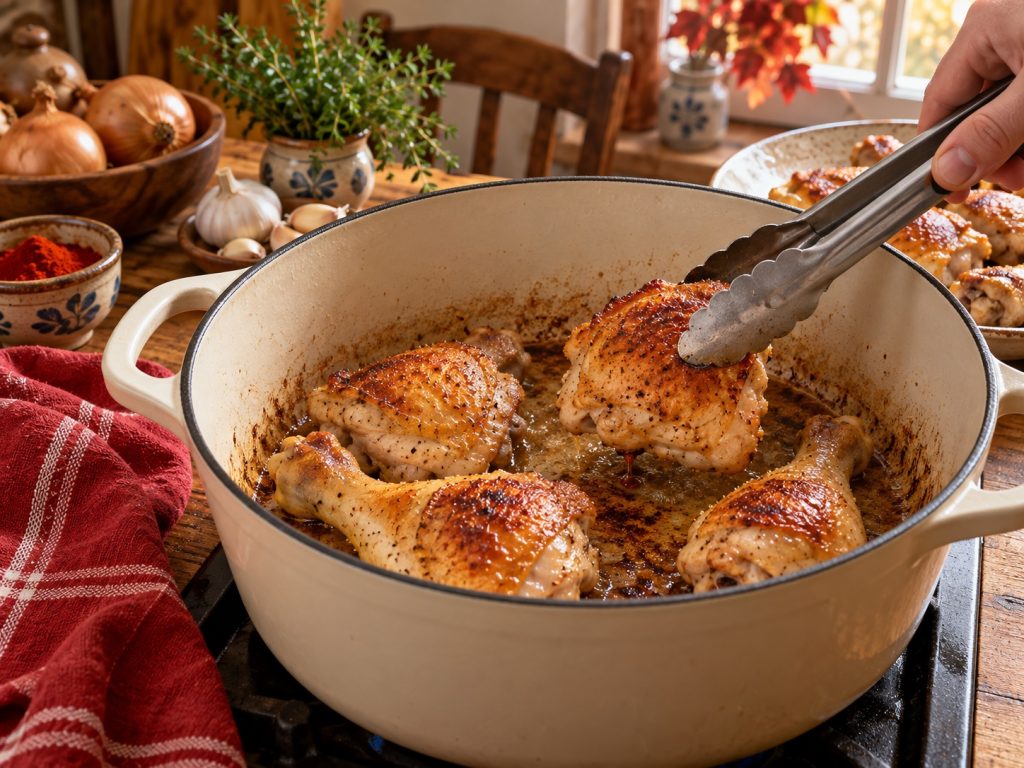
    Dry and salt chicken. Heat oil; brown without crowding, 4–5 minutes per side, then remove.

    Step-by-step method

    1. Brown chicken in batches

    Dry and salt chicken. Heat oil; brown without crowding, 4–5 minutes per side, then remove.

    2. Build the onion base

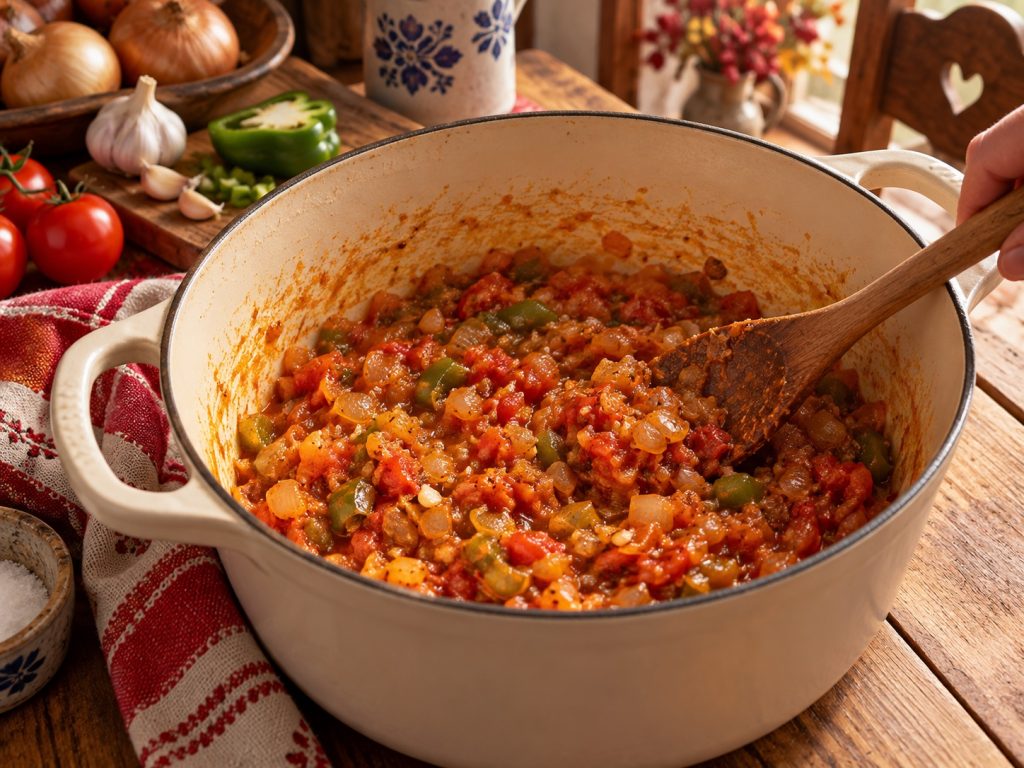
    Cook onions in the same pot over medium-low 12–15 minutes until gold and soft. Add garlic, tomato, and pepper; cook 5 minutes until moisture reduces.

    Build the onion base
    Cook onions in the same pot over medium-low 12–15 minutes until gold and soft. Add garlic, tomato, and pepper; cook 5 minutes until moisture reduces.

    3. Add paprika off heat and braise

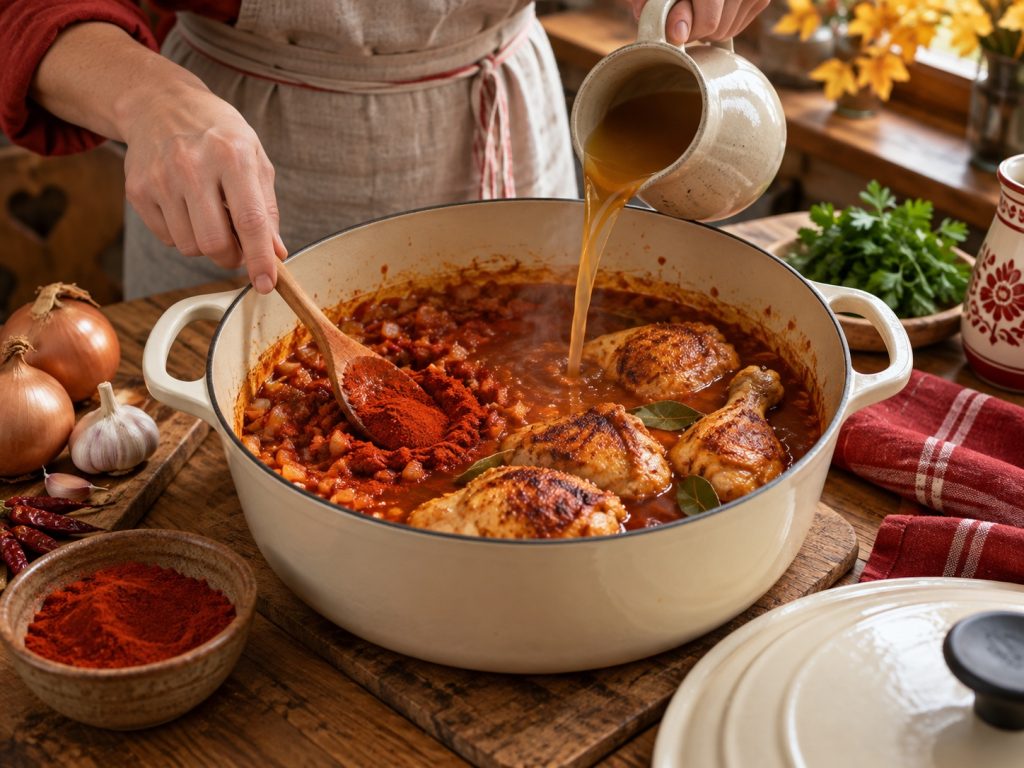
    Take pot off heat 30 seconds, stir in paprika for 20 seconds. Add stock and chicken; partially cover and simmer 30–35 minutes until chicken reaches 165°F.

    Add paprika off heat and braise
    Take pot off heat 30 seconds, stir in paprika for 20 seconds. Add stock and chicken; partially cover and simmer 30–35 minutes until chicken reaches 165°F.

    4. Temper sour cream and finish

    Mix sour cream and flour. Gradually whisk in ⅔ cup hot sauce to temper. Remove chicken, stir mixture into sauce, and thicken 3–4 minutes without boiling; return chicken.

    Temper sour cream and finish
    Mix sour cream and flour. Gradually whisk in ⅔ cup hot sauce to temper. Remove chicken, stir mixture into sauce, and thicken 3–4 minutes without boiling; return chicken.

    Texture and doneness cues

    Chicken is juicy at 165°F; sauce lightly coats a spoon without splitting, and paprika smells sweet, not bitter.

    Mistakes, substitutions, and measurements

    Full-fat yogurt can replace sour cream but do not boil. Use cornstarch for gluten-free thickening. Contains dairy; check stock.

    Serving, storage, and allergens

    Serve with nokedli or broad noodles. Chill within 2 hours for 3–4 days; reheat gently to 165°F without boiling. Freeze 2 months; dairy may split slightly.

    Frequently asked questions

    Why is paprika bitter?

    It fried in very hot fat; remove pot from heat before stirring it in.

    Why did sauce split?

    Sour cream was cold or boiled; temper it first.

    Can I use breast?

    Yes, but cook for less time and stop at 165°F.

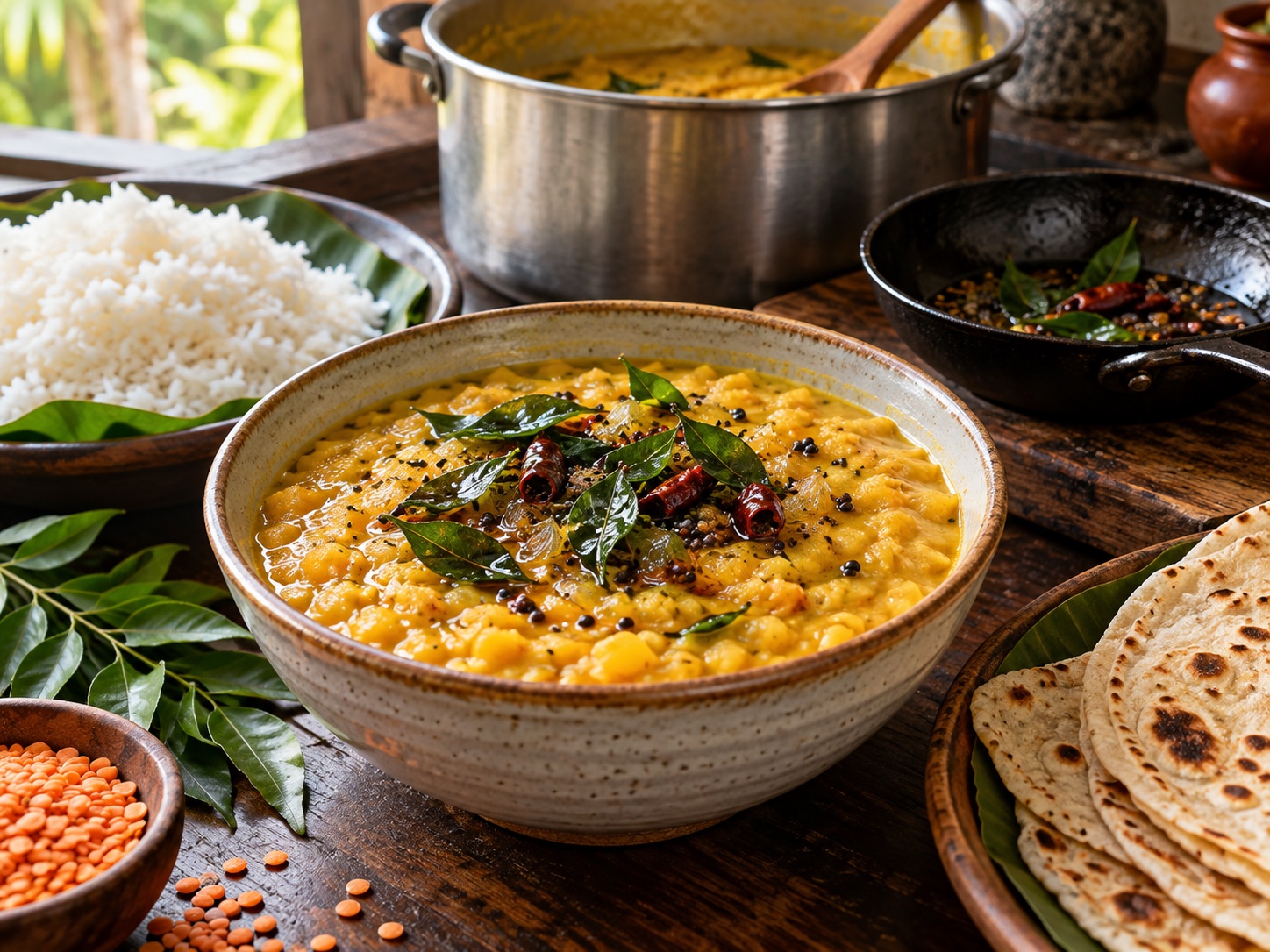
  • Sri Lankan Red Lentil Dhal: Creamy Coconut Parippu

    Sri Lankan Red Lentil Dhal: Creamy Coconut Parippu

    Dhal is a Sri Lankan staple served with rice, string hoppers, and many mains, commonly using masoor lentils and coconut milk.

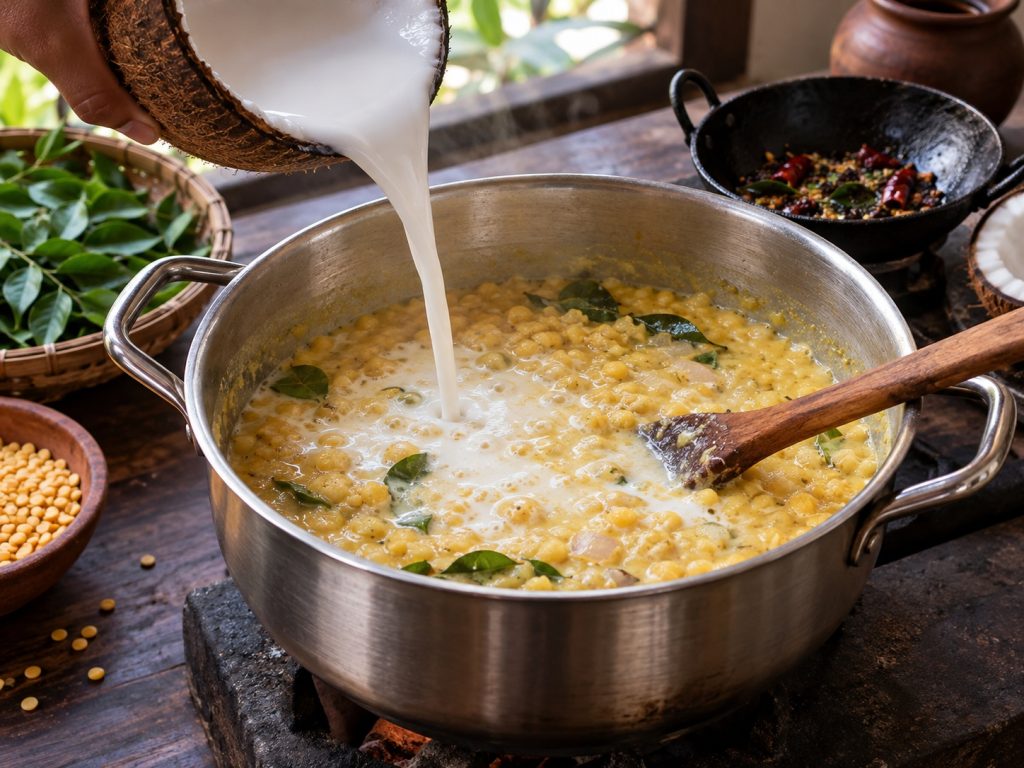
    Softening lentils first and adding coconut milk later reduces scorching and splitting.

    Why this method works

    • Rinsing removes excess starch.
    • A gentle simmer gives creamy but textured lentils.
    • Separate tempering preserves spice aroma.

    Before you start

    Use a medium pot, small skillet, and fine sieve.

    Rinse lentils 3–4 times until water is mostly clear.

    Cool a large batch in shallow containers within 2 hours.

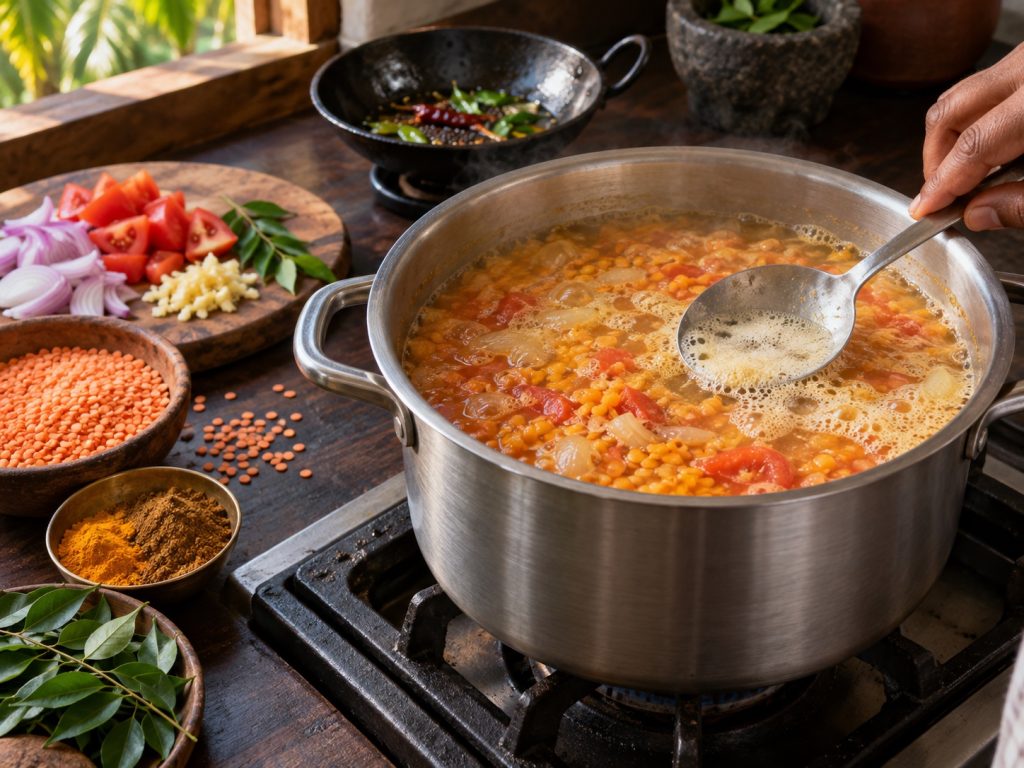
    Gently cook the lentils
    Simmer lentils, water, half the onion, garlic, turmeric, curry powder, and tomato. Skim foam; cook gently 15–18 minutes until soft and beginning to break down.

    Step-by-step method

    1. Gently cook the lentils

    Simmer lentils, water, half the onion, garlic, turmeric, curry powder, and tomato. Skim foam; cook gently 15–18 minutes until soft and beginning to break down.

    2. Finish with coconut milk

    Add coconut milk and salt. Simmer very gently 7–10 minutes; loosen with ¼ cup hot water if needed.

    Finish with coconut milk
    Add coconut milk and salt. Simmer very gently 7–10 minutes; loosen with ¼ cup hot water if needed.

    3. Make the spice tempering

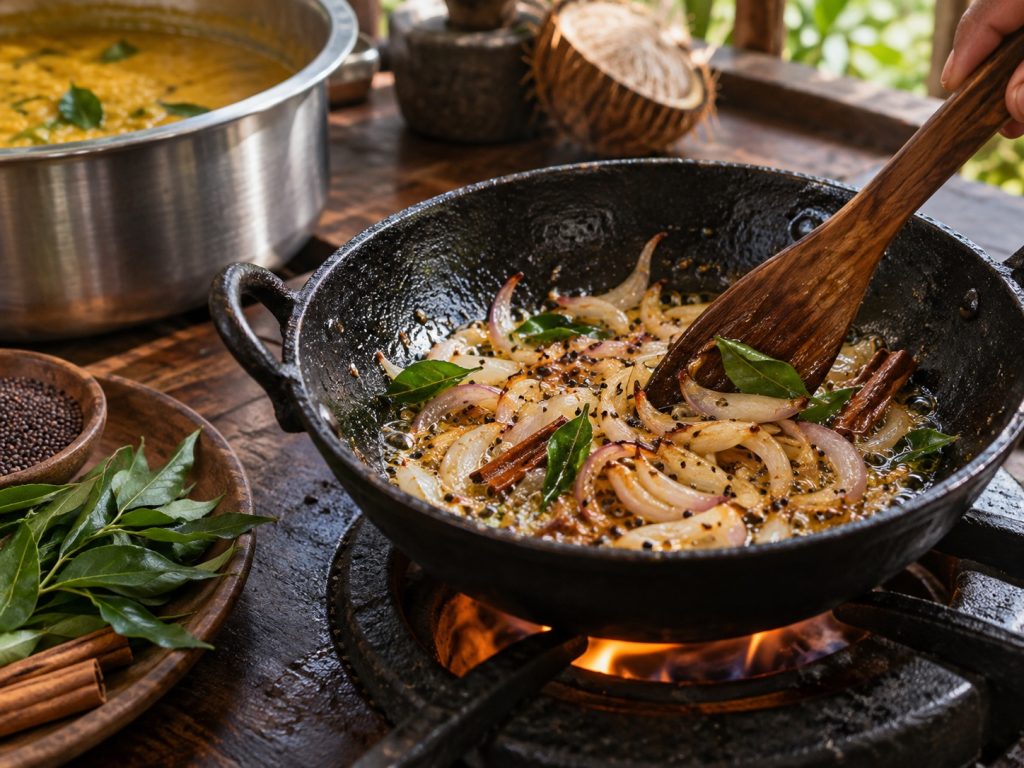
    Heat oil in a small skillet. When mustard seeds pop, add remaining onion, curry leaves, and cinnamon; cook 5–7 minutes until golden.

    Make the spice tempering
    Heat oil in a small skillet. When mustard seeds pop, add remaining onion, curry leaves, and cinnamon; cook 5–7 minutes until golden.

    4. Combine and balance

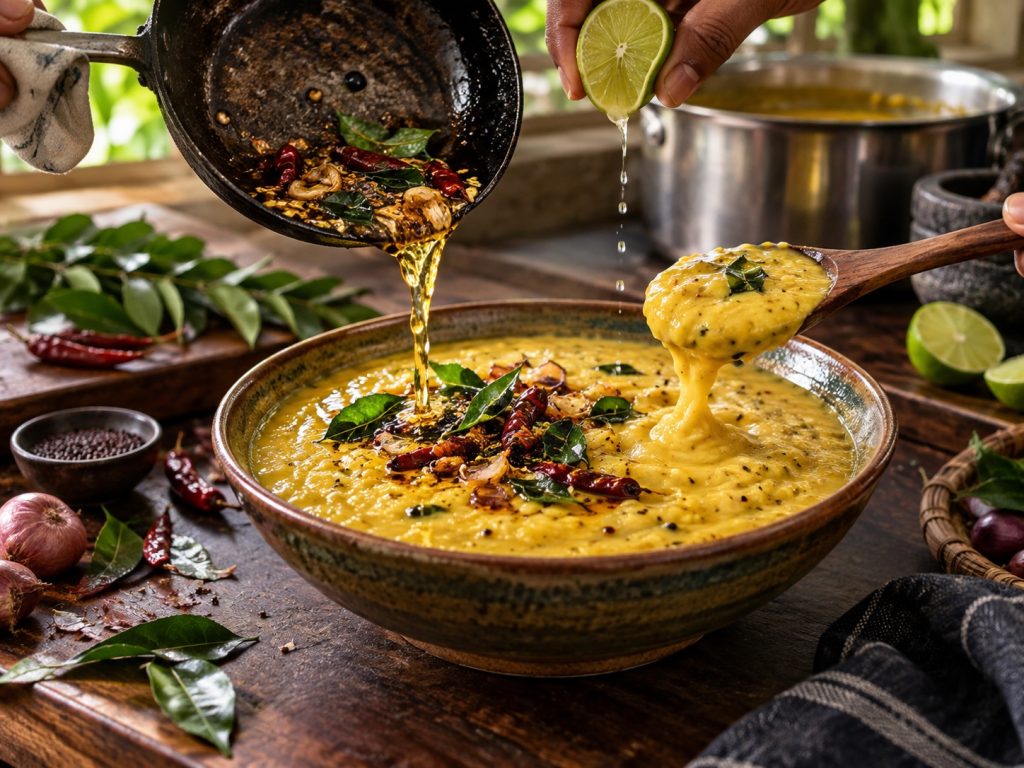
    Pour tempering into lentils and stir. Add lime; adjust with hot water until it flows heavily from a spoon but spreads on the plate.

    Combine and balance
    Pour tempering into lentils and stir. Add lime; adjust with hot water until it flows heavily from a spoon but spreads on the plate.

    Texture and doneness cues

    Lentils are fully soft, sauce creamy and ribboning from a spoon, with no coconut oil puddles.

    Mistakes, substitutions, and measurements

    If curry leaves are unavailable use lime zest, though flavor differs. Contains coconut; mustard may be an allergen. Naturally vegan and gluten-free.

    Serving, storage, and allergens

    Serve with rice, roti, or string hoppers. Cool within 2 hours; refrigerate 4 days or freeze 3 months. Reheat to a boil/165°F.

    Frequently asked questions

    Why did it get too thick?

    Lentils absorb liquid as they sit; add hot water gradually.

    Why did coconut split?

    It boiled too hard; simmer gently after adding.

    Are curry leaves essential?

    They provide the signature aroma; lime zest is only an adaptation.

  • Danish Cinnamon Rolls (Kanelsnegle): Soft, Defined Swirls

    Danish Cinnamon Rolls (Kanelsnegle): Soft, Defined Swirls

    Snegl is a classic Danish cinnamon-roll-style pastry; remonce is the butter-sugar filling.

    Cool filling and tucking the strip end underneath prevent the coils from unraveling.

    Why this method works

    • A small milk-flour gel keeps rolls soft the next day.
    • Room-temperature filling leaks less.
    • Spacing on the sheet browns edges evenly.

    Before you start

    Use a mixer or bowl, rolling pin, sheet, and thermometer.

    Butter should be soft, not melted; milk should not exceed 100°F.

    Use pasteurized egg/dairy products.

    Make milk gel and dough
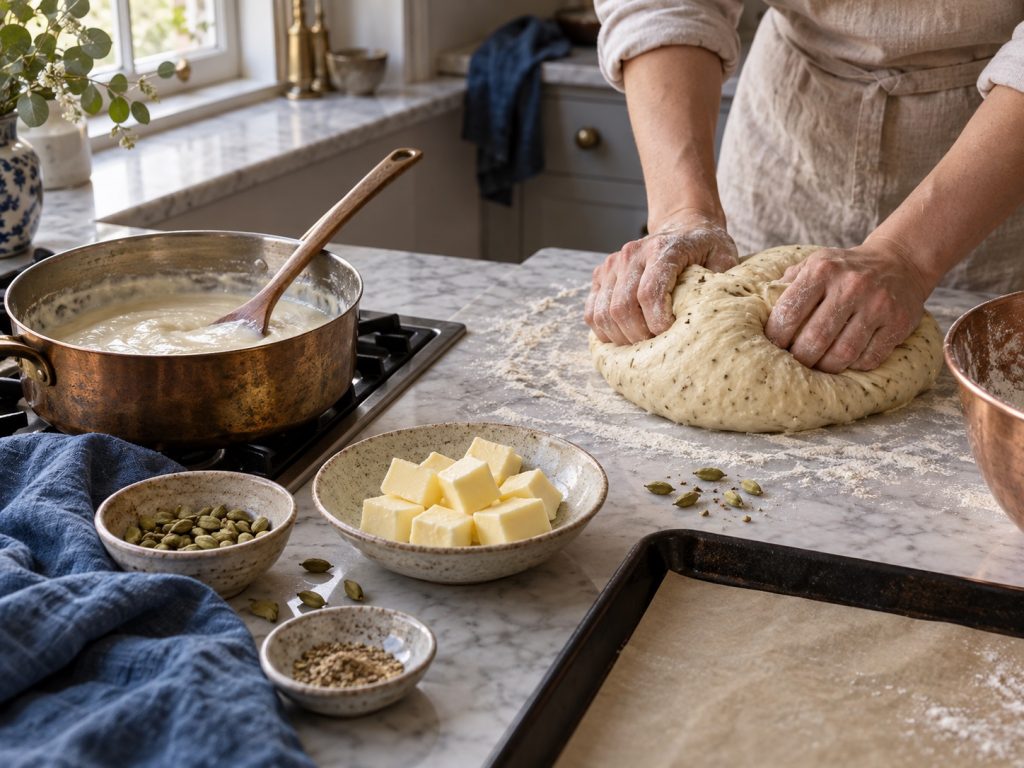
    Whisk ¼ cup flour with ½ cup milk over heat until thick; cool. Knead remaining flour/milk, yeast, sugar, egg, cardamom, salt, and gel 8 minutes; add 6 tbsp butter and knead 5 more. Rise 60 minutes.

    Step-by-step method

    1. Make milk gel and dough

    Whisk ¼ cup flour with ½ cup milk over heat until thick; cool. Knead remaining flour/milk, yeast, sugar, egg, cardamom, salt, and gel 8 minutes; add 6 tbsp butter and knead 5 more. Rise 60 minutes.

    2. Roll and spread remonce

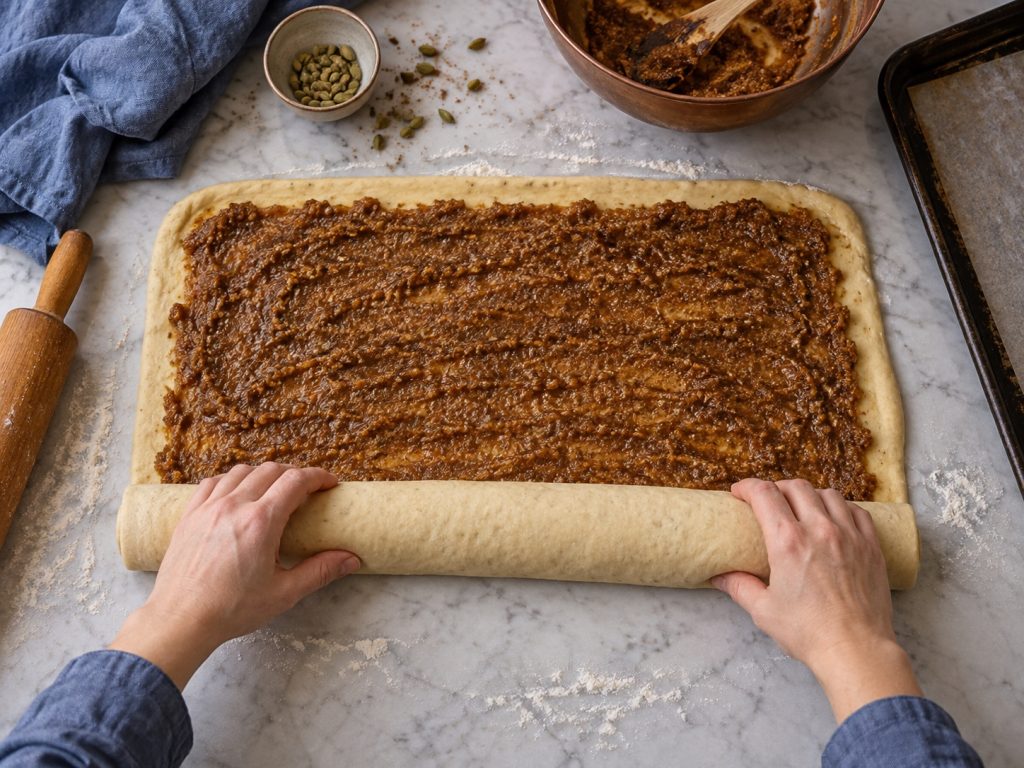
    Mix 8 tbsp soft butter, brown sugar, and cinnamon. Roll dough to 18×14 inches, spread thinly and evenly, then roll tightly from the long edge.

    Roll and spread remonce
    Mix 8 tbsp soft butter, brown sugar, and cinnamon. Roll dough to 18×14 inches, spread thinly and evenly, then roll tightly from the long edge.

    3. Cut and tuck the ends

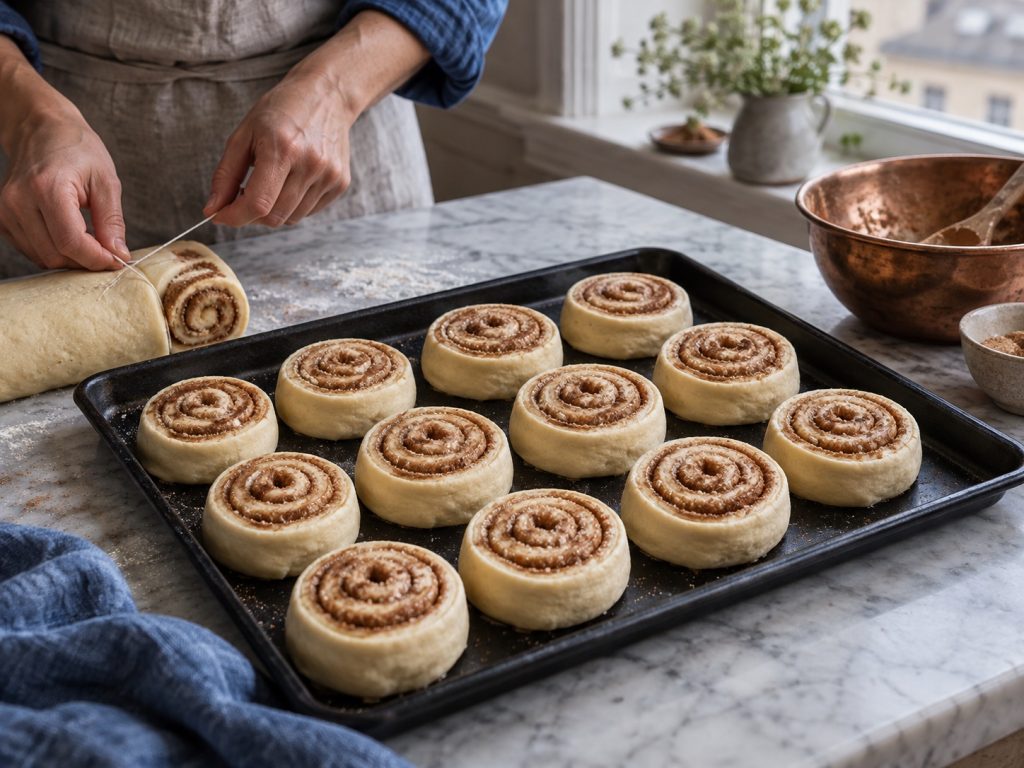
    Cut into 12 equal pieces with floss or a sharp knife. Stretch each outer tail slightly and tuck it underneath; space on a sheet.

    Cut and tuck the ends
    Cut into 12 equal pieces with floss or a sharp knife. Stretch each outer tail slightly and tuck it underneath; space on a sheet.

    4. Proof and bake golden

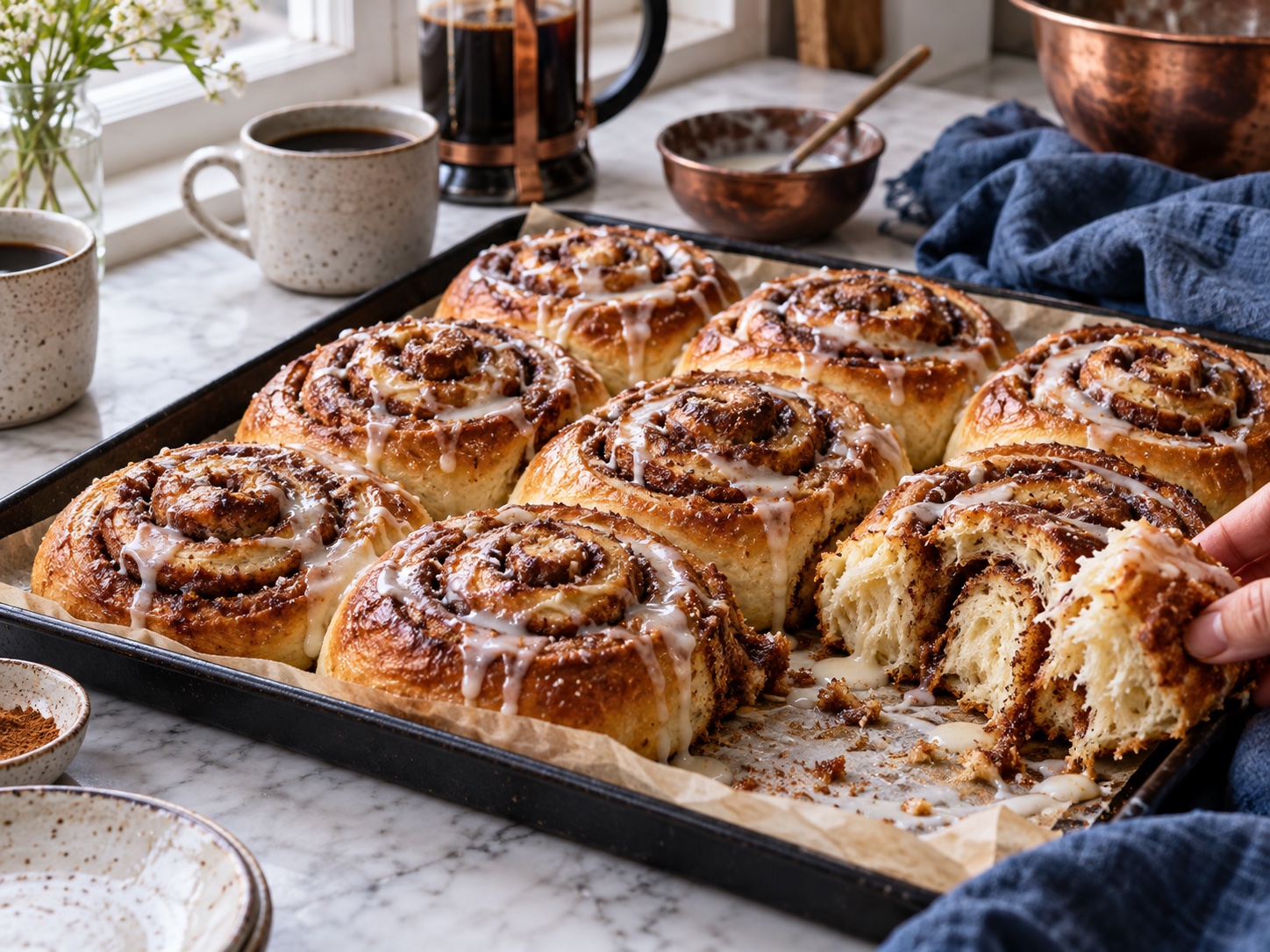
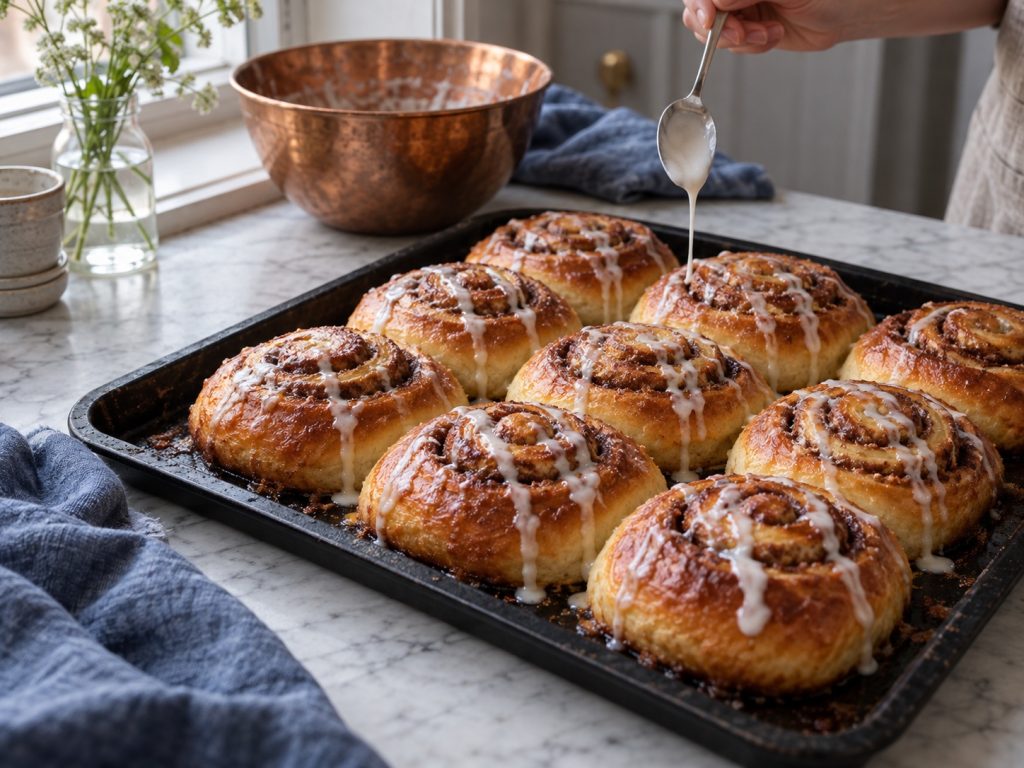
    Cover and proof 35–45 minutes. Bake at 375°F for 17–20 minutes until golden and center is 190–194°F. After 10 minutes, drizzle a thin icing.

    Proof and bake golden
    Cover and proof 35–45 minutes. Bake at 375°F for 17–20 minutes until golden and center is 190–194°F. After 10 minutes, drizzle a thin icing.

    Texture and doneness cues

    Rolls have defined swirls, golden edges, and a soft but baked center at 190–194°F.

    Mistakes, substitutions, and measurements

    Cardamom is optional. Plant milk and vegan block work; ¼ cup applesauce can replace egg with a texture change. Contains gluten, dairy, egg.

    Serving, storage, and allergens

    Serve with coffee. Cover within 2 hours; keep 1 day at room temperature, 3 days refrigerated, or freeze 2 months. Reheat at 325°F for 6–8 minutes.

    Frequently asked questions

    Why did rolls unravel?

    The tail was not tucked underneath or the log was rolled loosely.

    Why did filling leak?

    Butter was melted or dough warm; use soft but cool filling.

    Can they proof overnight?

    Refrigerate after shaping, then stand 30 minutes at room temperature before baking.

  • Indonesian Beef Rendang: Dark, Tender, Never Burnt

    Indonesian Beef Rendang: Dark, Tender, Never Burnt

    Rendang comes from the Minangkabau cooking tradition of West Sumatra. This home version moves deliberately from saucy kalio to a dark, dry rendang.

    Frequent stirring and lower heat in the final hour prevent scorching as coconut solids caramelize.

    Why this method works

    • A wide pot speeds evaporation.
    • Large beef cubes resist drying during the long cook.
    • Low heat after oil separation deepens color without burning.

    Before you start

    Use a wide heavy pot, blender, and thermometer.

    Cut beef into 1½–2-inch chunks and bruise lemongrass.

    Beef is safe at 145°F with rest, but long cooking is needed for tenderness.

    Blend the spice paste
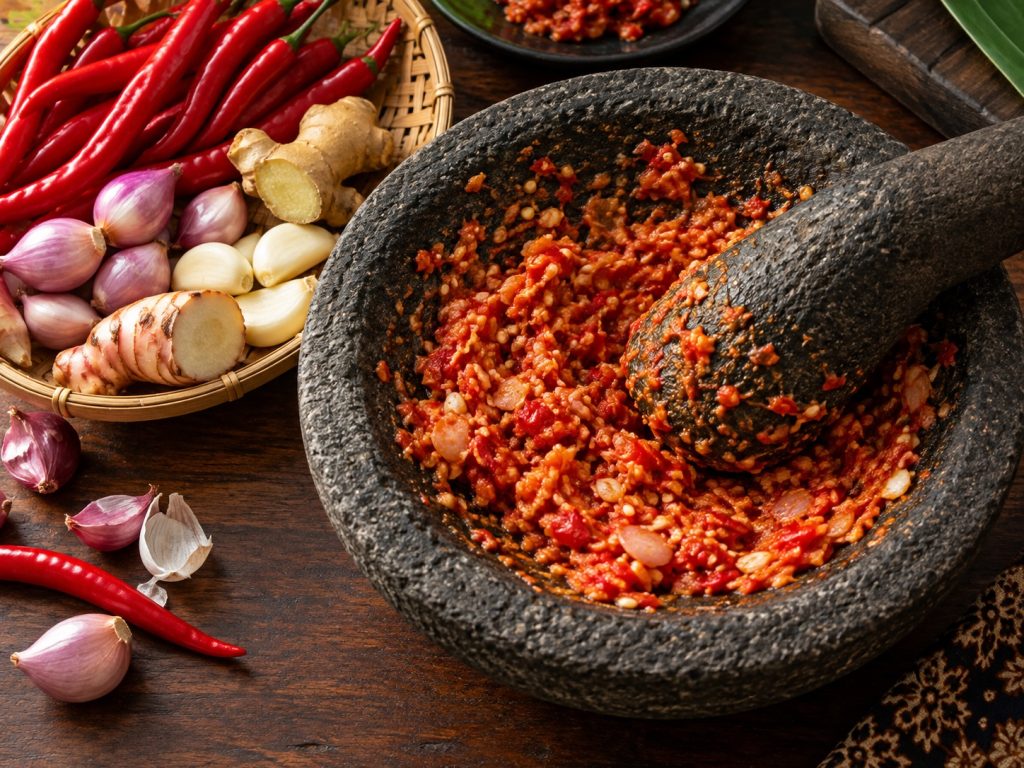
    Blend shallots, garlic, ginger, galangal, coriander, and turmeric with ¼ cup water. Cook in a wide pot 5 minutes until fragrant.

    Step-by-step method

    1. Blend the spice paste

    Blend shallots, garlic, ginger, galangal, coriander, and turmeric with ¼ cup water. Cook in a wide pot 5 minutes until fragrant.

    2. Simmer beef in coconut milk

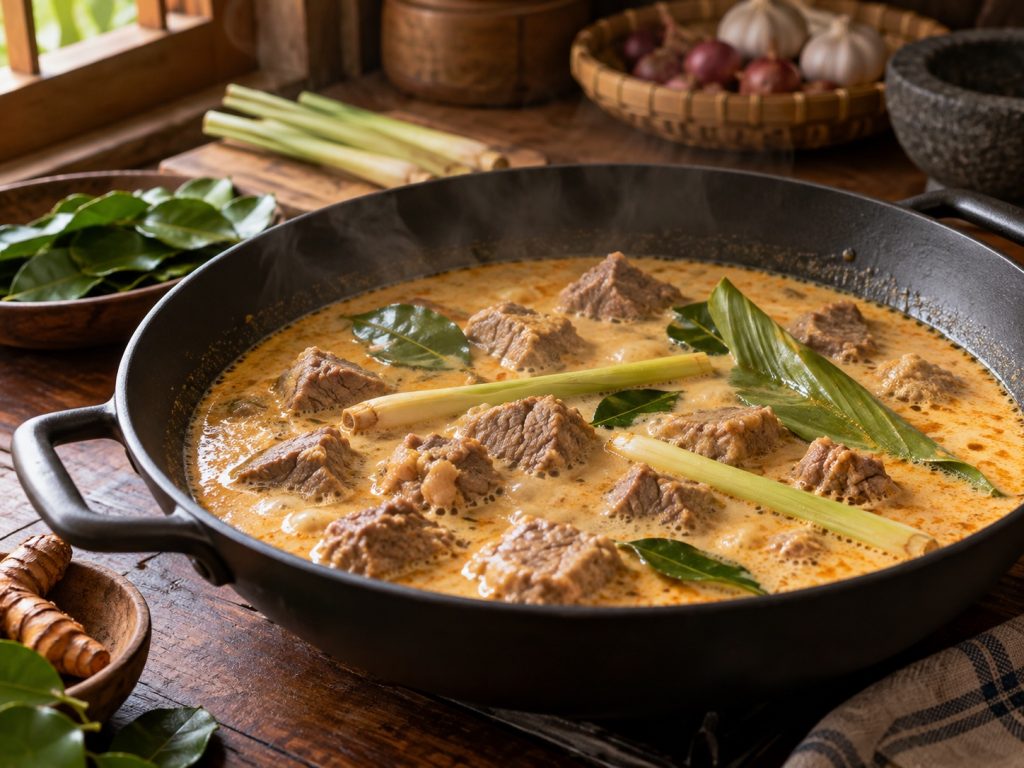
    Add beef, coconut milk, lemongrass, lime leaves, sugar, and salt. Bring to a gentle simmer; cook uncovered over medium-low 90 minutes, stirring occasionally.

    Simmer beef in coconut milk
    Add beef, coconut milk, lemongrass, lime leaves, sugar, and salt. Bring to a gentle simmer; cook uncovered over medium-low 90 minutes, stirring occasionally.

    3. Reduce slowly

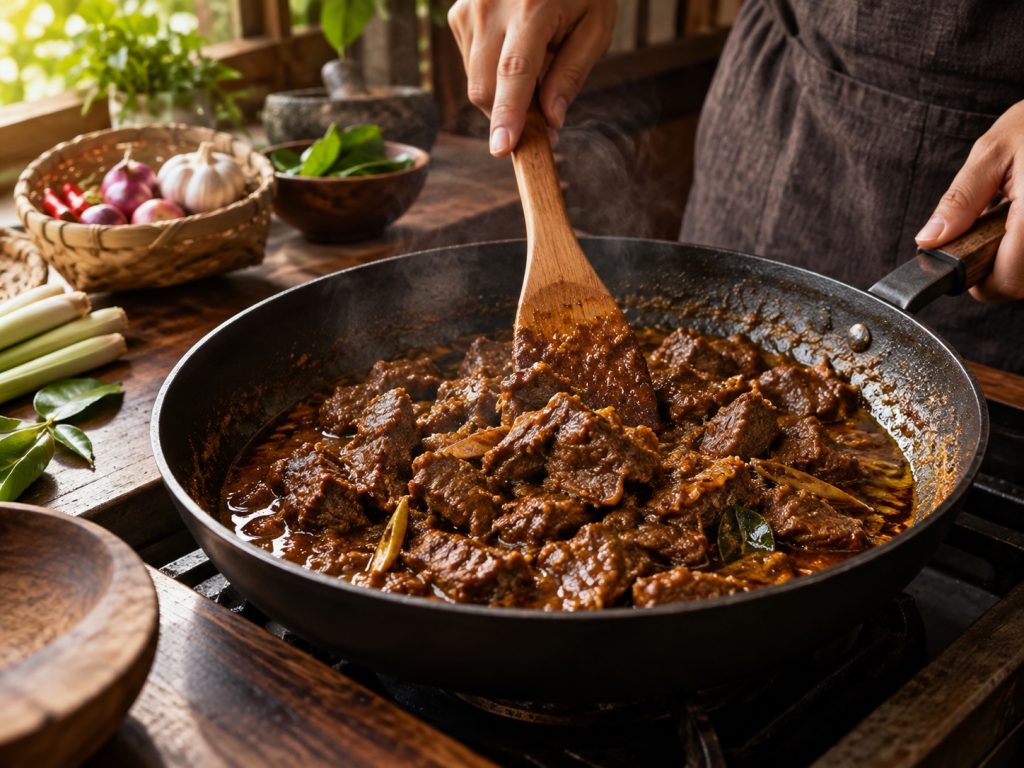
    As sauce thickens, lower heat. Cook 60–75 minutes more, scraping the base every 5–10 minutes, until beef pulls apart easily.
    Reduce slowly
    As sauce thickens, lower heat. Cook 60–75 minutes more, scraping the base every 5–10 minutes, until beef pulls apart easily.

    4. Fry gently after oil separates

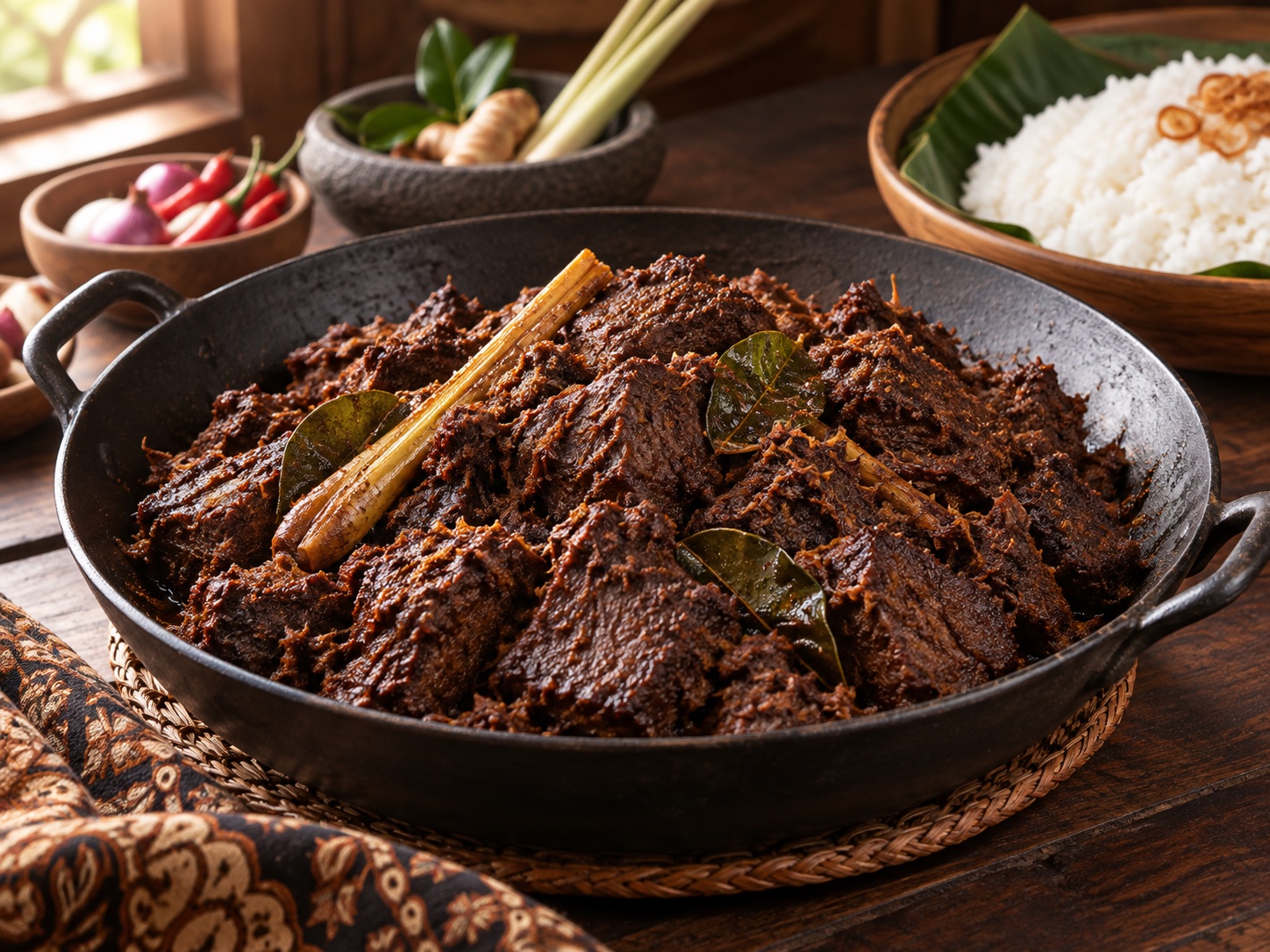
    When oil separates and paste clings to beef, cook on low 15–25 minutes, stirring almost constantly. Stop at deep brown and moist-dry; rest.

    Fry gently after oil separates
    When oil separates and paste clings to beef, cook on low 15–25 minutes, stirring almost constantly. Stop at deep brown and moist-dry; rest.

    Texture and doneness cues

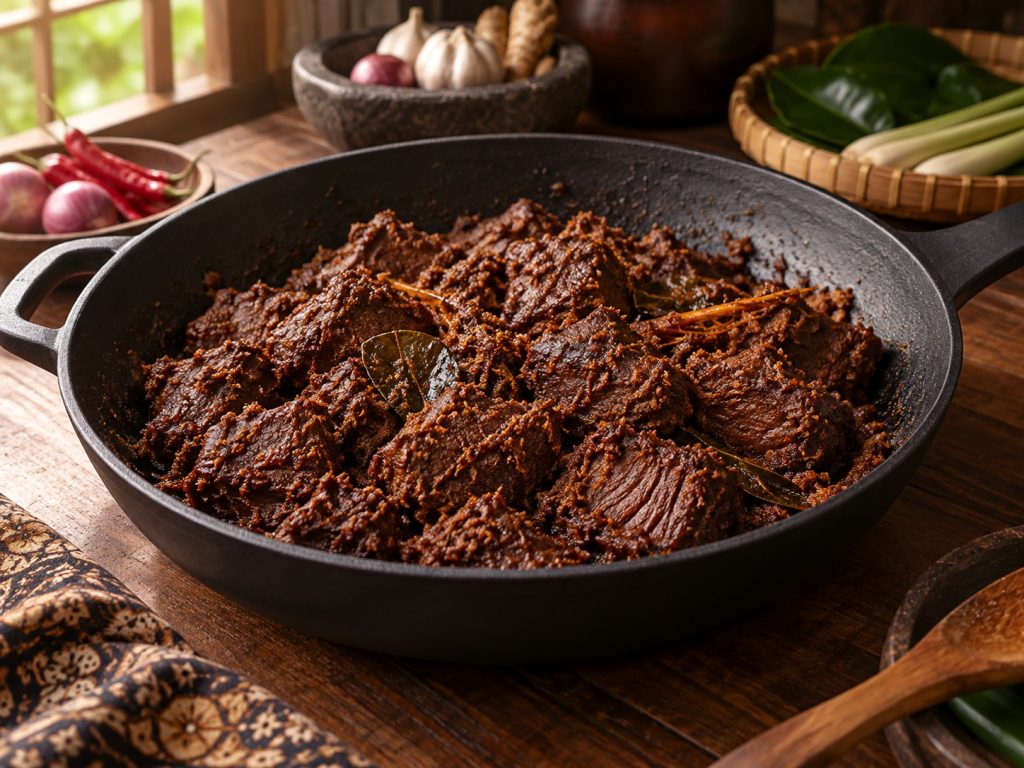
    Beef pulls apart with a fork; paste is dry-glossy and clings with no watery sauce. Black specks or bitter aroma mean scorching.

    Mistakes, substitutions, and measurements

    Replace galangal with extra ginger plus 1 tsp lime zest; replace makrut leaves with lime zest. Contains coconut; check any stock for gluten. 1 cup=240 ml.

    Serving, storage, and allergens

    Serve with rice and cucumber. Cool within 2 hours; refrigerate 3–4 days or freeze 3 months. Reheat with a splash of water to 165°F.

    Frequently asked questions

    Why is it not darkening?

    The pot may be narrow or heat too low; keep it uncovered and use a wide pot.

    Why did it burn?

    Stirring was too infrequent after oil separation; lower heat at the end.

    Can I make it ahead?

    Yes; flavor deepens overnight.

  • Adjarian Khachapuri: Cheese Boat with Runny Egg

    Adjarian Khachapuri: Cheese Boat with Runny Egg

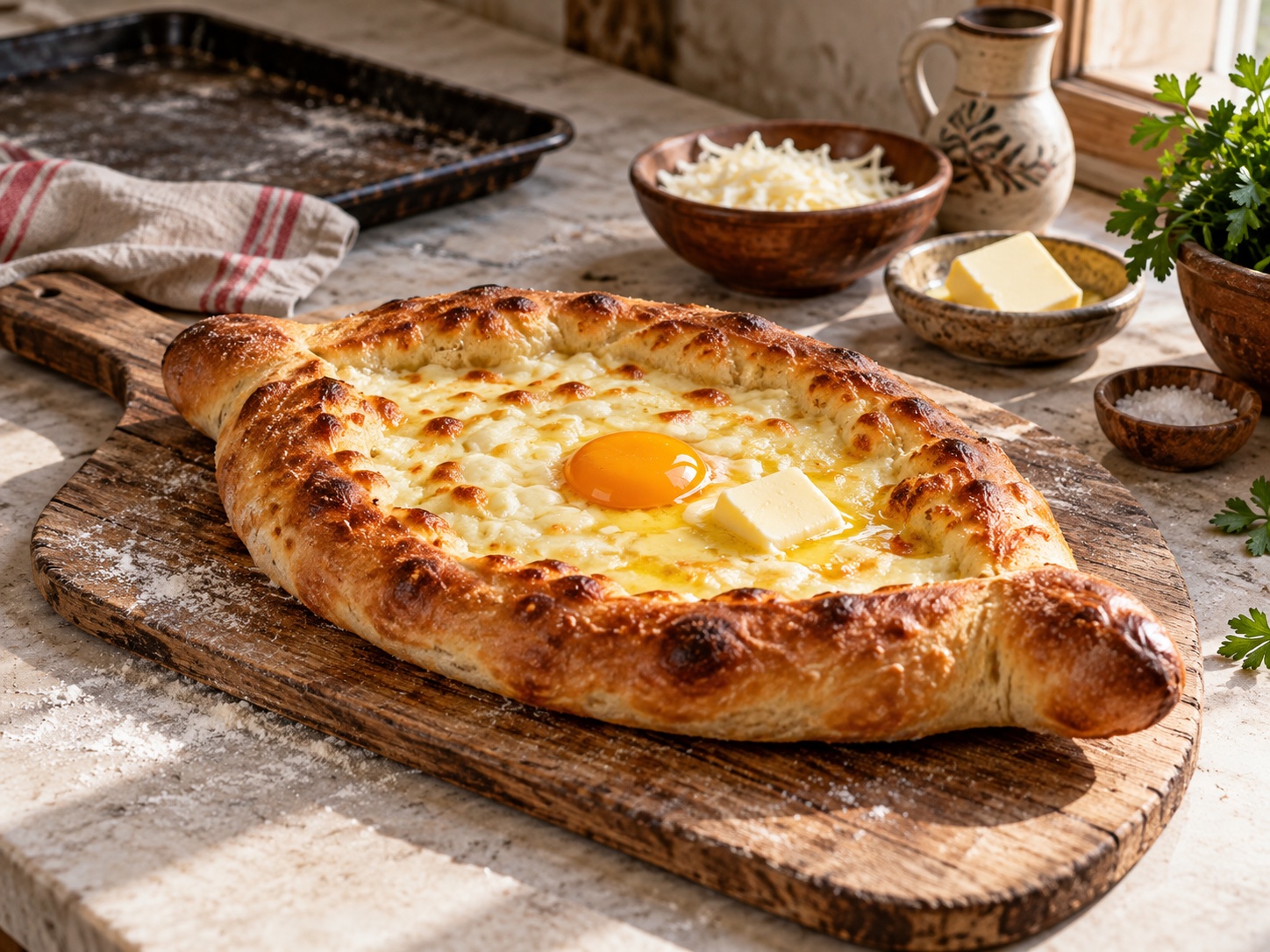
    Adjarian khachapuri is the boat-shaped cheese bread associated with Georgia’s Black Sea region of Adjara. Egg and butter are stirred into the hot cheese before eating.

    Where sulguni is unavailable, mozzarella plus feta is an accessible home adaptation for stretch and salinity.

    Why this method works

    • Two rises make dough extensible.
    • Rolling the rim over cheese locks the boat shape.
    • Adding egg late sets the white while preserving a runny yolk.

    Before you start

    Use a stone or inverted sheet, parchment, and brush; preheat to 475°F for 30 minutes.

    Dough should be soft and slightly tacky; excess flour toughens the rim.

    The white should be opaque; vulnerable diners should cook egg fully.

    Knead and proof soft dough
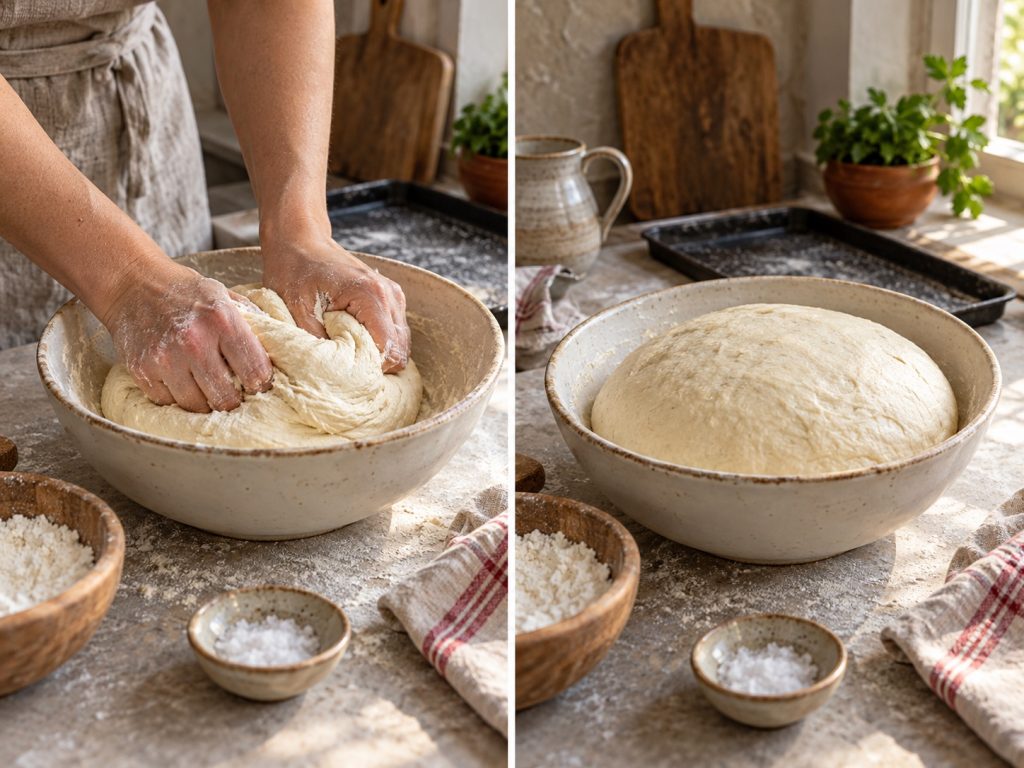
    Knead flour, yeast, sugar, salt, water, and oil 8–10 minutes. Cover and rise about 60 minutes until nearly doubled; divide in four and rest 15 minutes.

    Step-by-step method

    1. Knead and proof soft dough

    Knead flour, yeast, sugar, salt, water, and oil 8–10 minutes. Cover and rise about 60 minutes until nearly doubled; divide in four and rest 15 minutes.

    2. Shape cheese boats

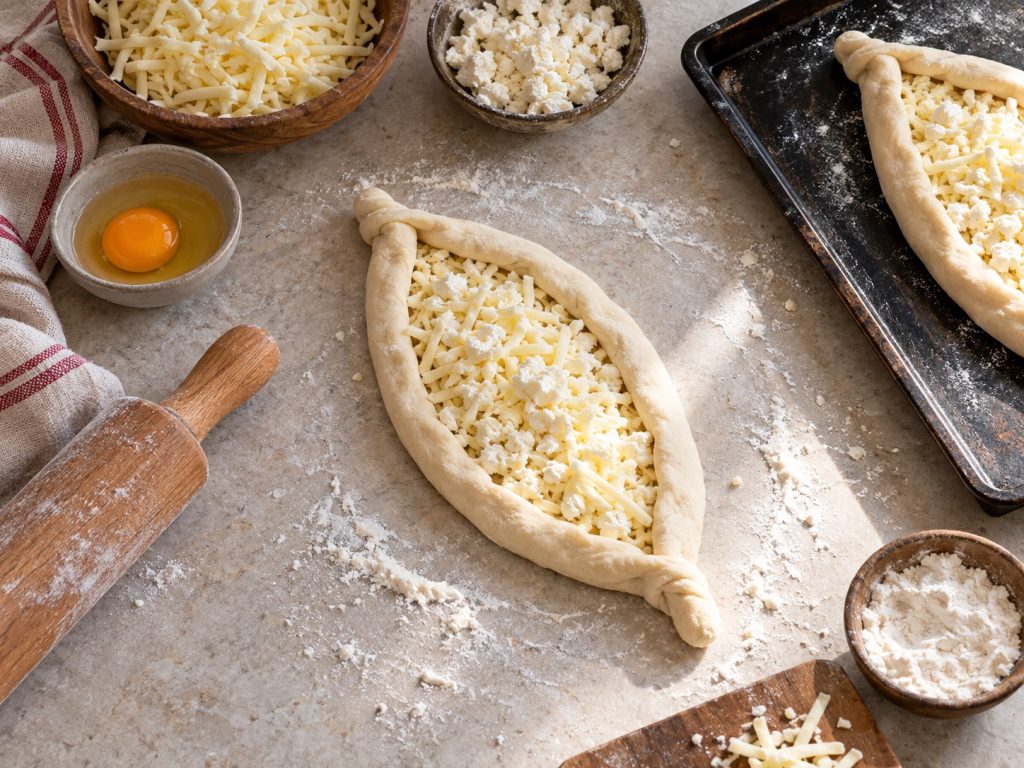
    Roll each into an 11×7-inch oval. Divide cheese; roll long edges inward over cheese and pinch ends into boats. Proof 20 minutes.

    Shape cheese boats
    Roll each into an 11×7-inch oval. Divide cheese; roll long edges inward over cheese and pinch ends into boats. Proof 20 minutes.

    3. Bake hot until browned

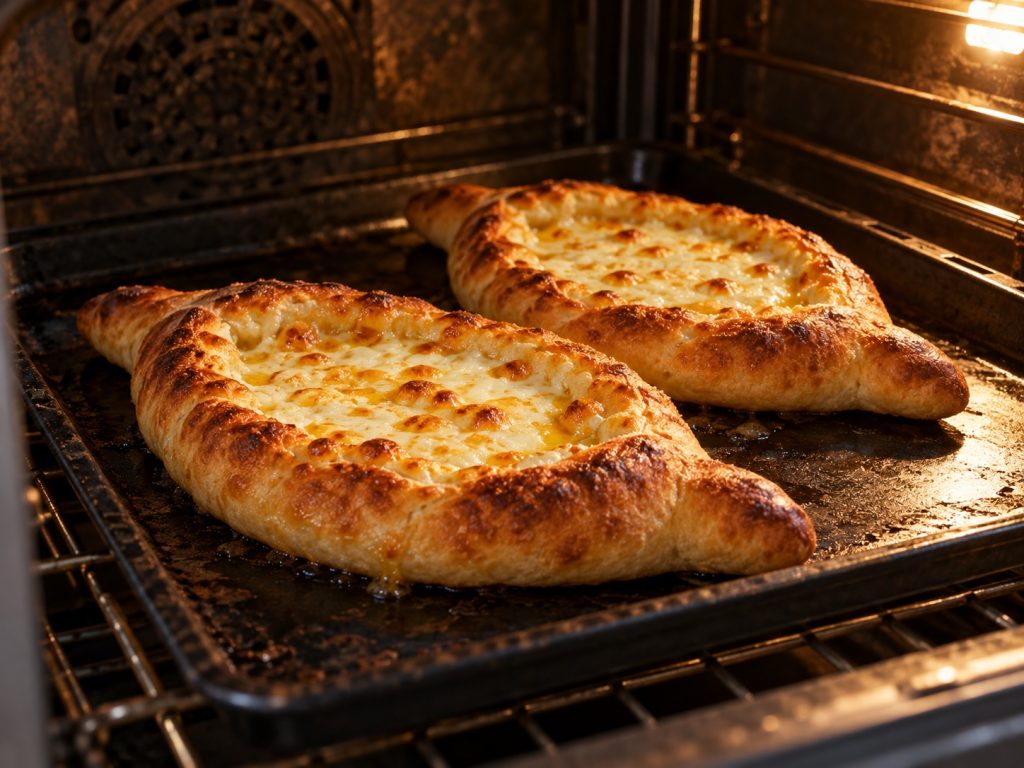
    Transfer on parchment to the hot surface. Bake at 475°F for 10–12 minutes until rims puff and turn deep gold.

    Bake hot until browned
    Transfer on parchment to the hot surface. Bake at 475°F for 10–12 minutes until rims puff and turn deep gold.

    4. Finish with egg and butter

    Open the center with a spoon and add one egg per boat. Bake 2–4 minutes until white is opaque and yolk runny; add butter and serve immediately.
    Finish with egg and butter
    Open the center with a spoon and add one egg per boat. Bake 2–4 minutes until white is opaque and yolk runny; add butter and serve immediately.
    Texture and doneness cues

    Rim is deep gold and airy, bottom dry, cheese bubbling, white opaque, and yolk runny.

    Mistakes, substitutions, and measurements

    Mozzarella-feta is a home adaptation for sulguni/Imeruli; low-moisture cheese works but is richer. Contains gluten, dairy, and egg.

    Serving, storage, and allergens

    Serve immediately. Chill leftovers within 2 hours for up to 2 days; freeze egg-free boats 1 month. Reheat at 400°F for 8–10 minutes.

    Frequently asked questions

    Why did the boat spread?

    Ends were not pinched firmly or dough was too soft; pinch twice.

    Why did the egg overcook?

    It went in too early; brown bread first, then add egg for 2–4 minutes.

    Why is cheese too salty?

    Use less feta and more mozzarella, or briefly soak feta.

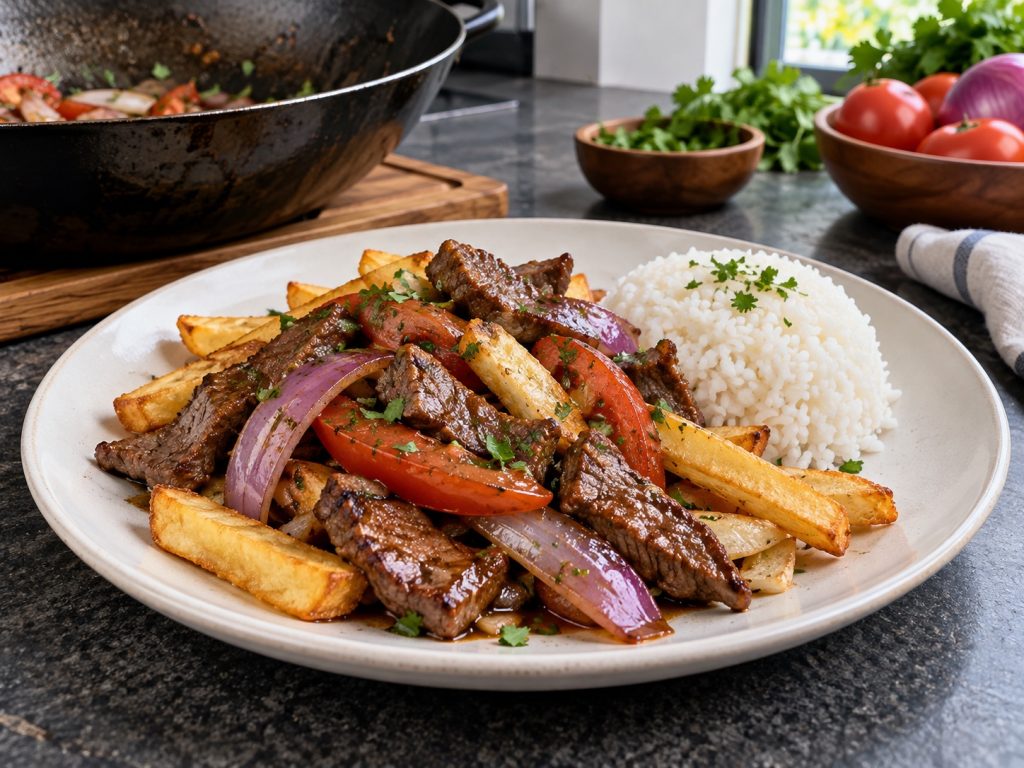
  • Peruvian Lomo Saltado: High Heat, No Watery Beef

    Peruvian Lomo Saltado: High Heat, No Watery Beef

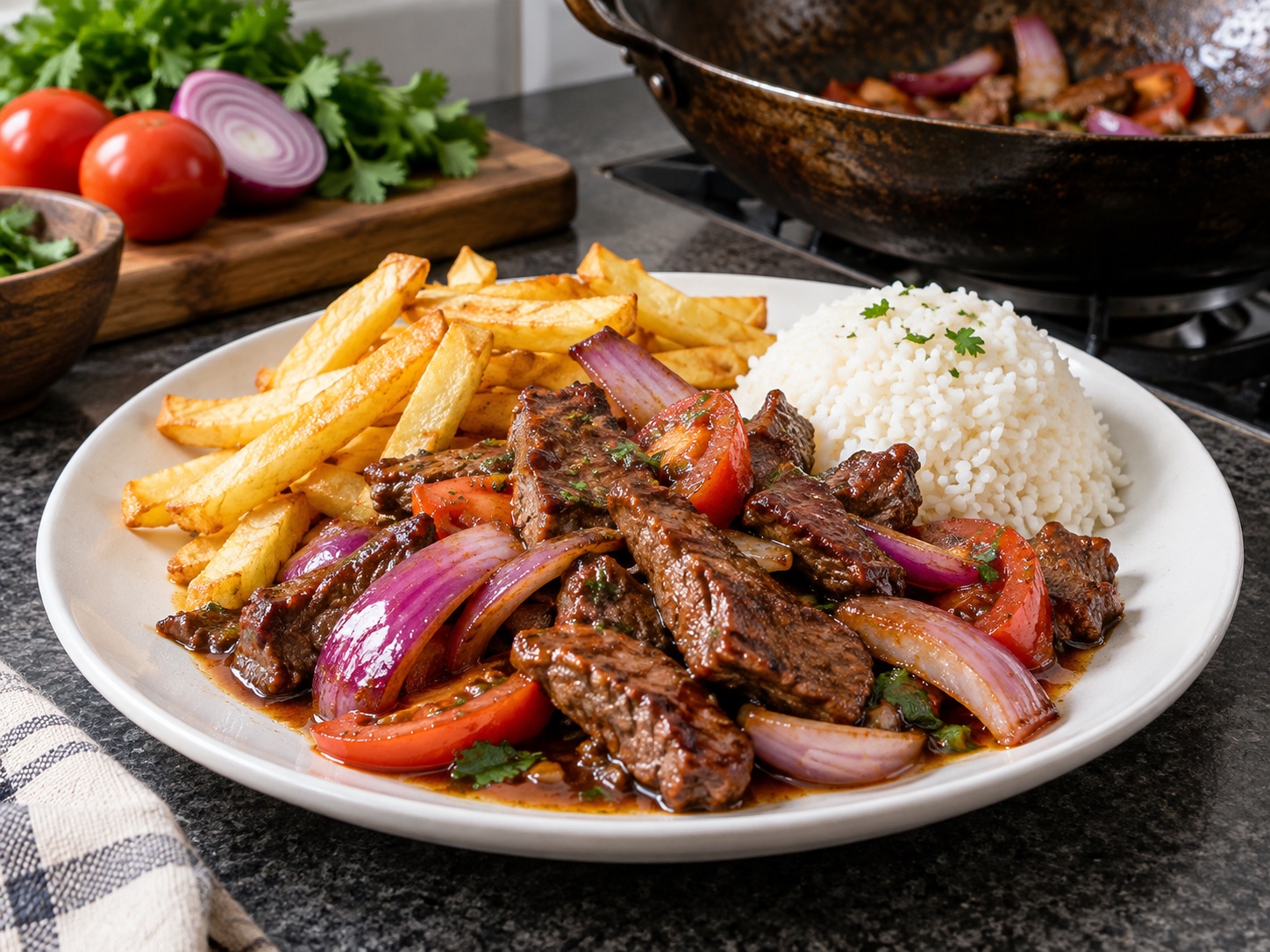
    Lomo saltado is a chifa dish born from Chinese stir-fry technique meeting Peruvian ingredients in the late 19th century.

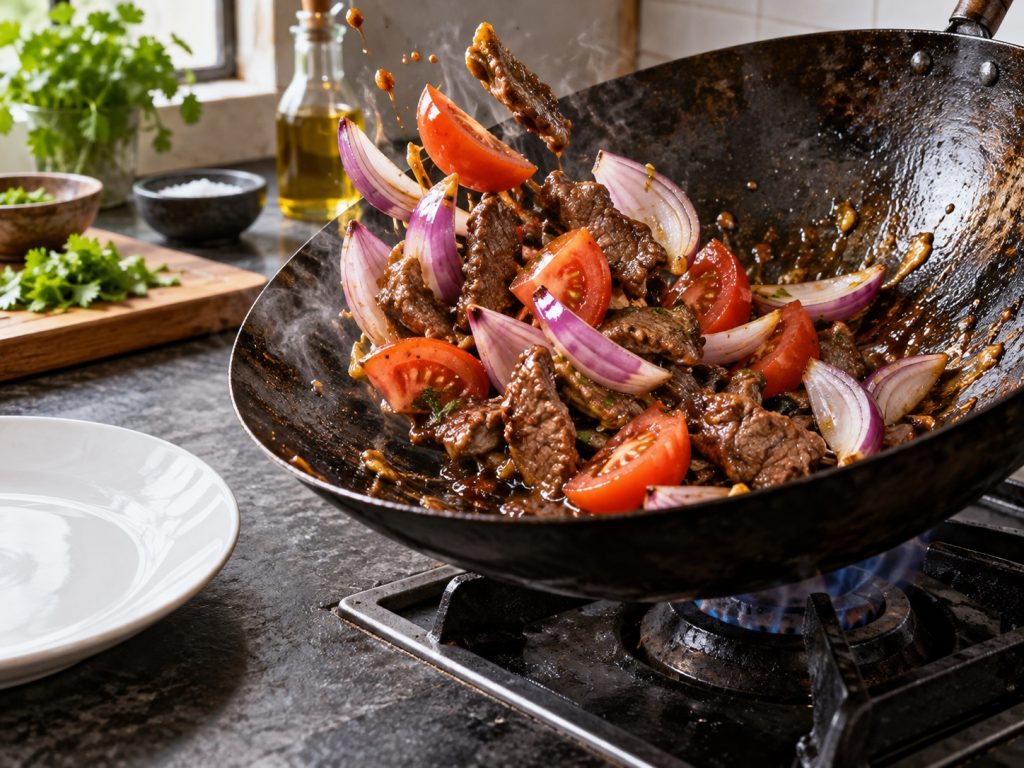
    At home, small batches, a very hot pan, and complete mise en place prevent steaming; tomato goes in last.

    Why this method works

    • Dry beef and an uncrowded pan create crust.
    • Thick onion wedges stay crisp.
    • Soy-vinegar sauce is reduced briefly at the end.

    Before you start

    Use a wok/cast-iron skillet, tongs, two plates, and thermometer; prep everything first.

    Pat beef dry and cook in two batches.

    Whole beef cuts are safe at 145°F with a 3-minute rest.

    Cook the fries
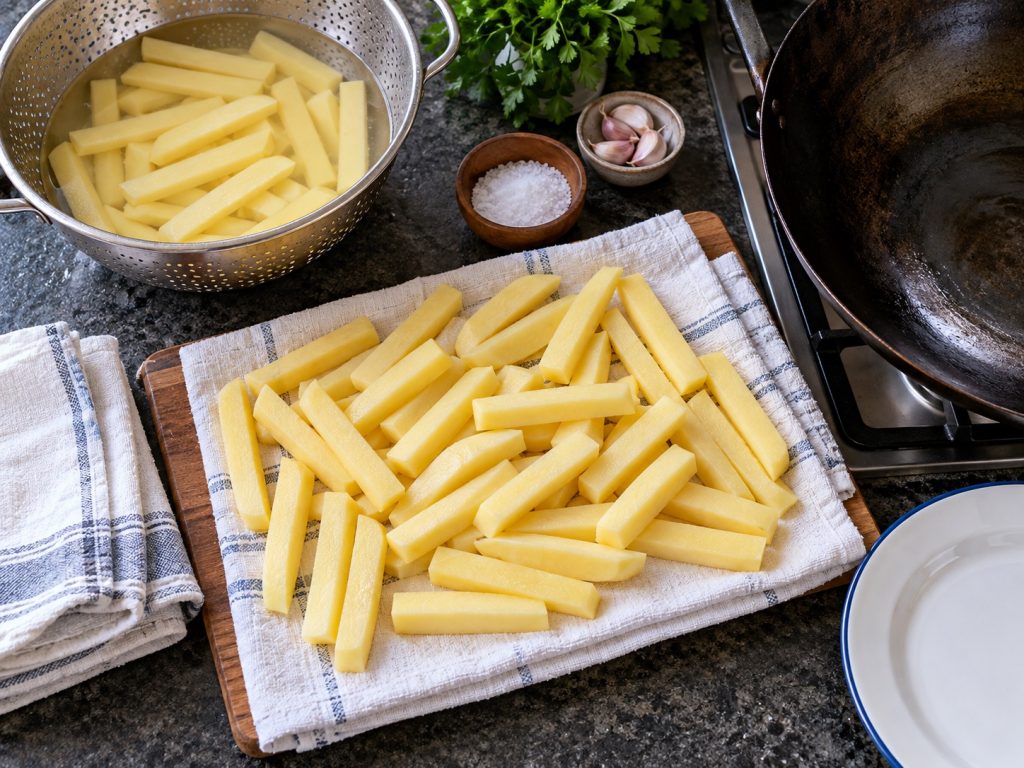
    Cut potatoes into ⅜-inch fries; roast with oil and salt at 450°F for 25–30 minutes, or fry safely. Keep rice hot.

    Step-by-step method

    1. Cook the fries

    Cut potatoes into ⅜-inch fries; roast with oil and salt at 450°F for 25–30 minutes, or fry safely. Keep rice hot.

    2. Sear beef in batches

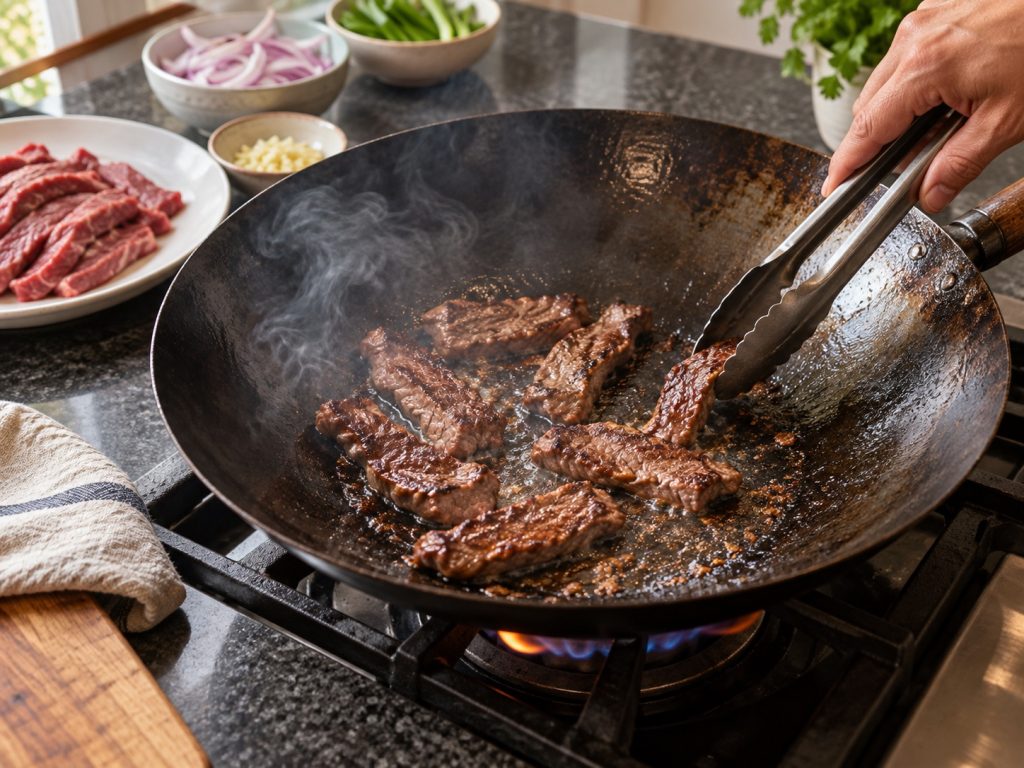
    Cut beef into ½×2-inch strips and dry well; season with cumin, salt, and pepper. Sear in two batches in a smoking-hot oiled pan, 45–60 seconds per side; remove.

    Sear beef in batches
    Cut beef into ½×2-inch strips and dry well; season with cumin, salt, and pepper. Sear in two batches in a smoking-hot oiled pan, 45–60 seconds per side; remove.

    3. Flash-cook onion and tomato

    Cook onion in the same pan 60–90 seconds and garlic 20 seconds. Add tomato for only 30–45 seconds so wedges hold shape.

    Flash-cook onion and tomato
    Cook onion in the same pan 60–90 seconds and garlic 20 seconds. Add tomato for only 30–45 seconds so wedges hold shape.

    4. Reduce sauce and serve

    Return beef; add soy and vinegar and toss 30–60 seconds until glossy. Fold in fries and cilantro at the last moment; serve with rice.

    Reduce sauce and serve
    Return beef; add soy and vinegar and toss 30–60 seconds until glossy. Fold in fries and cilantro at the last moment; serve with rice.

    Texture and doneness cues

    Beef is browned but juicy, onion crisp, tomato intact, and sauce glossy with no puddle.

    Mistakes, substitutions, and measurements

    Use a mild fresh chile if ají amarillo is unavailable. Gluten-free tamari removes wheat but still contains soy. 1 tbsp=15 ml.

    Serving, storage, and allergens

    Best fresh. Separate and chill within 2 hours for 3–4 days; reheat beef and fries separately to 165°F. Freezing softens fries.

    Frequently asked questions

    Why did beef steam?

    The pan was not hot enough or overcrowded; use two batches.

    Why did tomato collapse?

    It went in too early; use thick wedges for the final 30–45 seconds.

    Will fries soften?

    Yes; fold them in only at serving time.

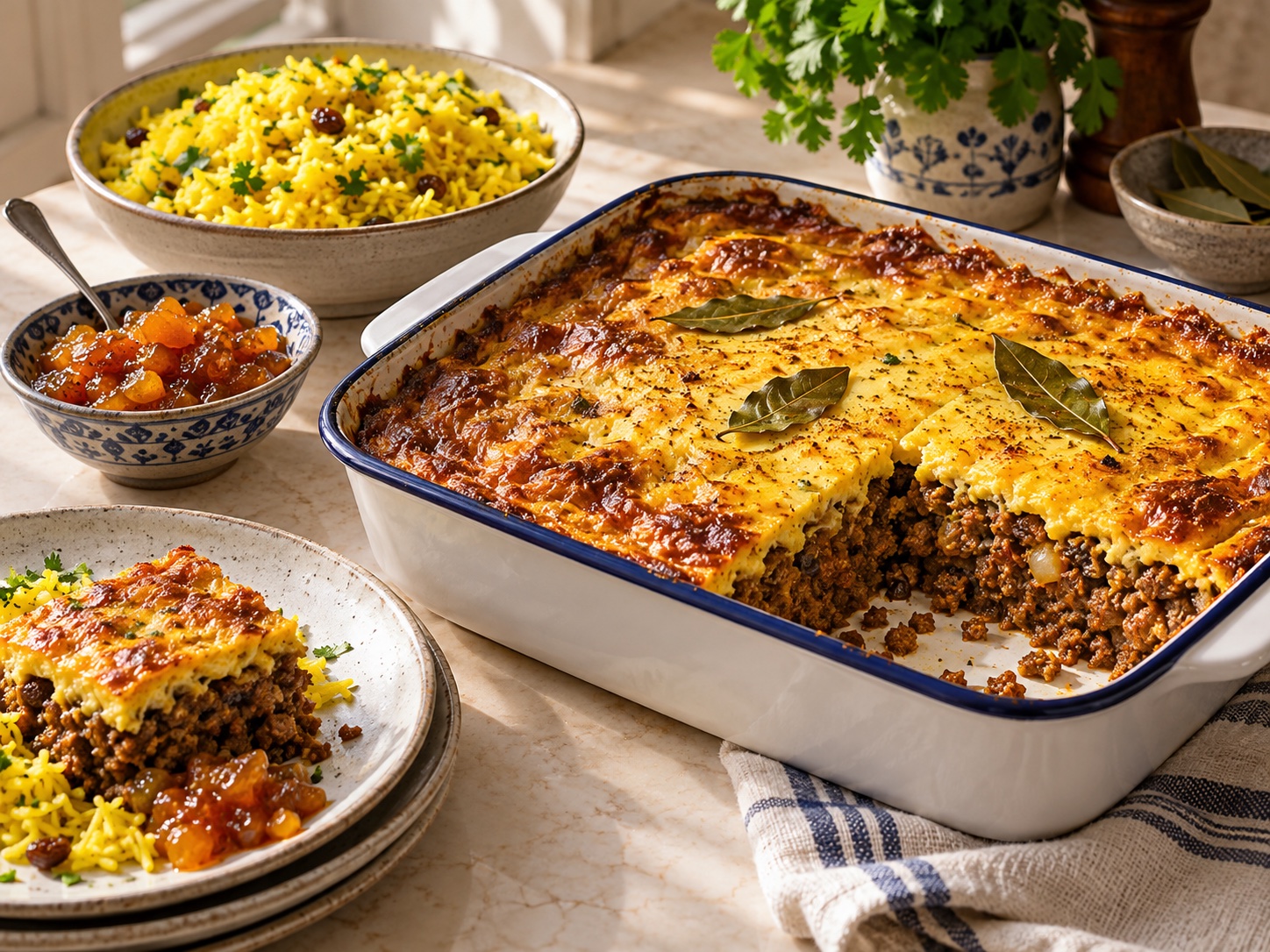
  • South African Bobotie: Juicy Mince, Set Custard

    South African Bobotie: Juicy Mince, Set Custard

    Bobotie is a South African baked dish shaped by Cape Malay influences: spiced mince under a milk-and-egg custard.

    Soaked bread retains moisture; adding custard after the meat cools slightly creates a distinct top layer.

    Why this method works

    • Soaked bread binds mince and retains moisture.
    • Blooming spices with onion removes raw flavor.
    • Adding custard in a second stage keeps layers distinct.

    Before you start

    Use a 9×13-inch dish, skillet, bowl, and thermometer; heat oven to 350°F.

    Raisins and almonds are optional; replace chutney with apricot jam plus vinegar.

    Ground beef and egg casserole should reach 160°F.

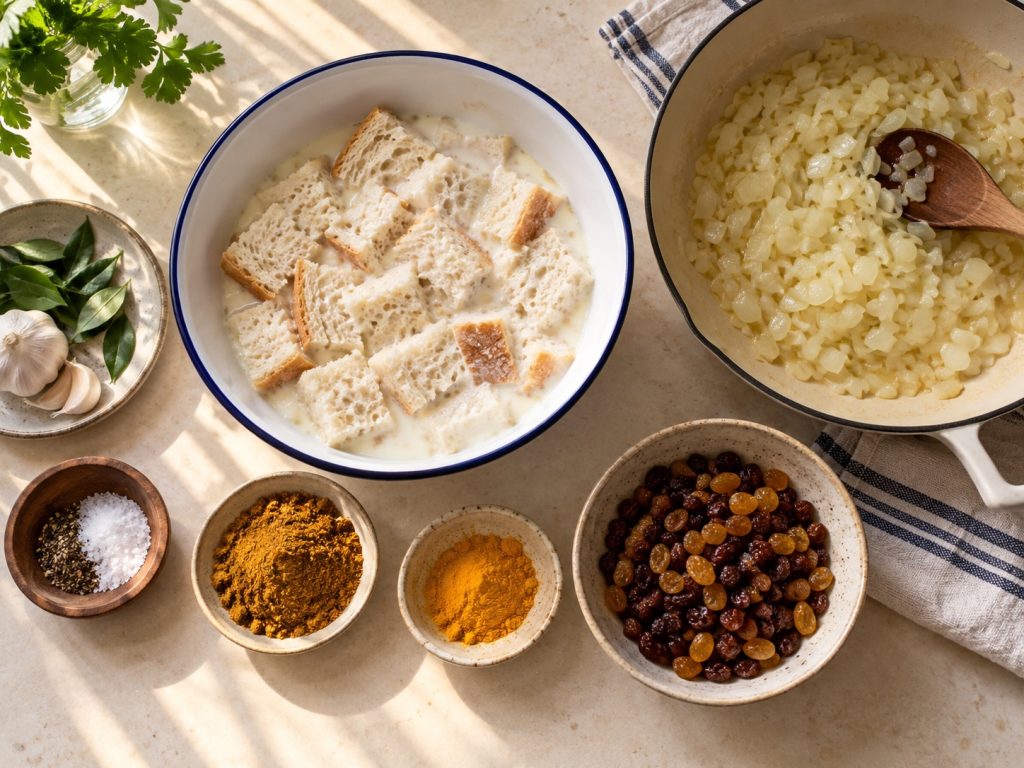
    Soak bread and soften onion
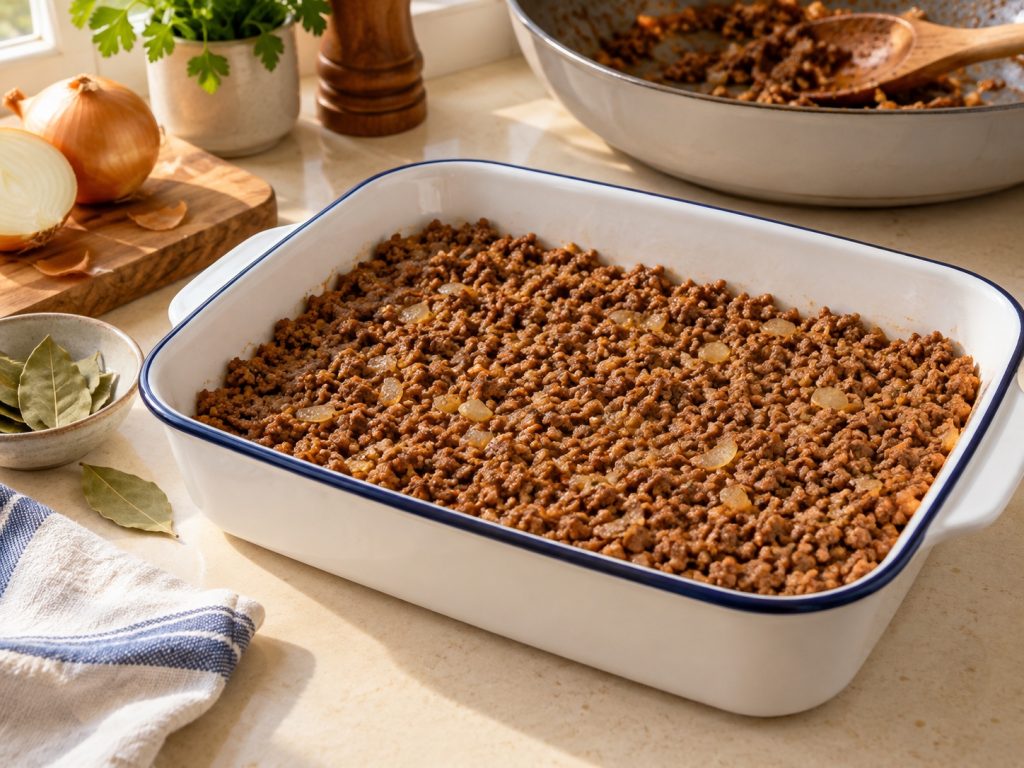
    Soak bread in ⅔ cup milk 10 minutes. Soften onion in oil 8 minutes; bloom curry and turmeric 30 seconds.

    Step-by-step method

    1. Soak bread and soften onion

    Soak bread in ⅔ cup milk 10 minutes. Soften onion in oil 8 minutes; bloom curry and turmeric 30 seconds.

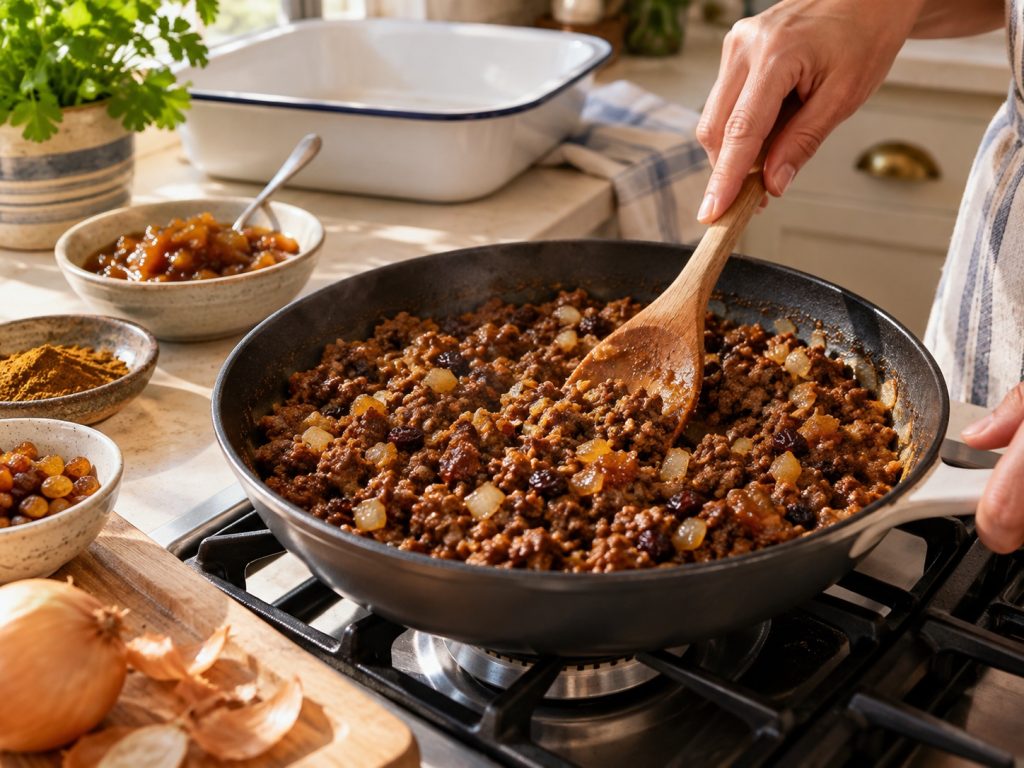
    2. Cook the spiced mince

    Add beef and break it finely; cook 8–10 minutes to 160°F. Stir in squeezed bread, jam, vinegar, and raisins; season.

    Cook the spiced mince
    Add beef and break it finely; cook 8–10 minutes to 160°F. Stir in squeezed bread, jam, vinegar, and raisins; season.

    3. Pack and pre-bake

    Press mixture evenly into a greased dish. Bake at 350°F for 20 minutes; rest 5 minutes.

    Pack and pre-bake
    Press mixture evenly into a greased dish. Bake at 350°F for 20 minutes; rest 5 minutes.

    4. Add custard and finish

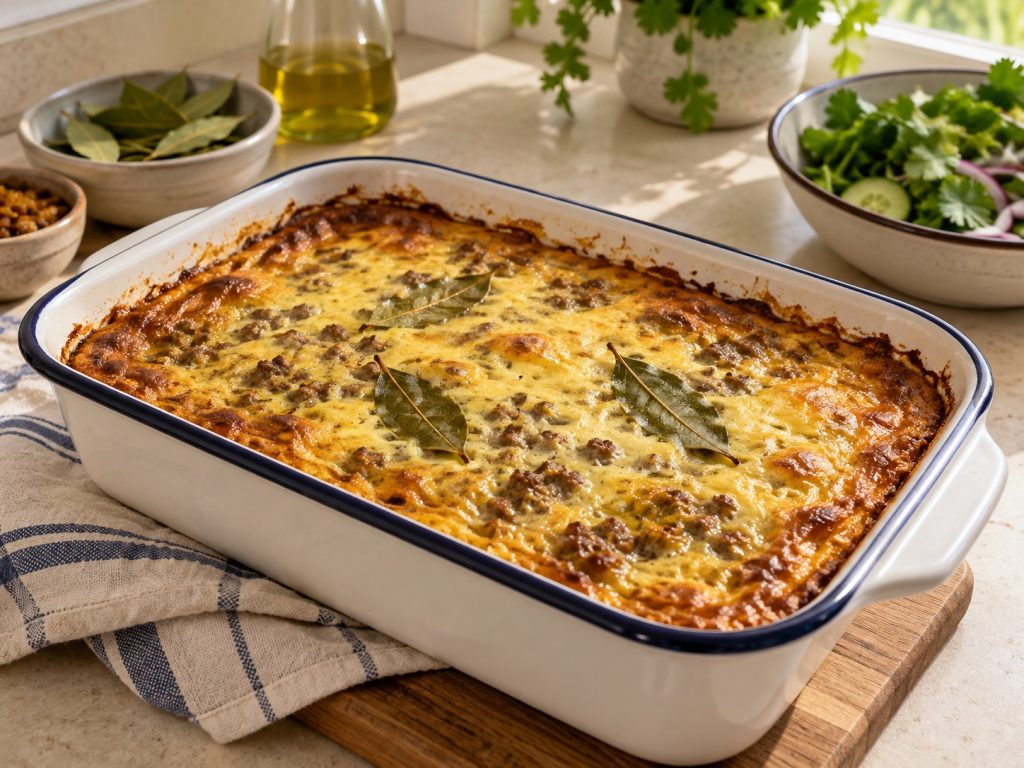
    Whisk eggs with remaining ¾ cup milk and pour over. Add bay and almonds. Bake 20–25 minutes until gold and 160°F in the center. Rest 10 minutes.

    Add custard and finish
    Whisk eggs with remaining ¾ cup milk and pour over. Add bay and almonds. Bake 20–25 minutes until gold and 160°F in the center. Rest 10 minutes.

    Texture and doneness cues

    Custard is gold with no liquid wobble; mince stays moist without pooling.

    Mistakes, substitutions, and measurements

    Lamb can replace beef; gluten-free bread works. Contains dairy, egg, gluten, and optional almonds.

    Serving, storage, and allergens

    Serve with yellow rice and sambal. Chill within 2 hours for 3–4 days or freeze 2 months; reheat covered to 165°F.

    Frequently asked questions

    Why is the mince dry?

    Very lean beef overcooked or bread was not soaked; do not extend the first bake.

    Why did custard sink?

    The meat was too hot or loose; pack it and rest 5 minutes.

    Are raisins essential?

    No; omit for a less sweet-savory result.