Author: emredikmen1

  • Chicken Karahi: Pakistani Tomato-Ginger Chicken

    Chicken Karahi: Pakistani Tomato-Ginger Chicken

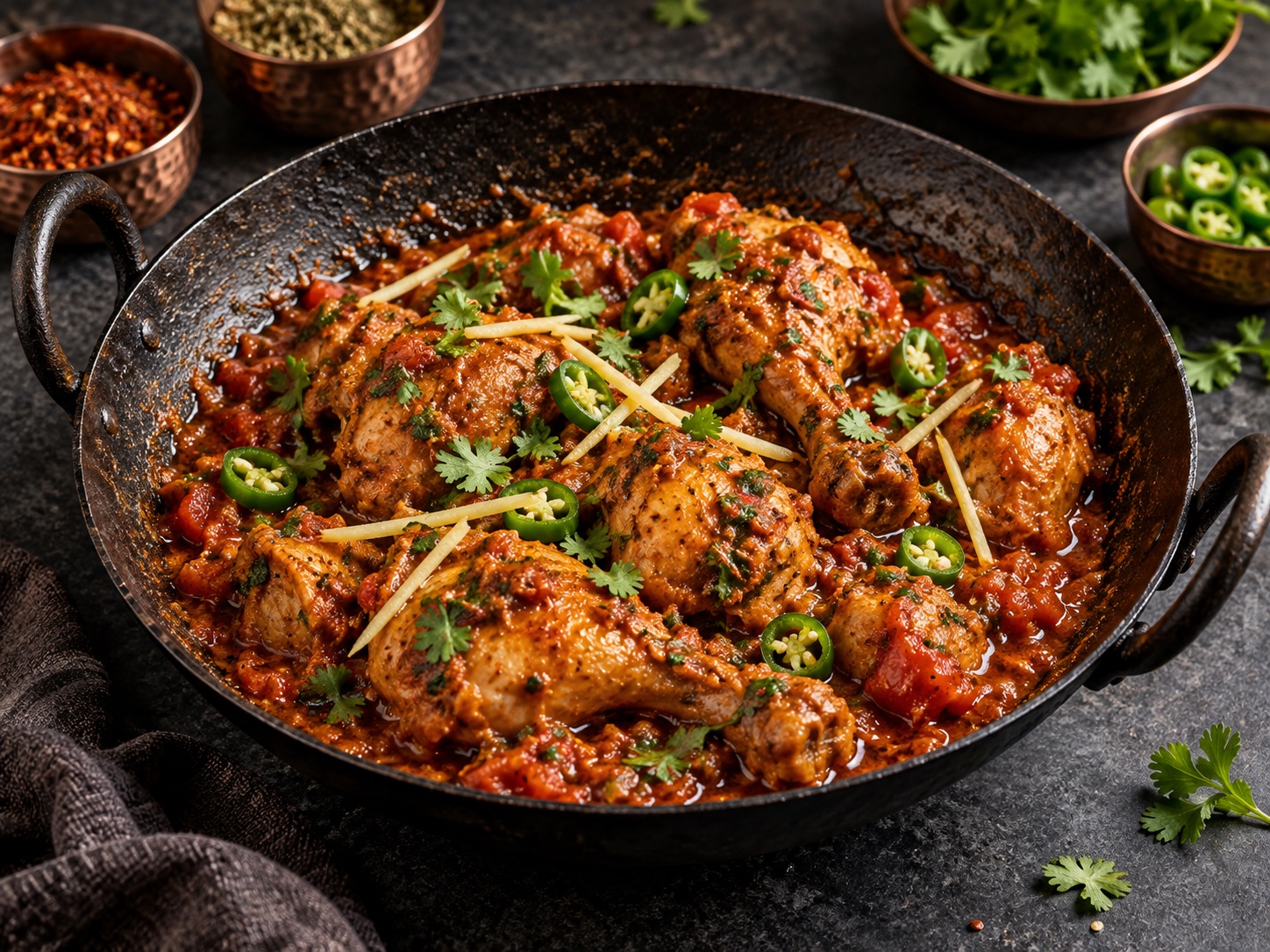
    Karahi takes its name from the wide round metal pan in which it is cooked. Pakistani versions use goat, lamb, or chicken with tomato, ginger, green chilli, and bold black pepper.

    This practical home adaptation uses bone-in chicken and accessible spices. It omits onion and reduces fresh tomato directly in the pan for a concentrated masala.

    Why this method works

    • Browning chicken first builds flavor and prevents a boiled texture once the tomatoes release water.
    • Uncovered reduction evaporates excess tomato water and thickens the masala without flour or starch.
    • Using ginger, black pepper, and green chilli in two stages provides both depth and fresh aroma.

    Before you start

    Use a karahi, wok, or 12-inch heavy skillet with a lid, plus tongs, grater, and instant-read thermometer.

    Do not wash raw chicken; pat it dry and wash all contacted surfaces with hot soapy water.

    For controllable heat, leave half the chillies whole; seed the sliced ones for a milder dish.
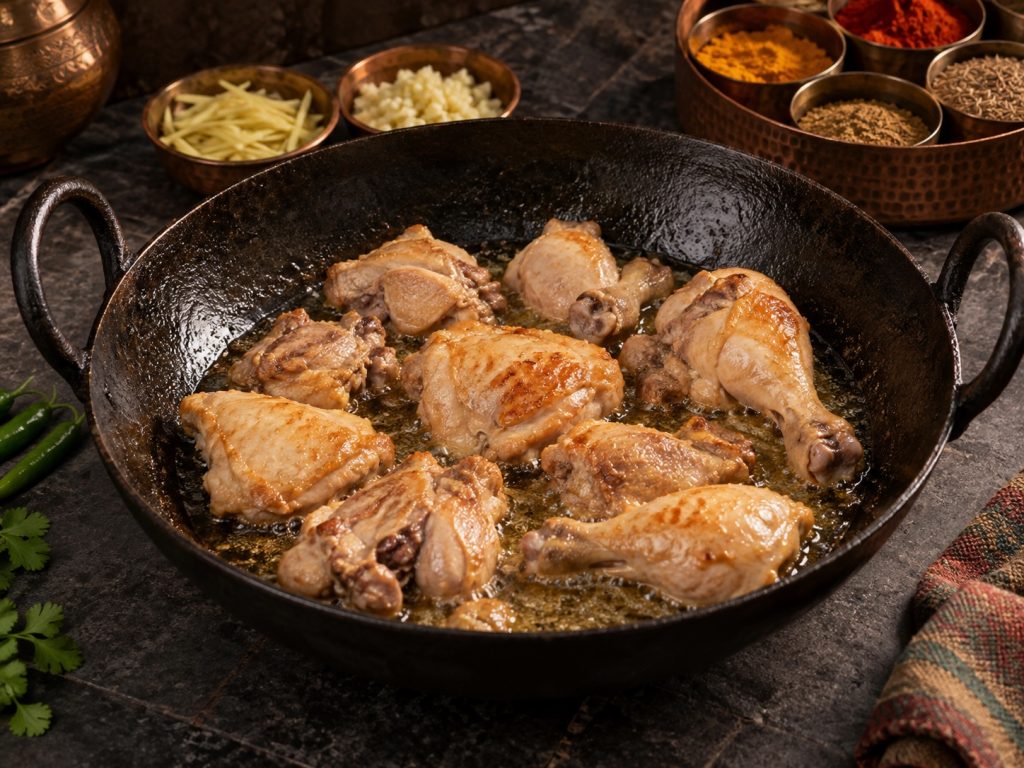
    Dry and brown the chicken
    Pat chicken very dry and season with 1 teaspoon salt. Heat oil over medium-high in a wide pan. Without crowding, brown in two batches for 8–10 minutes total, turning until golden; transfer to a plate.

    Step-by-step method

    1. Dry and brown the chicken

    Pat chicken very dry and season with 1 teaspoon salt. Heat oil over medium-high in a wide pan. Without crowding, brown in two batches for 8–10 minutes total, turning until golden; transfer to a plate.

    2. Build the tomato-spice base

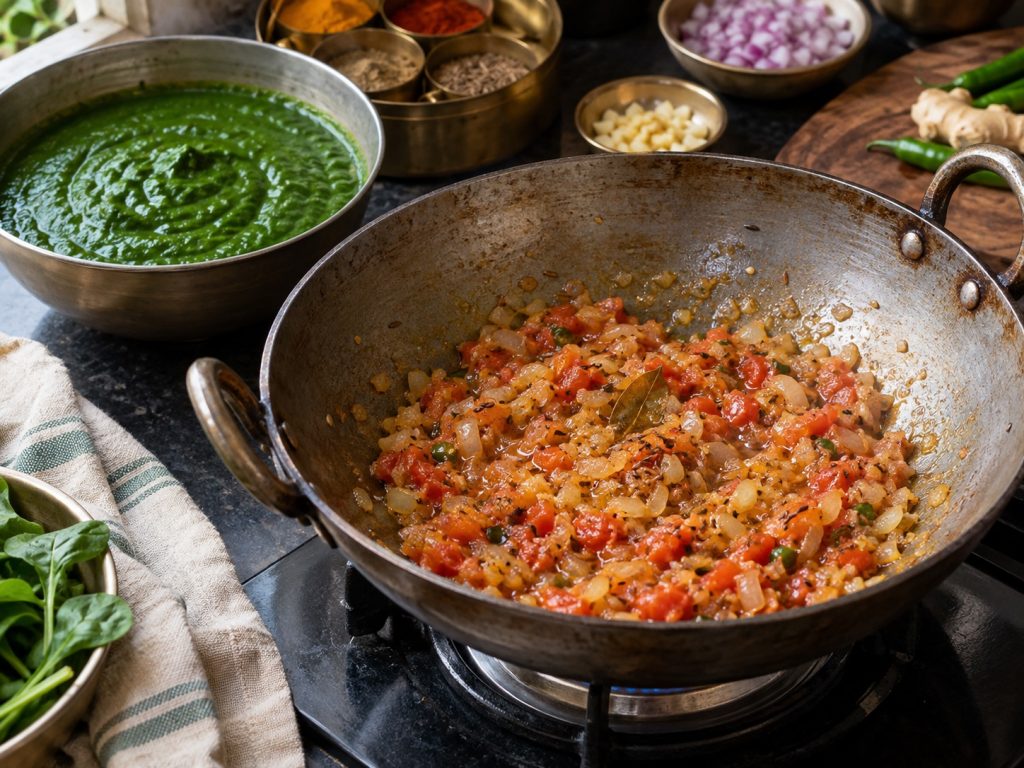
    Lower heat to medium. Stir grated ginger, garlic, coriander, and cumin for 30 seconds. Add tomatoes, chilli powder, and remaining salt. Crush and cook 8–10 minutes until the tomatoes break down into a glossy sauce.
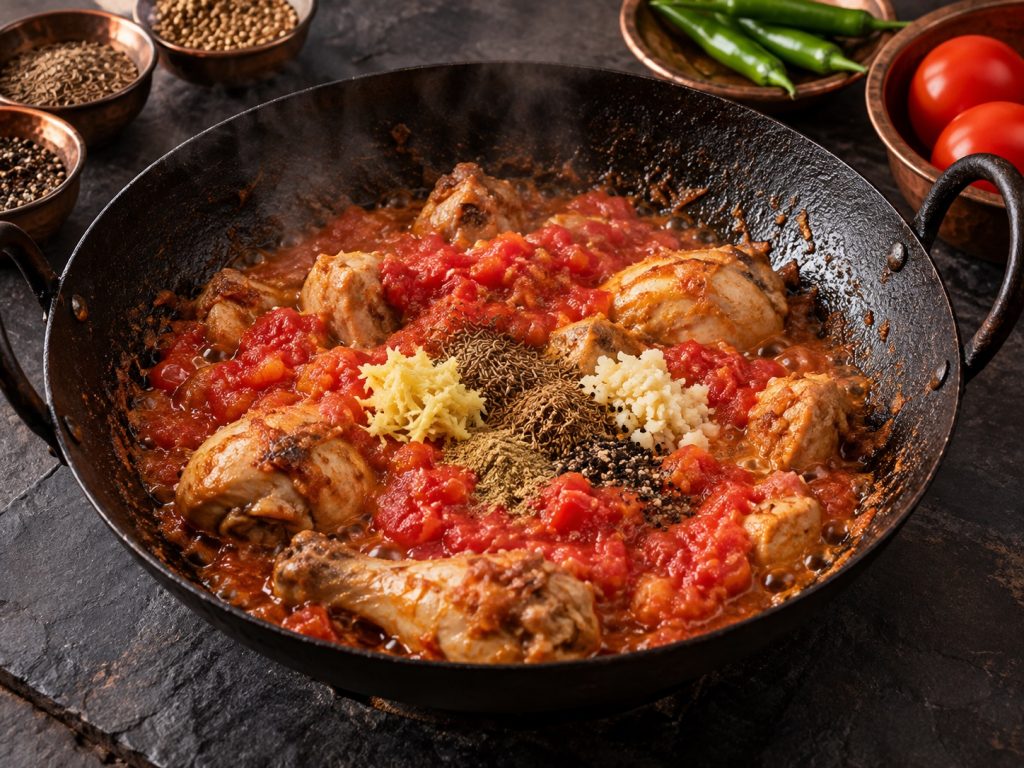
    Build the tomato-spice base
    Lower heat to medium. Stir grated ginger, garlic, coriander, and cumin for 30 seconds. Add tomatoes, chilli powder, and remaining salt. Crush and cook 8–10 minutes until the tomatoes break down into a glossy sauce.

    3. Cover and cook to a safe temperature

    Return chicken and its juices. Add two whole green chillies, cover, and cook over medium-low for 18–22 minutes. Check the thickest piece away from bone and confirm it reaches 165°F.
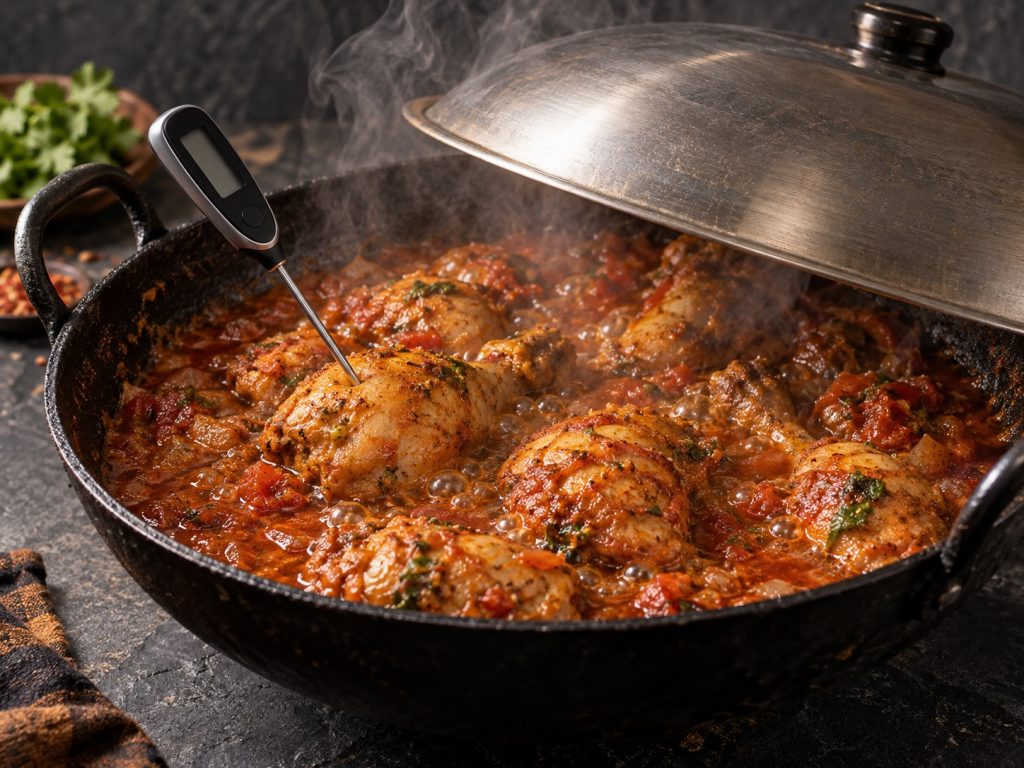
    Cover and cook to a safe temperature
    Return chicken and its juices. Add two whole green chillies, cover, and cook over medium-low for 18–22 minutes. Check the thickest piece away from bone and confirm it reaches 165°F.

    4. Reduce uncovered and add fresh aromatics

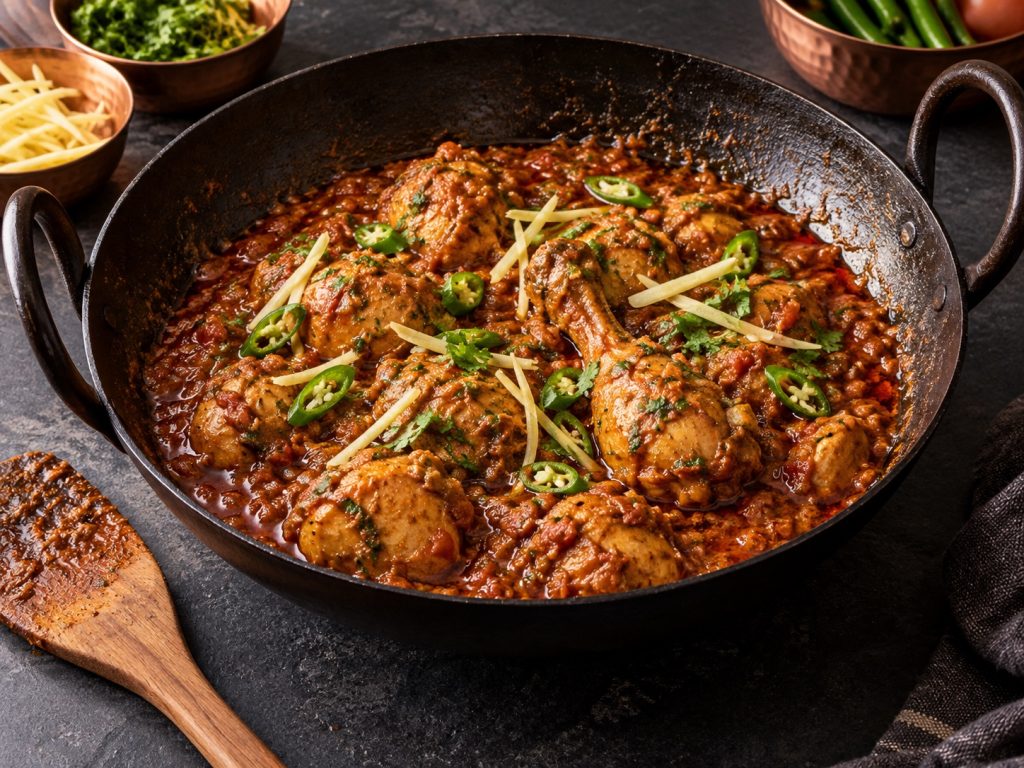
    Uncover and reduce over medium-high for 8–12 minutes, turning often. When masala clings and a little oil appears at the edges, add remaining chilli, black pepper, ginger matchsticks, and cilantro. Rest 2 minutes and serve with lime.
    Reduce uncovered and add fresh aromatics
    Uncover and reduce over medium-high for 8–12 minutes, turning often. When masala clings and a little oil appears at the edges, add remaining chilli, black pepper, ginger matchsticks, and cilantro. Rest 2 minutes and serve with lime.

    Texture and doneness cues

    Chicken reaches 165°F in the thickest area near the bone and remains juicy. The masala is thick and glossy enough to cling rather than pooling like a loose curry; a light oil sheen appears at the edge.

    Mistakes, substitutions, and measurements

    A wide wok or heavy skillet replaces a karahi. For boneless thighs use about 2 pounds and begin checking earlier, still reaching 165°F. Parsley can replace cilantro, though the flavor changes. ¼ cup oil is about 60 ml. Gluten- and dairy-free when made with oil; check ghee labels.

    Serving, storage, and allergens

    Refrigerate in a shallow container within 2 hours for 3–4 days, or freeze with the sauce up to 2 months. Thaw in the refrigerator and reheat with a splash of water until every piece reaches 165°F. Discard any garnish that contacted raw chicken.

    Frequently asked questions

    Why is the sauce watery?

    Very juicy tomatoes or too much covered cooking are common causes; finish uncovered in a wide pan.

    Why is the chicken tough?

    Breast-heavy pieces or overcooking can dry it; favor bone-in thighs and stop once safely cooked and reduced.

    How can I make it milder?

    Seed the green chillies, halve their quantity, and use mild paprika instead of hot chilli powder.
  • Lohikeitto: Creamy Finnish Salmon Soup

    Lohikeitto: Creamy Finnish Salmon Soup

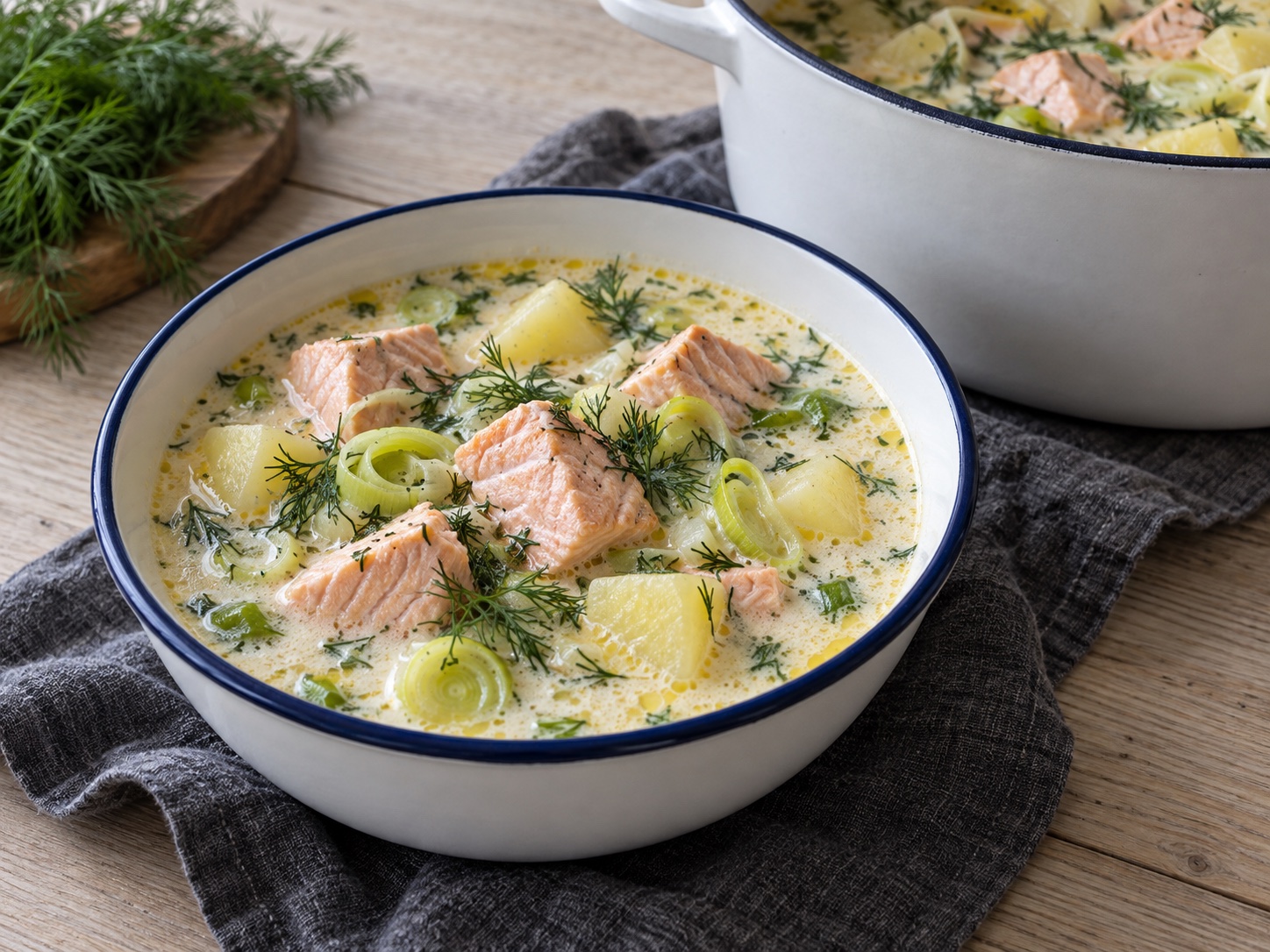
    Lohikeitto is Finland’s comforting salmon soup, found in home kitchens, lunch cafés, and traditional restaurants, usually with potatoes, leek, cream, and dill.

    This home version cooks the vegetables first, adds salmon near the end so it stays moist at 145°F, and finishes with cream without a hard boil.

    Why this method works

    • Waxy potatoes hold their shape in broth better than floury varieties.
    • Adding salmon only after the vegetables are tender keeps the fish from overcooking.
    • Finishing with cream over low heat keeps the broth smooth, while late-added dill stays aromatic.

    Before you start

    Have a 4–5-quart pot, board, sharp knife, ladle, and instant-read thermometer ready.

    Cut salmon into even 1¼-inch pieces and refrigerate until the vegetables are ready; keep the raw-fish board separate.

    Taste the fish stock before salting, especially when using store-bought stock.

    Prepare the salmon and vegetables safely
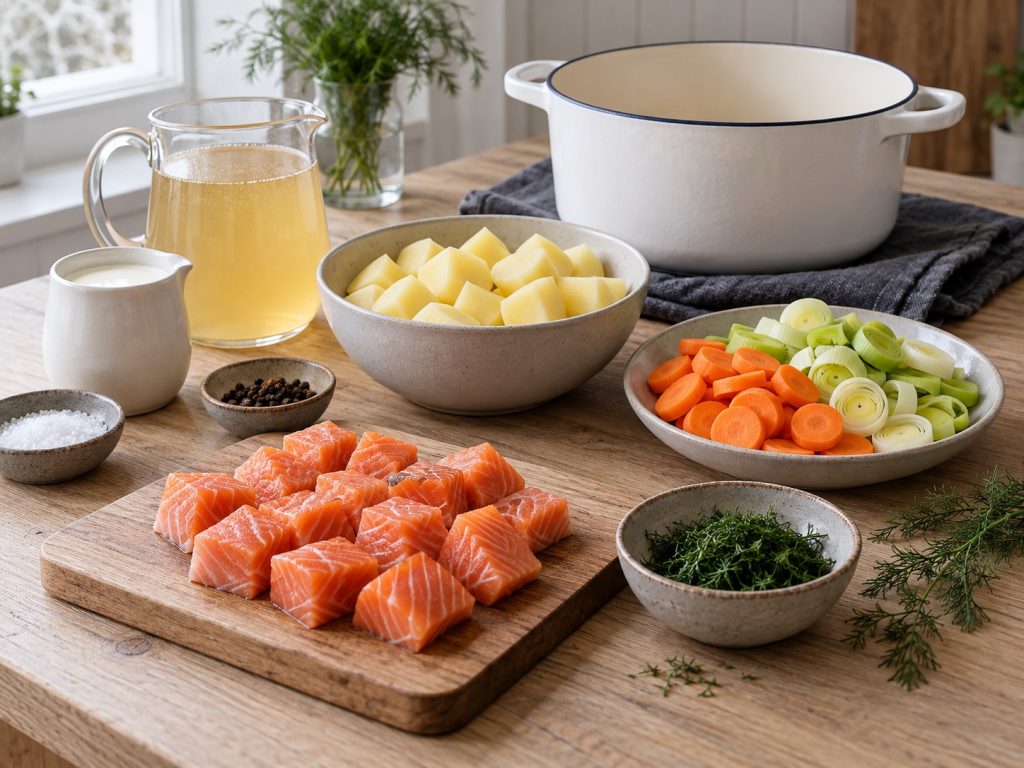
    Cut salmon into 1¼-inch cubes and keep covered and cold. Cut potatoes similarly, carrots ½ inch thick, and thoroughly washed leek into ½-inch rounds. Wash the raw-fish board and knife with hot soapy water.

    Step-by-step method

    1. Prepare the salmon and vegetables safely

    Cut salmon into 1¼-inch cubes and keep covered and cold. Cut potatoes similarly, carrots ½ inch thick, and thoroughly washed leek into ½-inch rounds. Wash the raw-fish board and knife with hot soapy water.

    2. Simmer the vegetables in stock

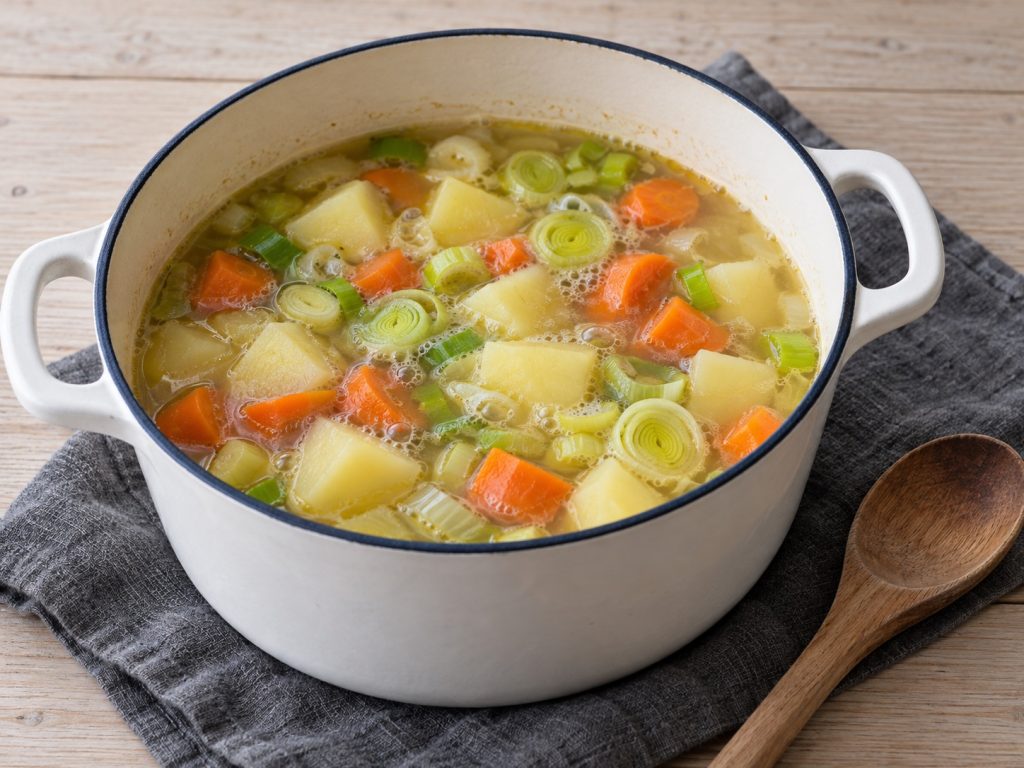
    Melt butter in the pot over medium heat. Sweat leek 4 minutes; add potatoes, carrots, bay, and allspice. Pour in stock and bring to a gentle simmer. Cook 15–18 minutes, until a knife enters the potato easily but the pieces still hold.

    Simmer the vegetables in stock
    Melt butter in the pot over medium heat. Sweat leek 4 minutes; add potatoes, carrots, bay, and allspice. Pour in stock and bring to a gentle simmer. Cook 15–18 minutes, until a knife enters the potato easily but the pieces still hold.

    3. Cook the salmon gently

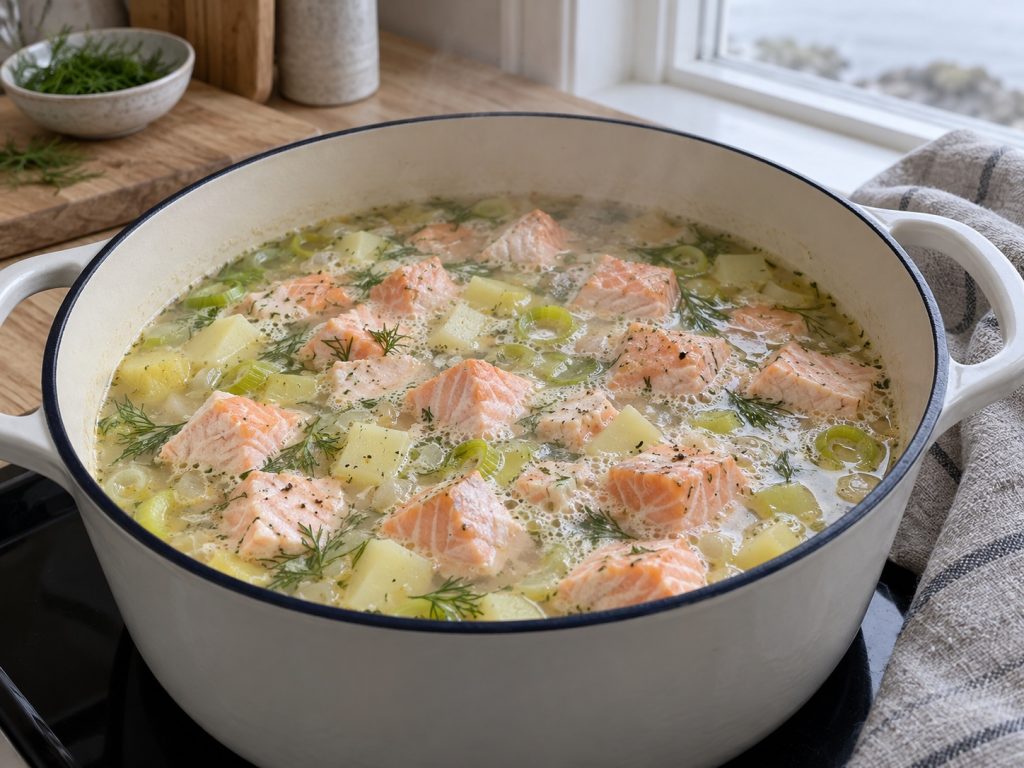
    Reduce to the gentlest simmer. Add salmon in one layer and rock the pot instead of stirring. Cook 5–7 minutes, until the thickest piece reaches 145°F or is opaque and separates easily with a fork.

    Cook the salmon gently
    Reduce to the gentlest simmer. Add salmon in one layer and rock the pot instead of stirring. Cook 5–7 minutes, until the thickest piece reaches 145°F or is opaque and separates easily with a fork.

    4. Finish with cream and dill

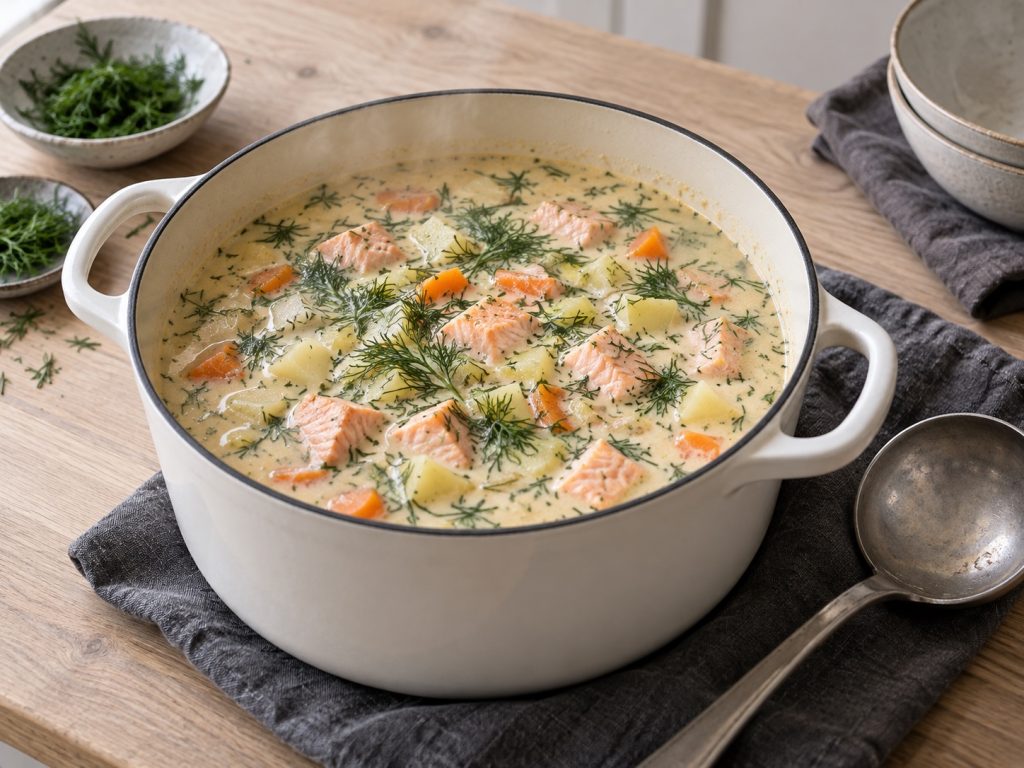
    Add cream and heat 2–3 minutes just until steaming; do not boil hard. Remove bay and allspice. Fold in most dill, pepper, and salt as needed. Rest 5 minutes and serve with the remaining dill.

    Finish with cream and dill
    Add cream and heat 2–3 minutes just until steaming; do not boil hard. Remove bay and allspice. Fold in most dill, pepper, and salt as needed. Rest 5 minutes and serve with the remaining dill.

    Texture and doneness cues

    Potatoes yield to a knife without collapsing; salmon is opaque, moist, and flakes in large pieces. The broth is creamy but pourable, never split or greasy.

    Mistakes, substitutions, and measurements

    Trout or a firm skinless white fish can replace salmon; adjust time to thickness. Unsweetened oat cream works, though the flavor changes. 1 litre is about 4¼ cups; 200 ml is about ¾ cup plus 1 tablespoon. Contains fish and dairy.

    Serving, storage, and allergens

    Cool in shallow containers within 2 hours and refrigerate up to 2 days. Reheat gently without vigorous stirring to 165°F. Cream can split after freezing; for best results freeze the soup without cream up to 1 month and add cream after thawing.

    Frequently asked questions

    Why did the cream split?

    The soup boiled hard after the cream went in; add it over low heat and warm only to steaming.

    Why is the salmon dry?

    It cooked with the vegetables or boiled too long; add near the end and stop at 145°F.

    Why did the potatoes fall apart?

    A floury variety or vigorous stirring is usually responsible; use waxy potatoes and rock the pot.

  • Spanish Churros: Crisp Dough with Thick Hot Chocolate

    Spanish Churros: Crisp Dough with Thick Hot Chocolate

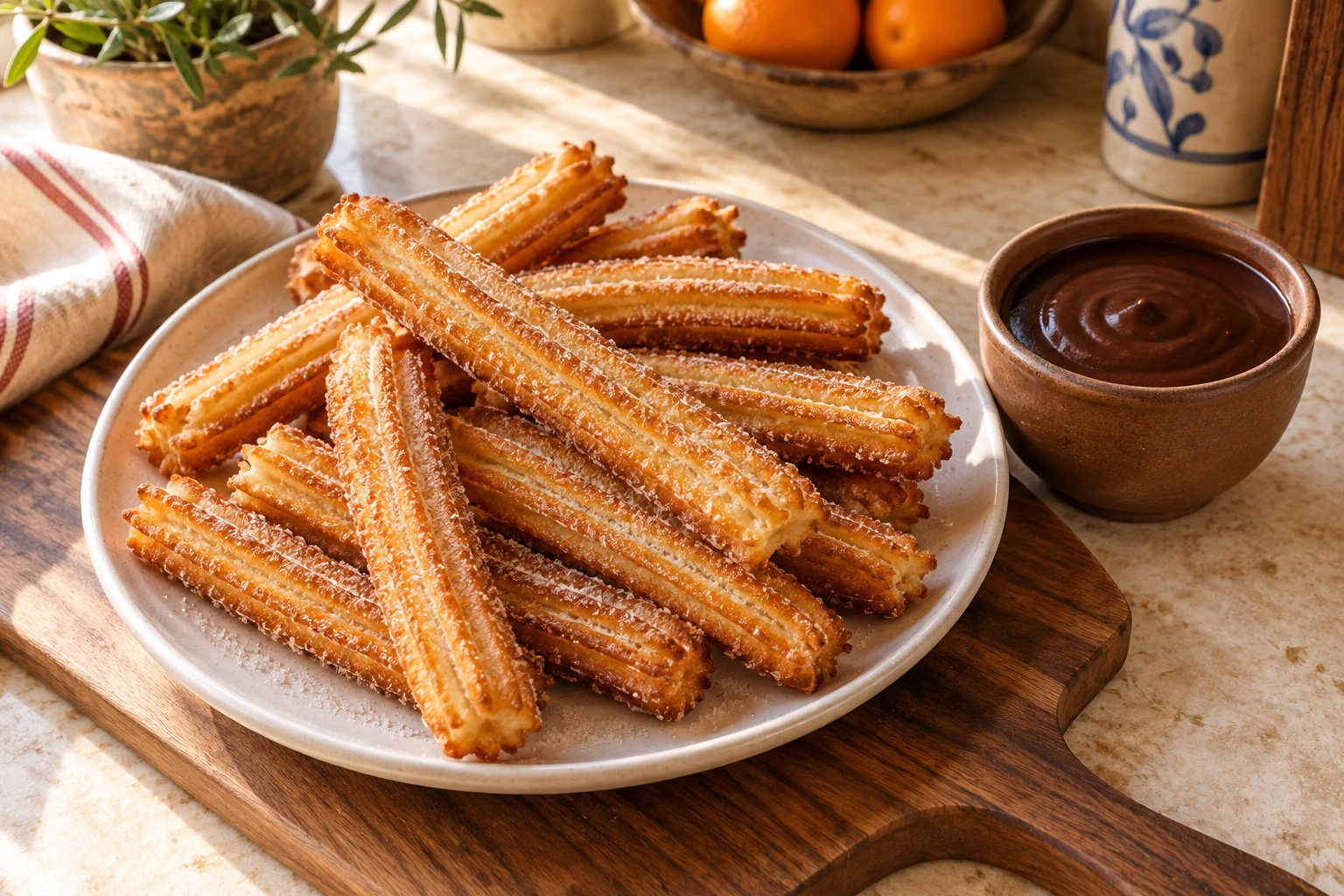
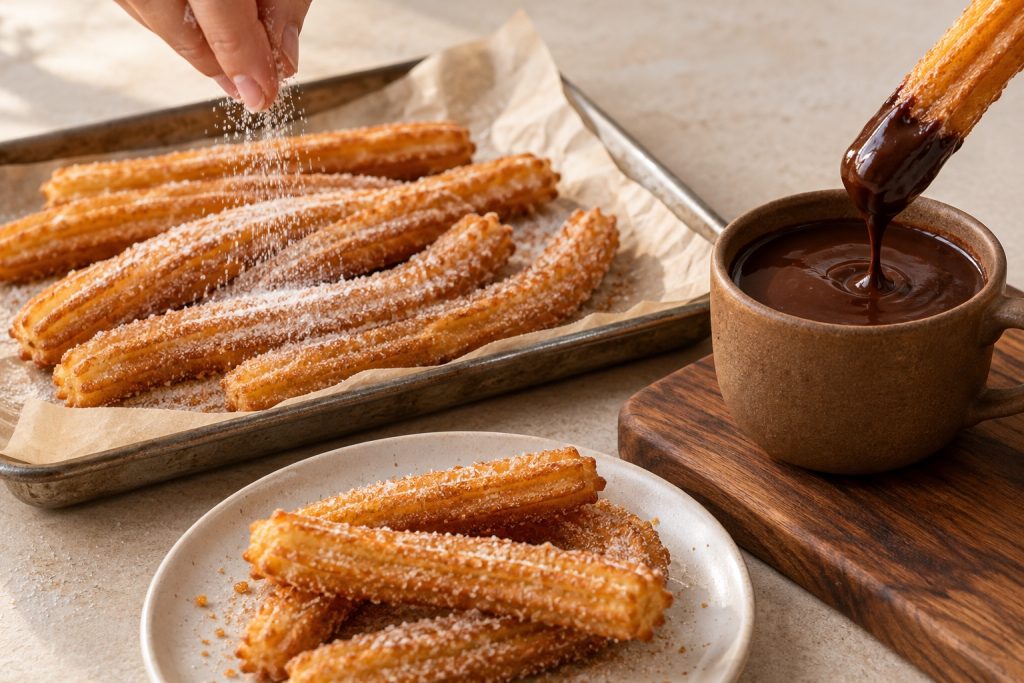
    Churros are fried dough served in Spain for breakfast or merienda, dusted with sugar and often paired with thick hot chocolate.

    This egg-free flour-and-water dough is piped through a star tip. Holding the oil at 350–355°F cooks the center before the ridges overbrown.

    Why this method works

    • Adding flour to boiling liquid all at once creates a smooth, pipeable dough.
    • A star tip increases surface area so the churros cook and crisp more evenly.
    • Small batches protect oil temperature and prevent a greasy result.

    Before you start

    Fill a deep heavy pot no more than one-third with oil; have a thermometer, strong piping bag, large star tip, and metal lid ready.

    The dough must be smooth; pack it firmly into the bag to reduce air pockets.

    Never leave hot oil unattended, and never put water on an oil fire.

    Cook and smooth the dough
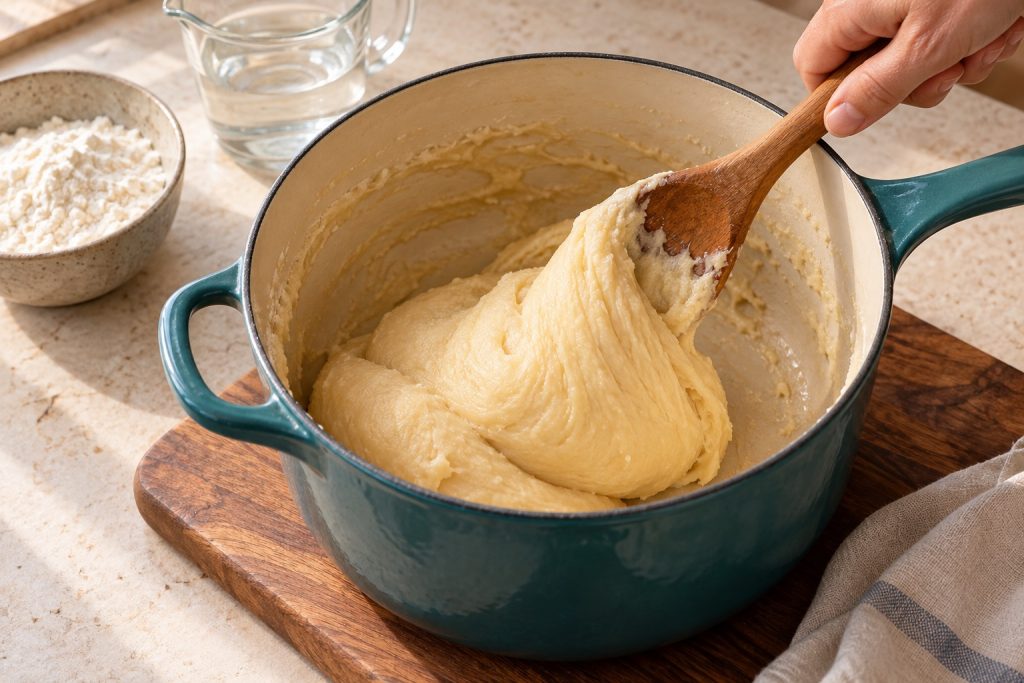
    Bring water, salt, and olive oil to a boil. Remove from heat, add flour all at once, and beat quickly with a wooden spoon. When the dough pulls from the pan, cool 5–7 minutes until safe to handle.

    Step-by-step method

    1. Cook and smooth the dough

    Bring water, salt, and olive oil to a boil. Remove from heat, add flour all at once, and beat quickly with a wooden spoon. When the dough pulls from the pan, cool 5–7 minutes until safe to handle.

    2. Pipe through a star tip

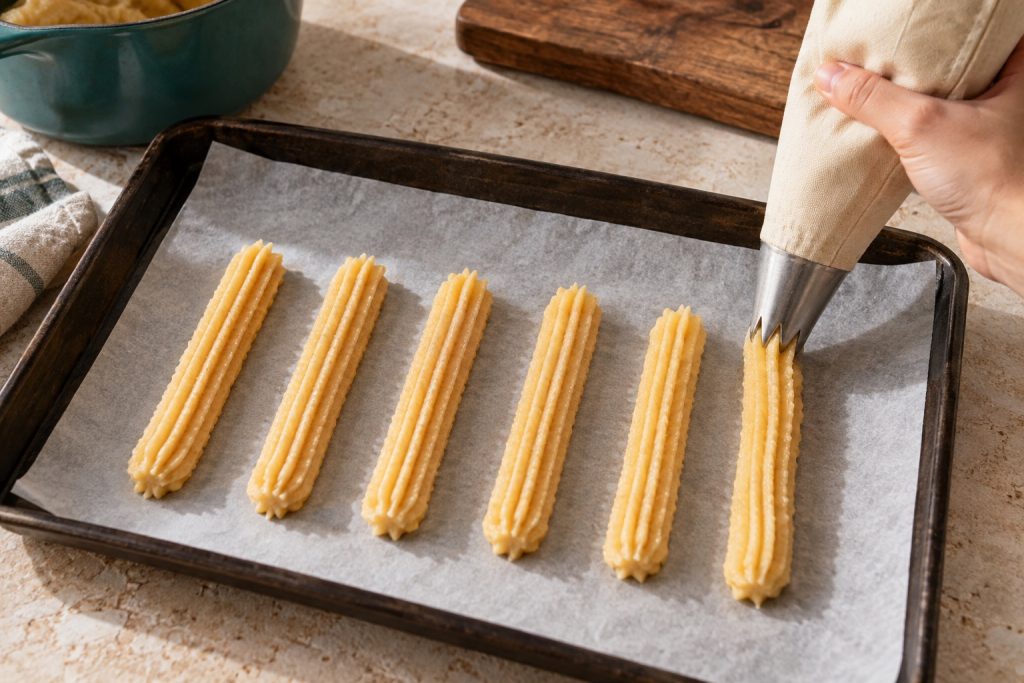
    Pack dough firmly into a strong bag fitted with a large star tip. Pipe 5–6-inch lengths onto parchment, or pipe carefully above the oil and snip with scissors.

    Pipe through a star tip
    Pack dough firmly into a strong bag fitted with a large star tip. Pipe 5–6-inch lengths onto parchment, or pipe carefully above the oil and snip with scissors.

    3. Fry safely in small batches

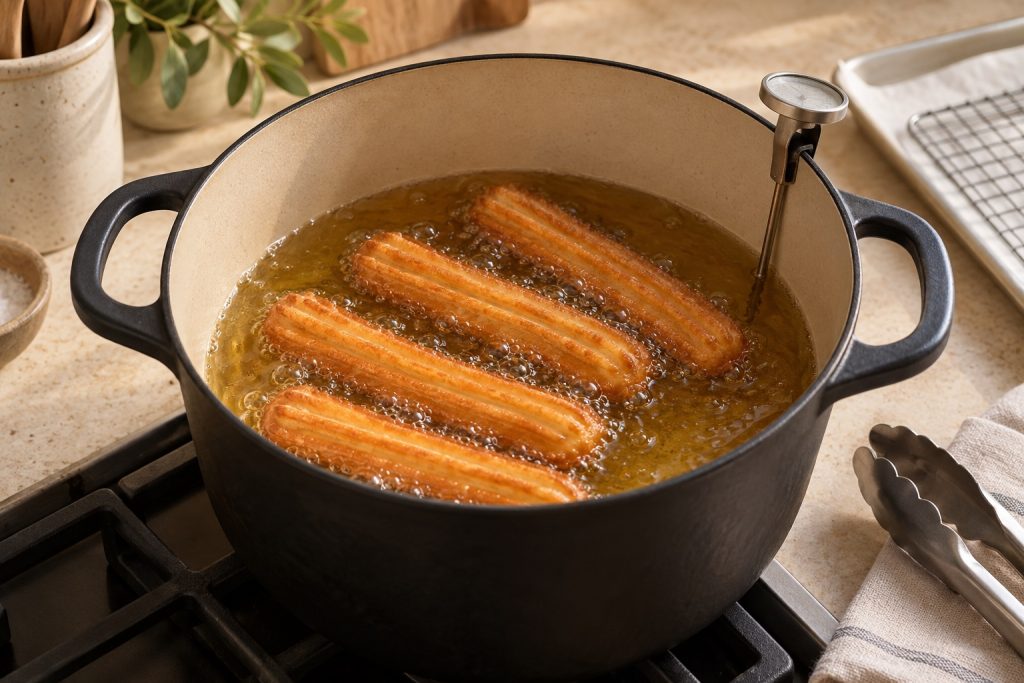
    Heat oil slowly to 350–355°F. Using dry tools, fry in small batches 4–5 minutes, turning until deep golden all over. Do not let the oil fall below 340°F or rise above 365°F.

    Fry safely in small batches
    Heat oil slowly to 350–355°F. Using dry tools, fry in small batches 4–5 minutes, turning until deep golden all over. Do not let the oil fall below 340°F or rise above 365°F.

    4. Thicken the chocolate and serve

    Warm the milk. Slurry cornstarch with 2 tablespoons cold milk, add, and thicken 1–2 minutes; stir in chocolate until smooth. Drain churros, coat warm with cinnamon sugar, and serve with chocolate.

    Thicken the chocolate and serve
    Warm the milk. Slurry cornstarch with 2 tablespoons cold milk, add, and thicken 1–2 minutes; stir in chocolate until smooth. Drain churros, coat warm with cinnamon sugar, and serve with chocolate.

    Texture and doneness cues

    Churros are deep golden with defined ridges and a light interior; no wet dough remains when one is broken. Chocolate coats a spoon but still pours.

    Mistakes, substitutions, and measurements

    Unsweetened plant milk can replace dairy milk. Serve with sugar only if skipping chocolate. 1 cup flour is about 125 g; 1 cup liquid is 240 ml. Contains gluten and dairy; check the chocolate label.

    Serving, storage, and allergens

    Best freshly fried. Store airtight at room temperature for 1 day and re-crisp 5–7 minutes at 350°F. Freeze shaped raw dough on a tray for up to 1 month and fry from frozen. Never move hot oil before it is fully cool.

    Frequently asked questions

    Why are they greasy?

    The oil was cool or crowded; hold 350–355°F and fry small batches.

    Why is the center doughy?

    The rope was too thick or oil too hot; use a large narrow star tip and stay below 365°F.

    Why not use a round tip?

    Ridges increase surface area and support more even cooking; use a star tip.

  • Uzbek Palov: Separate Grains and Deep Zirvak Flavor

    Uzbek Palov: Separate Grains and Deep Zirvak Flavor

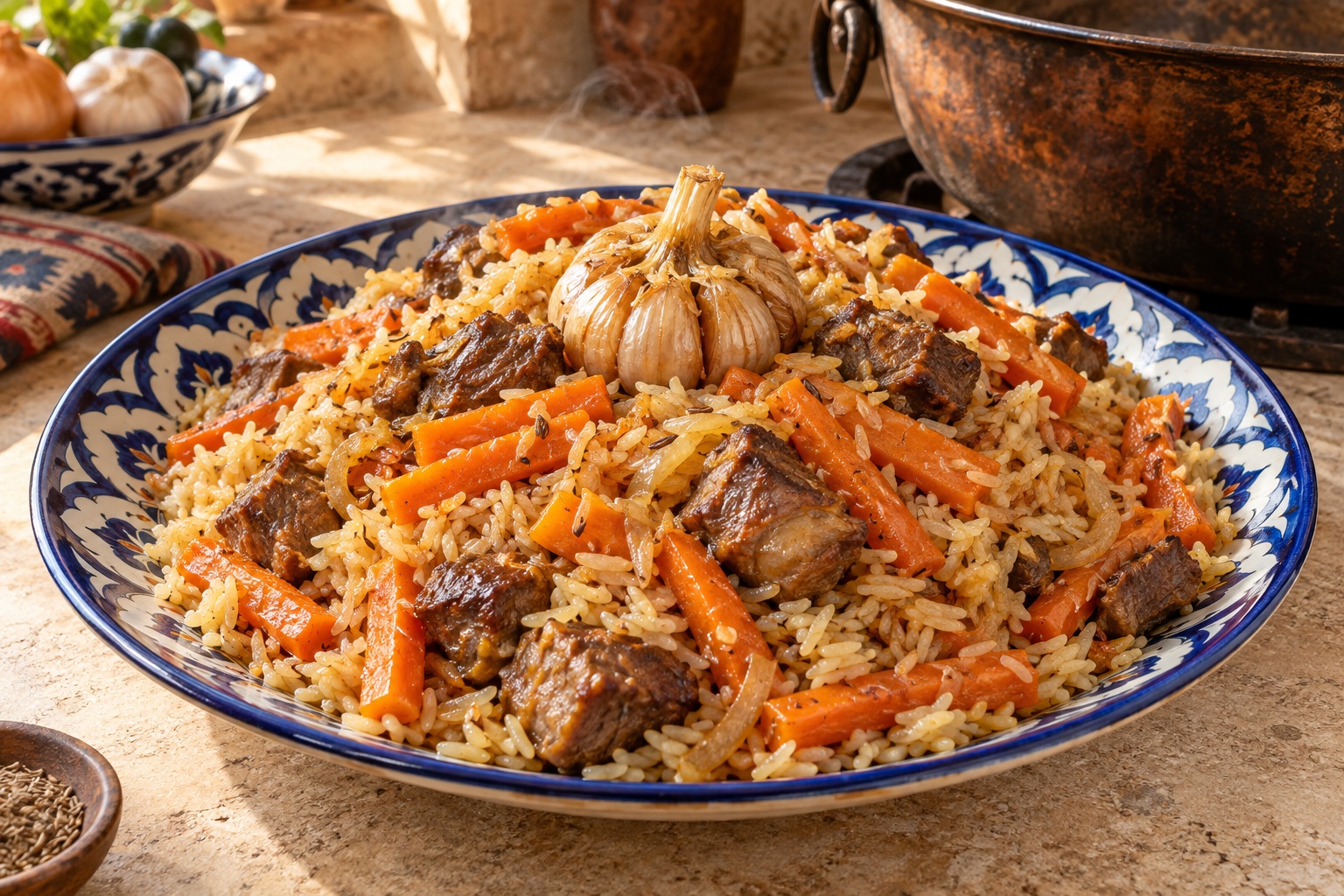
    Palov, or osh, is Uzbekistan’s communal rice dish of meat, carrots, and onion, served from everyday tables to celebrations; its culture entered UNESCO’s list in 2016.

    Regional versions vary widely. This home adaptation uses accessible long-grain rice and a heavy pot, cooking the layers without stirring.

    Why this method works

    • Cooking the zirvak fully first builds concentrated flavor for the rice.
    • Keeping rice in a level top layer lets steam cook it without crushing starch.
    • The final rest redistributes moisture and sets separate grains.

    Before you start

    Use a 5–6 quart heavy pot or kazan, colander, and long spoon.

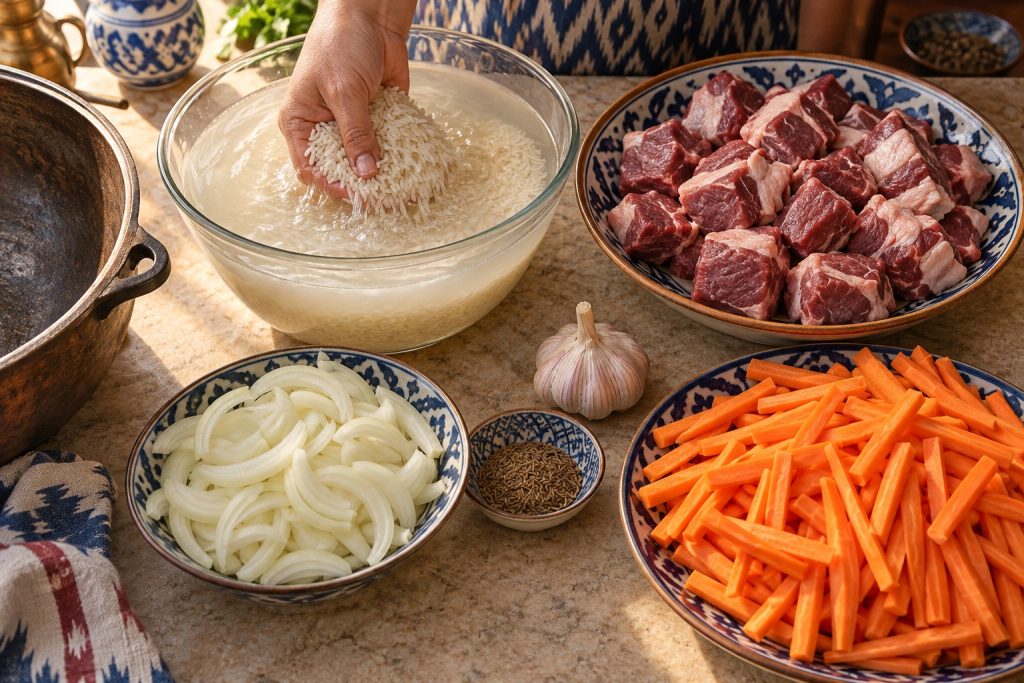
    Rinse rice 5–6 times until mostly clear and soak 30 minutes in warm salted water.

    Cut carrots into ¼-inch batons rather than grating so they remain distinct.

    Rinse rice and prepare vegetables
    Rinse rice 5–6 times, soak 30 minutes in warm salted water, and drain. Cut meat into 1½-inch cubes, carrots into ¼-inch batons, and onions into half-moons. Remove only garlic’s outer paper.

    Step-by-step method

    1. Rinse rice and prepare vegetables

    Rinse rice 5–6 times, soak 30 minutes in warm salted water, and drain. Cut meat into 1½-inch cubes, carrots into ¼-inch batons, and onions into half-moons. Remove only garlic’s outer paper.

    2. Build the meat zirvak

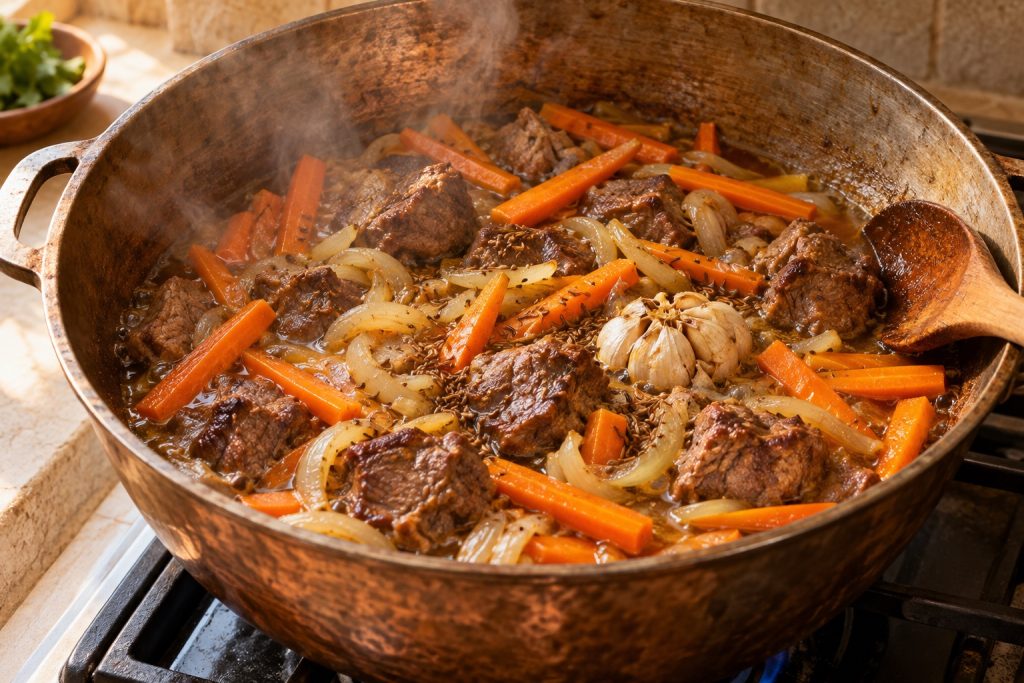
    Heat oil in a heavy pot over medium-high. Brown meat deeply in batches. Cook onion 6–8 minutes and carrots 8–10 minutes. Add cumin, coriander, and salt; pour in 2 cups boiling water, add garlic, cover, and simmer 35–45 minutes until meat is tender.
    Build the meat zirvak
    Heat oil in a heavy pot over medium-high. Brown meat deeply in batches. Cook onion 6–8 minutes and carrots 8–10 minutes. Add cumin, coriander, and salt; pour in 2 cups boiling water, add garlic, cover, and simmer 35–45 minutes until meat is tender.
    3. Layer rice and reduce the liquid

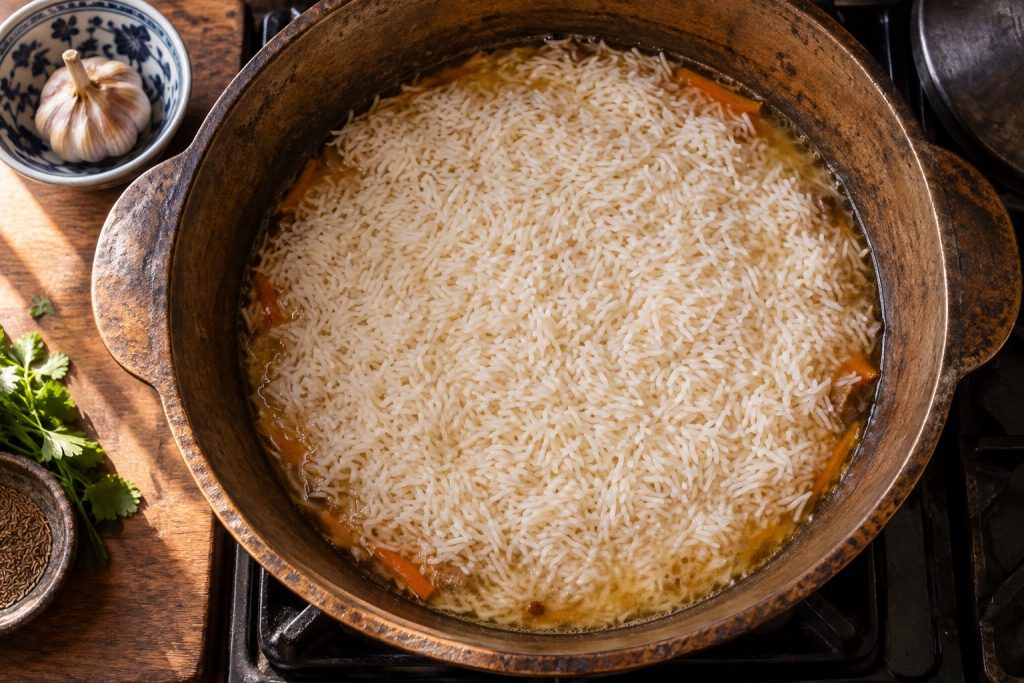
    Remove garlic briefly. Spread rice evenly over the zirvak without stirring. Add boiling water to sit about ½ inch above rice. Cook uncovered over medium-high 10–15 minutes until liquid disappears from the surface and rice is nearly tender.
    Layer rice and reduce the liquid
    Remove garlic briefly. Spread rice evenly over the zirvak without stirring. Add boiling water to sit about ½ inch above rice. Cook uncovered over medium-high 10–15 minutes until liquid disappears from the surface and rice is nearly tender.
    4. Steam in a mound and rest

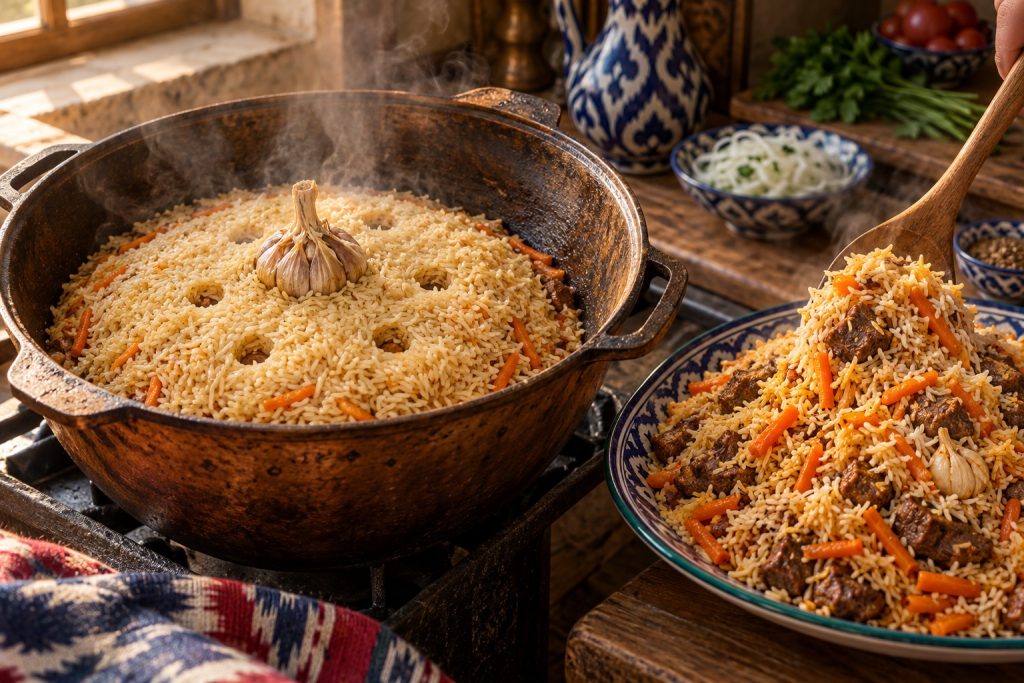
    Mound rice toward the center, pierce 5–6 steam holes with a spoon handle, and return garlic on top. Cover tightly and steam over the lowest heat 20–25 minutes. Turn off heat, rest 15 minutes, then fold layers together gently.

    Steam in a mound and rest
    Mound rice toward the center, pierce 5–6 steam holes with a spoon handle, and return garlic on top. Cover tightly and steam over the lowest heat 20–25 minutes. Turn off heat, rest 15 minutes, then fold layers together gently.

    Texture and doneness cues

    Rice grains are separate, tender but defined, with no free water at the bottom. Meat yields to a fork, carrots remain distinct, and nothing smells scorched.

    Mistakes, substitutions, and measurements

    Beef can replace lamb. Parboiled long-grain rice is forgiving if devzira is unavailable; basmati may need less water. Chickpeas or raisins appear in regional variants but are optional here. Naturally gluten- and dairy-free; check stock labels if used. 1 cup rice is about 190 g.

    Serving, storage, and allergens

    Serve with tomato-onion salad and yogurt. Divide into shallow containers and chill within 2 hours; refrigerate up to 3 days. Reheat once, covered with a splash of water, until the center reaches 165°F. Freeze up to 2 months.

    Frequently asked questions

    Why is the rice mushy?

    Starch remained, water was excessive, or layers were stirred; rinse until clear and keep rice on top.

    Why did the bottom burn?

    Heat stayed high after liquid reduced; use the lowest heat for steaming and a heavy pot.

    Can I cook the meat ahead?

    Make zirvak one day ahead, chill promptly, bring it back to a boil, then add rice.

  • Canadian Poutine: Double-Fried Fries, Curds, and Gravy

    Canadian Poutine: Double-Fried Fries, Curds, and Gravy

    Poutine is the Québec-associated Canadian dish of fries, fresh cheese curds, and hot brown gravy.

    The home challenge is preserving crunch. Fries are cooked once at a lower temperature, crisped hotter, and topped only at the moment of serving.

    Why this method works

    • Soaking removes surface starch; thorough drying prevents splatter and sogginess.
    • The first fry cooks the center, while the hotter second fry builds a dry crisp crust.
    • Adding hot gravy last warms the curds without drowning the fries too soon.

    Before you start

    Fill a deep heavy pot no more than one-third with oil; prepare a thermometer, dry tongs, rack, and small saucepan.

    Cut potatoes into even ⅜-inch sticks, soak 30 minutes in cold water, and dry completely.

    Let curds sit out 20 minutes before serving, but not longer.

    Cut, soak, and dry the potatoes
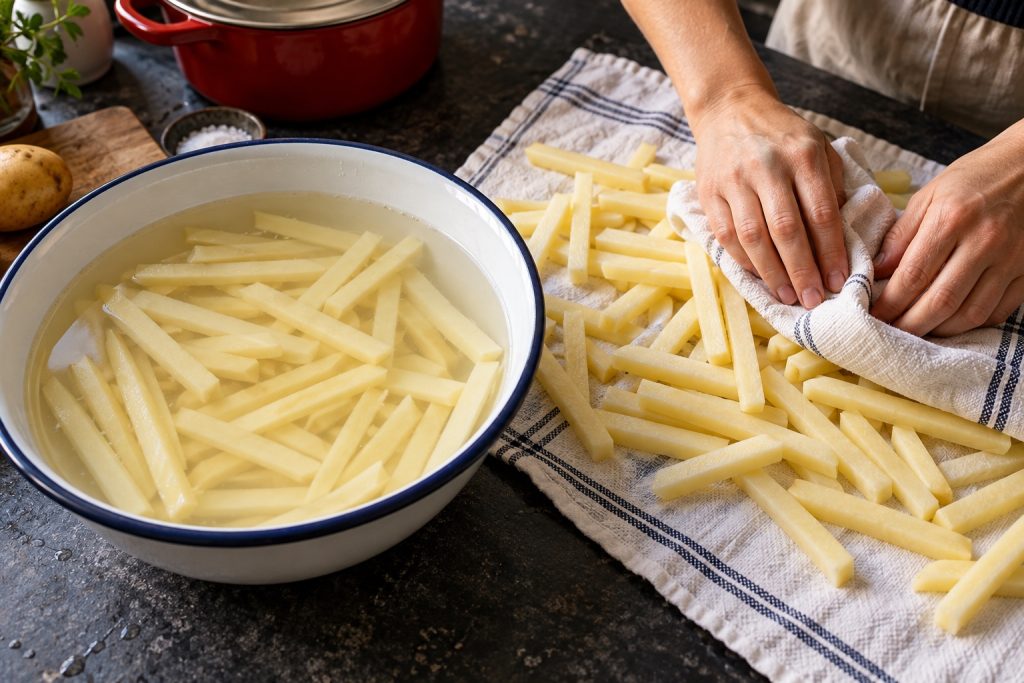
    Cut potatoes into ⅜-inch sticks and soak 30 minutes in cold water. Rinse until clearer, drain, and dry with towels until not a single surface droplet remains.

    Step-by-step method

    1. Cut, soak, and dry the potatoes

    Cut potatoes into ⅜-inch sticks and soak 30 minutes in cold water. Rinse until clearer, drain, and dry with towels until not a single surface droplet remains.

    2. Make smooth brown gravy

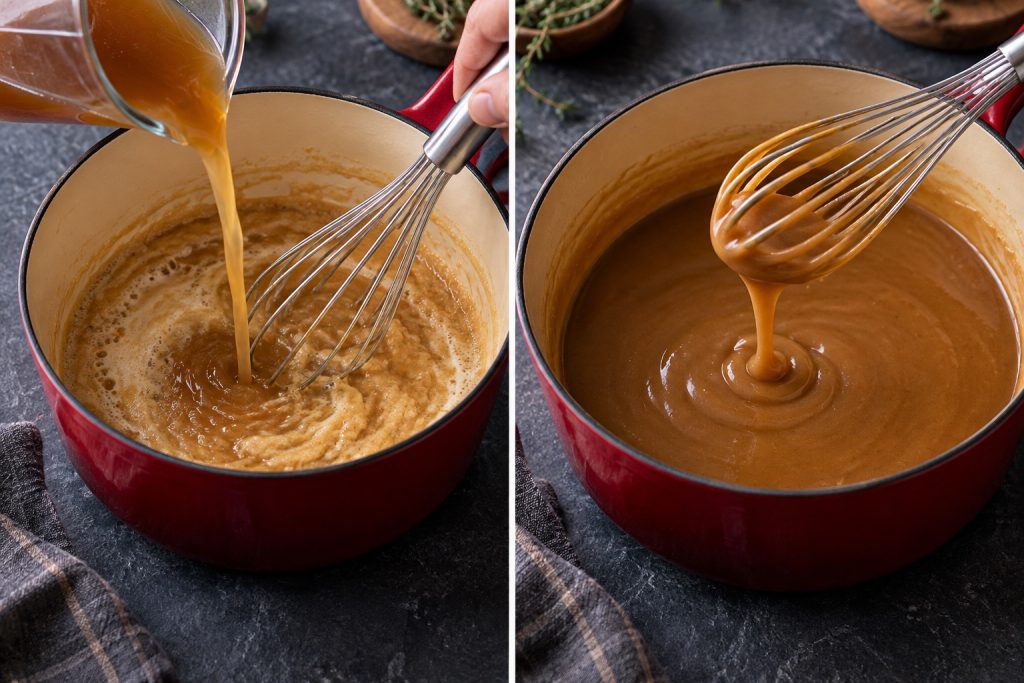
    Melt butter in a saucepan. Whisk in flour 3–4 minutes to pale nutty brown. Add warm broth gradually; simmer 5–7 minutes until it coats a spoon. Add Worcestershire and pepper and keep hot.

    Make smooth brown gravy
    Melt butter in a saucepan. Whisk in flour 3–4 minutes to pale nutty brown. Add warm broth gradually; simmer 5–7 minutes until it coats a spoon. Add Worcestershire and pepper and keep hot.

    3. Fry at two temperatures

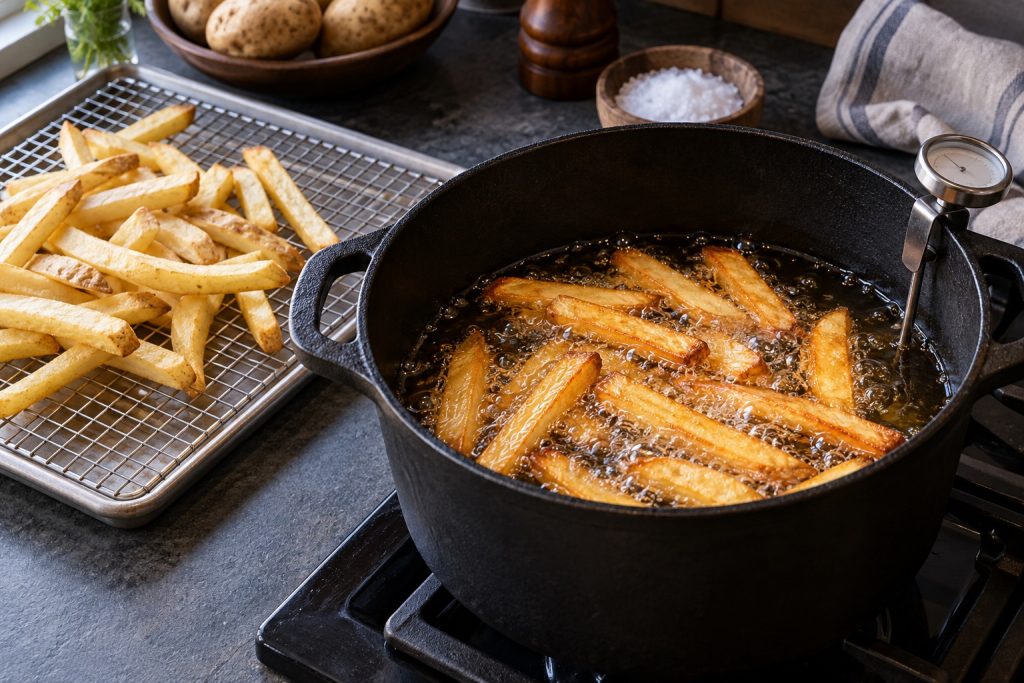
    Heat oil slowly to 320°F. Fry small batches 5–6 minutes until pale and tender; rest on a rack 10 minutes. Raise oil to 375°F and fry again 2–3 minutes until deep golden and crisp.

    Fry at two temperatures
    Heat oil slowly to 320°F. Fry small batches 5–6 minutes until pale and tender; rest on a rack 10 minutes. Raise oil to 375°F and fry again 2–3 minutes until deep golden and crisp.

    4. Assemble with curds and hot gravy

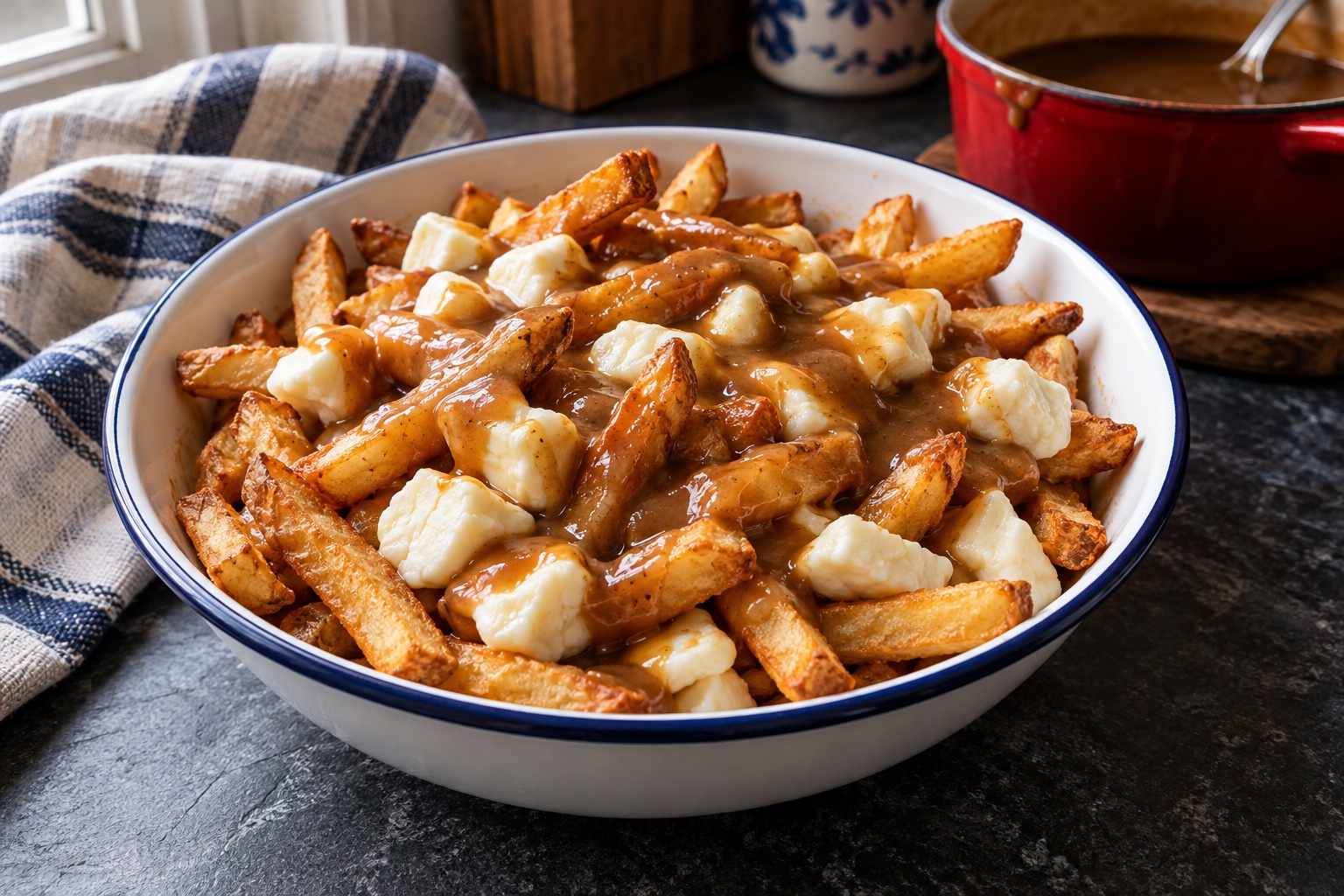
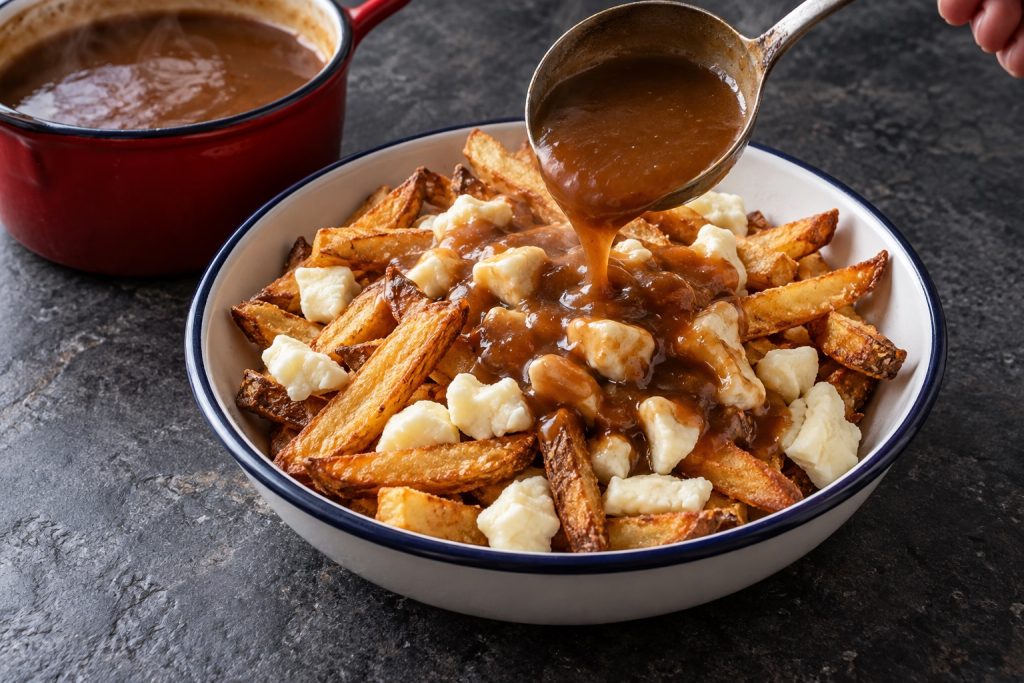
    Salt fries and divide among warm bowls. Scatter room-temperature curds over them. Spoon on hot but not violently boiling gravy only at serving time; serve immediately as the curds soften slightly.

    Assemble with curds and hot gravy
    Salt fries and divide among warm bowls. Scatter room-temperature curds over them. Spoon on hot but not violently boiling gravy only at serving time; serve immediately as the curds soften slightly.

    Texture and doneness cues

    Fries are deep golden and crisp outside, fluffy inside. Gravy coats a spoon yet pours; curds warm and soften without fully melting, retaining a slight squeak.

    Mistakes, substitutions, and measurements

    Large chunks of low-moisture mozzarella can substitute for fresh curds, but are not traditional poutine. Use vegetable broth and vegetarian Worcestershire for a meatless adaptation. Rice flour can replace wheat flour for gravy; verify all labels. Contains gluten and dairy. 1 cup liquid is 240 ml.

    Serving, storage, and allergens

    Poutine should be eaten immediately. Chill leftover fries, gravy, and curds separately within 2 hours and refrigerate 2–3 days. Bring gravy to a full boil and 165°F; re-crisp fries in a 400°F oven or air fryer. Do not freeze assembled poutine.

    Frequently asked questions

    Why did the fries go soggy immediately?

    The second fry was short or gravy went on early; crisp to deep gold and assemble at the table.

    Why did the curds stay cold?

    They were fridge-cold or gravy was lukewarm; temper curds 20 minutes and use hot gravy.

    Why is the gravy lumpy?

    Broth was added too fast; whisk warm broth gradually into the roux.

  • Japanese Oyakodon: Juicy Chicken and Egg Rice Bowl

    Japanese Oyakodon: Juicy Chicken and Egg Rice Bowl

    Oyakodon is a Japanese donburi of chicken and egg simmered in a sweet-savory dashi sauce over rice; its name means “parent-and-child bowl.”

    Japanese versions may leave the egg softer. This home adaptation cooks chicken to 165°F and the egg mixture to 160°F for a safer fully set result.

    Why this method works

    • Thigh meat stays juicier than breast during the short simmer.
    • Adding egg in two stages creates a binding lower layer and a moist upper layer.
    • A wide skillet keeps chicken in one layer for even cooking.

    Before you start

    Use a lidded 10-inch skillet, board, separate raw-chicken knife, and thermometer.

    Unsalted chicken stock can replace dashi, but it is an adaptation.

    Wash the board and knife that touched raw chicken with hot soapy water.

    Prepare ingredients safely
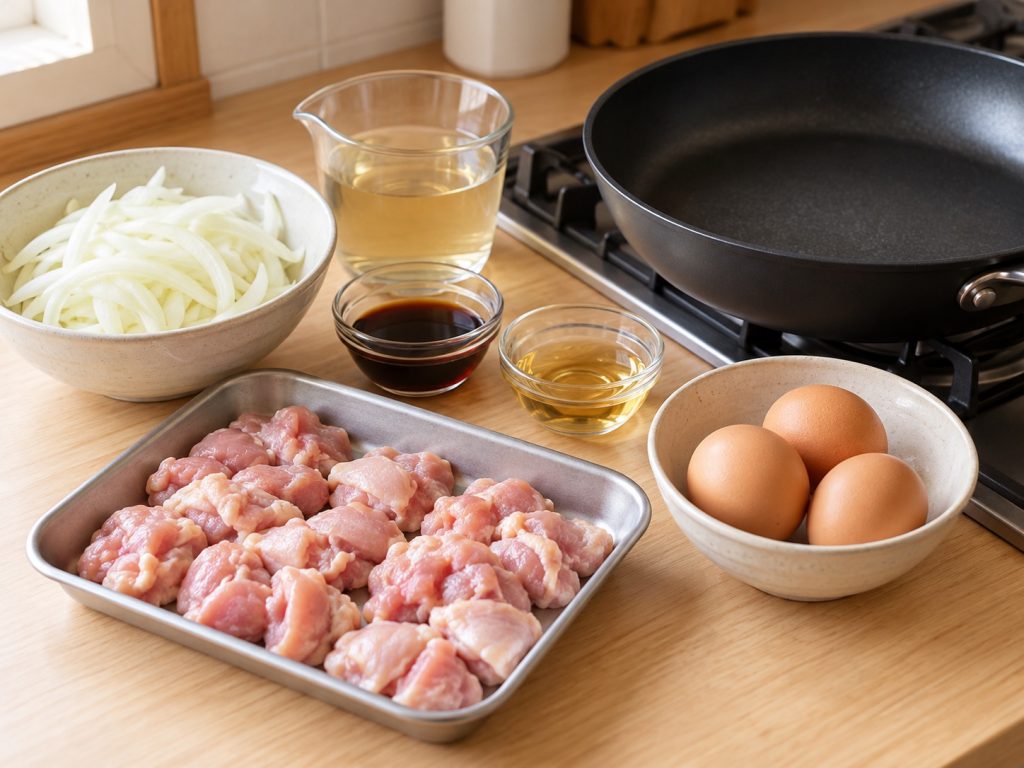
    Divide hot rice among four bowls. Cut chicken into ¾-inch pieces. Mix dashi, soy, mirin, and sugar; lightly beat eggs so a few streaks remain.

    Step-by-step method

    1. Prepare ingredients safely

    Divide hot rice among four bowls. Cut chicken into ¾-inch pieces. Mix dashi, soy, mirin, and sugar; lightly beat eggs so a few streaks remain.

    2. Simmer chicken and onion

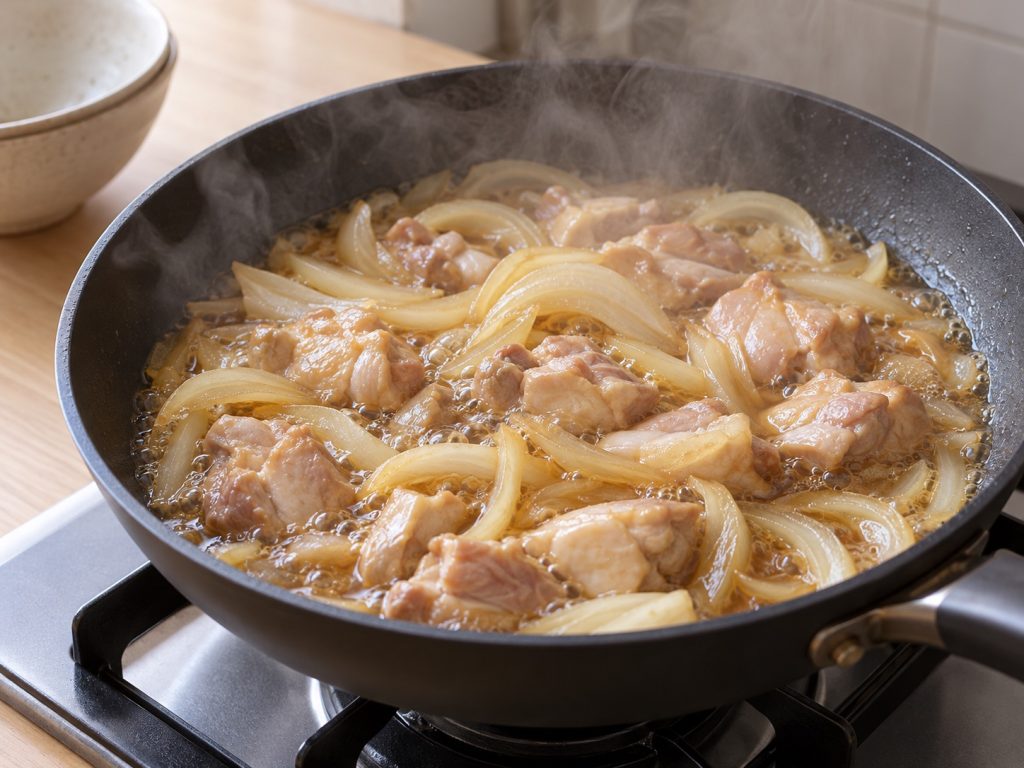
    Simmer sauce and onion gently for 3 minutes. Add chicken in one layer, cover, and cook 6–8 minutes until the thickest piece reaches 165°F.

    Simmer chicken and onion
    Simmer sauce and onion gently for 3 minutes. Add chicken in one layer, cover, and cook 6–8 minutes until the thickest piece reaches 165°F.

    3. Add egg in two stages

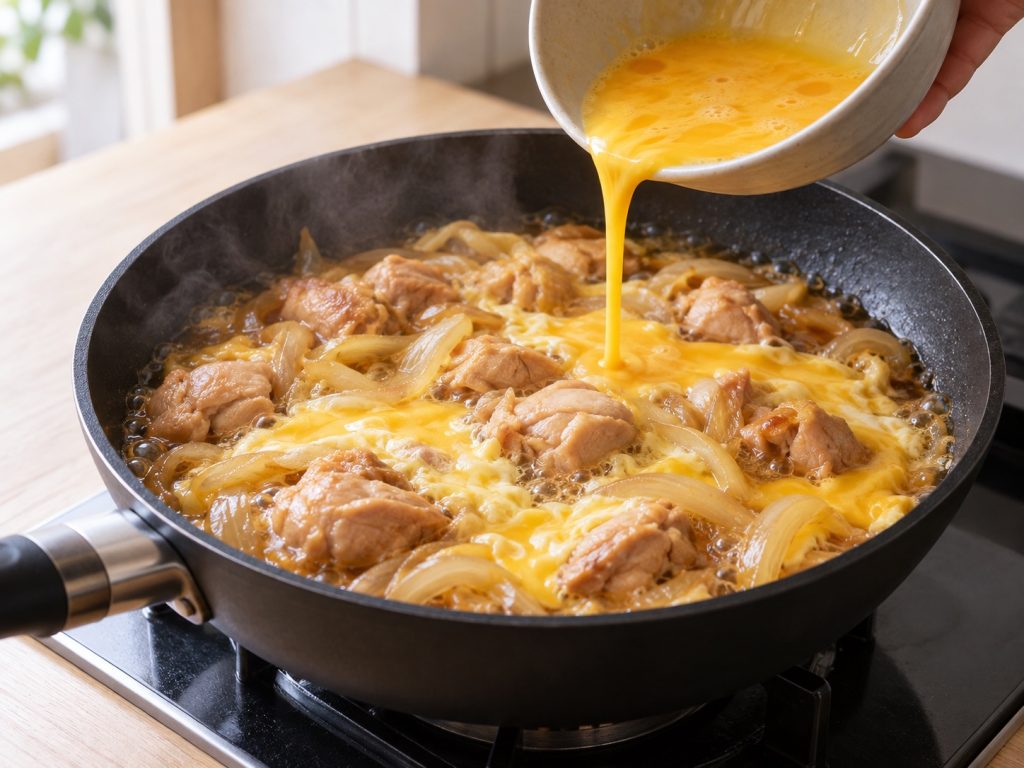
    With the liquid bubbling steadily, stream in two-thirds of the egg. Cover 60–90 seconds; add the rest and cook 1–2 minutes until the center reaches 160°F and no liquid egg remains.

    Add egg in two stages
    With the liquid bubbling steadily, stream in two-thirds of the egg. Cover 60–90 seconds; add the rest and cook 1–2 minutes until the center reaches 160°F and no liquid egg remains.

    4. Serve immediately over rice

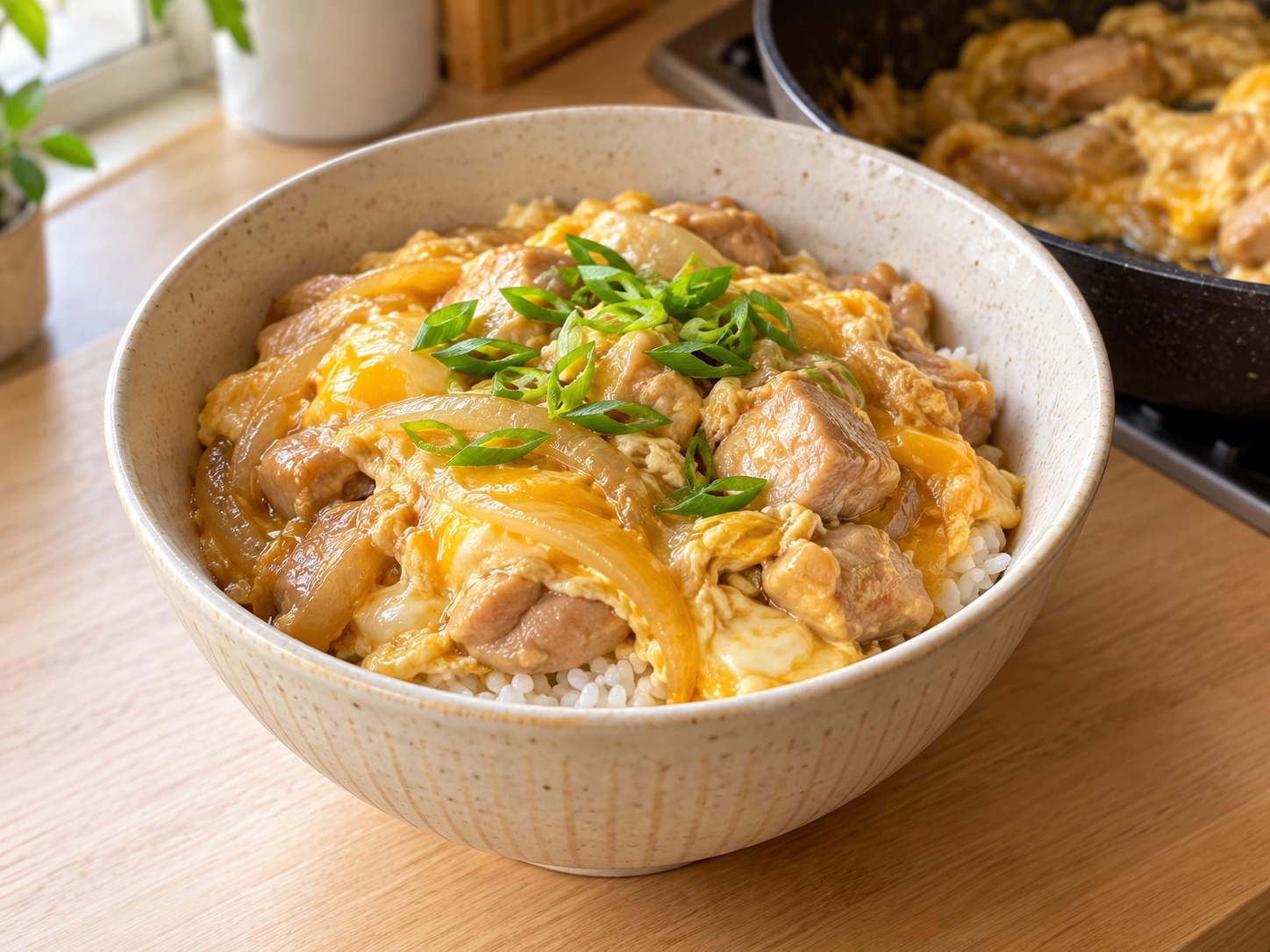
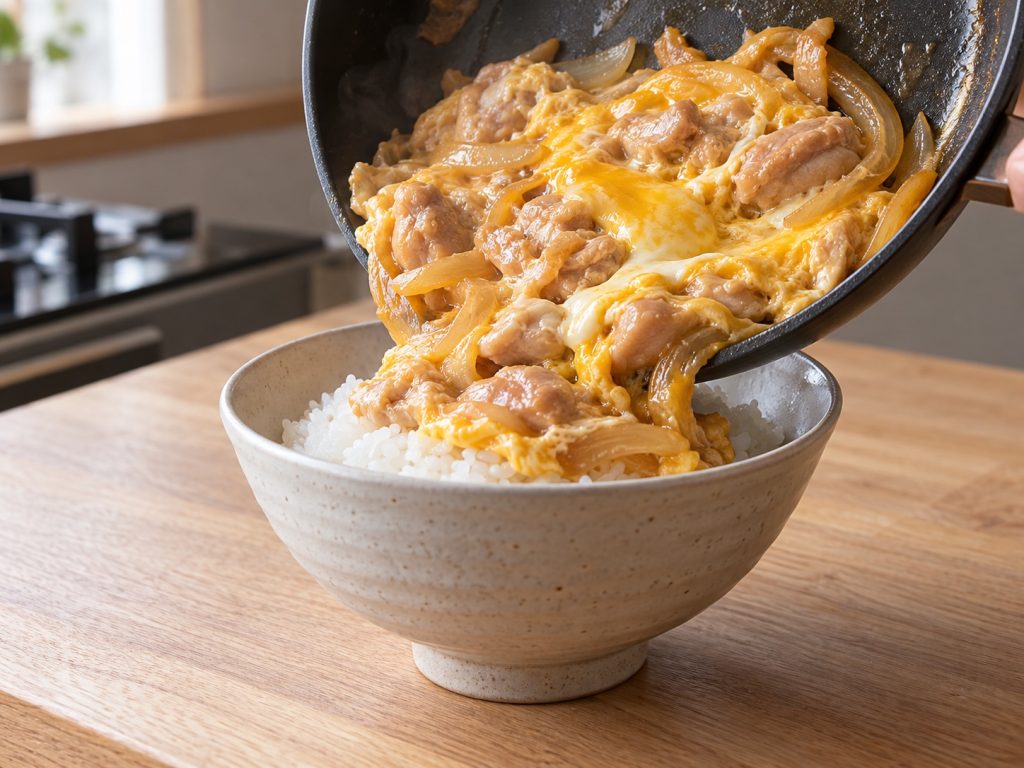
    Remove from heat. Divide chicken, egg, and broth over the hot rice, add scallions, and serve immediately.

    Serve immediately over rice
    Remove from heat. Divide chicken, egg, and broth over the hot rice, add scallions, and serve immediately.

    Texture and doneness cues

    Chicken is opaque at 165°F; egg is moist but not runny at 160°F; onion is translucent and sauce remains fluid enough to soak the rice.

    Mistakes, substitutions, and measurements

    Chicken breast works but check temperature earlier. Unsalted stock for dashi is an adaptation. Use certified tamari for gluten-free service. 1 cup=240 ml; 1 tbsp=15 ml.

    Serving, storage, and allergens

    Serve alone or with pickles. Cool in a shallow container within 2 hours, refrigerate 3–4 days, and reheat to 165°F. Freezing is not recommended because egg texture suffers. Contains egg and soy; regular soy sauce may contain gluten.

    Frequently asked questions

    Why did the egg turn firm?

    Carryover heat continued cooking it; remove from heat as soon as it reaches 160°F.

    Why is there too much broth?

    The pan may be narrow or heat too low; reduce uncovered 1–2 minutes before adding egg.

    Can I make it without dashi?

    Yes, use unsalted chicken stock and recognize the flavor is an adaptation.

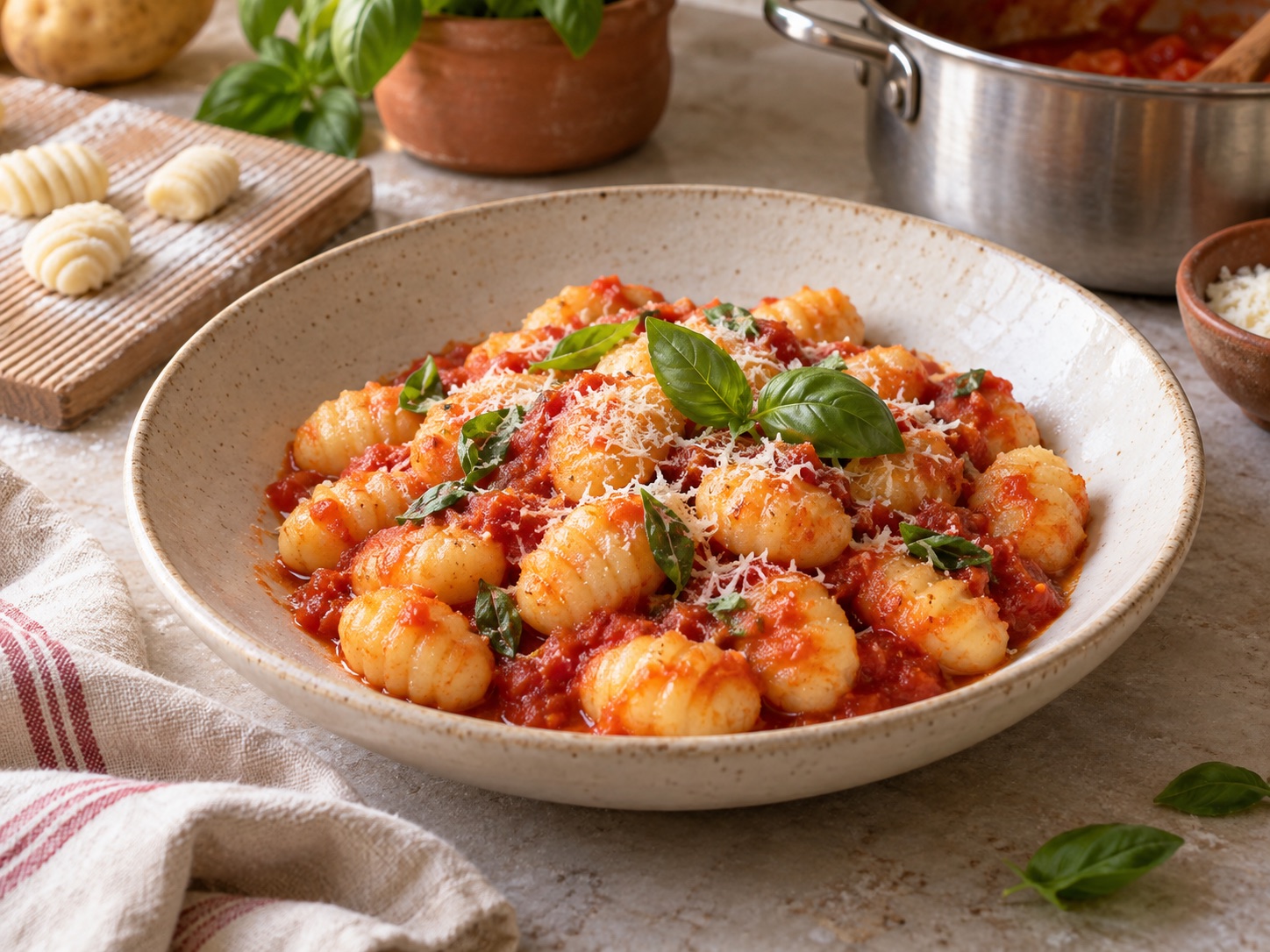
  • Homemade Potato Gnocchi: Light, Tender, Never Gummy

    Homemade Potato Gnocchi: Light, Tender, Never Gummy

    Potato gnocchi are small Italian potato dumplings especially associated with northern regions; formulas may use egg or be eggless.

    Success depends more on potato dryness than a fixed flour number. We bake the potatoes and adjust flour with a test piece.

    Why this method works

    • Baking prevents potatoes from absorbing cooking water.
    • Ricing while hot prevents lumps, while minimal mixing limits gumminess.
    • A test gnocchi lets you correct the dough before shaping the whole batch.

    Before you start

    Use a potato ricer, bench scraper, wide pot, spider, and gnocchi board or fork.

    Choose floury, starchy potatoes; waxy or new potatoes need more flour.

    Shape and cook without a long rest because potato dough releases moisture.

    Bake and rice the potatoes
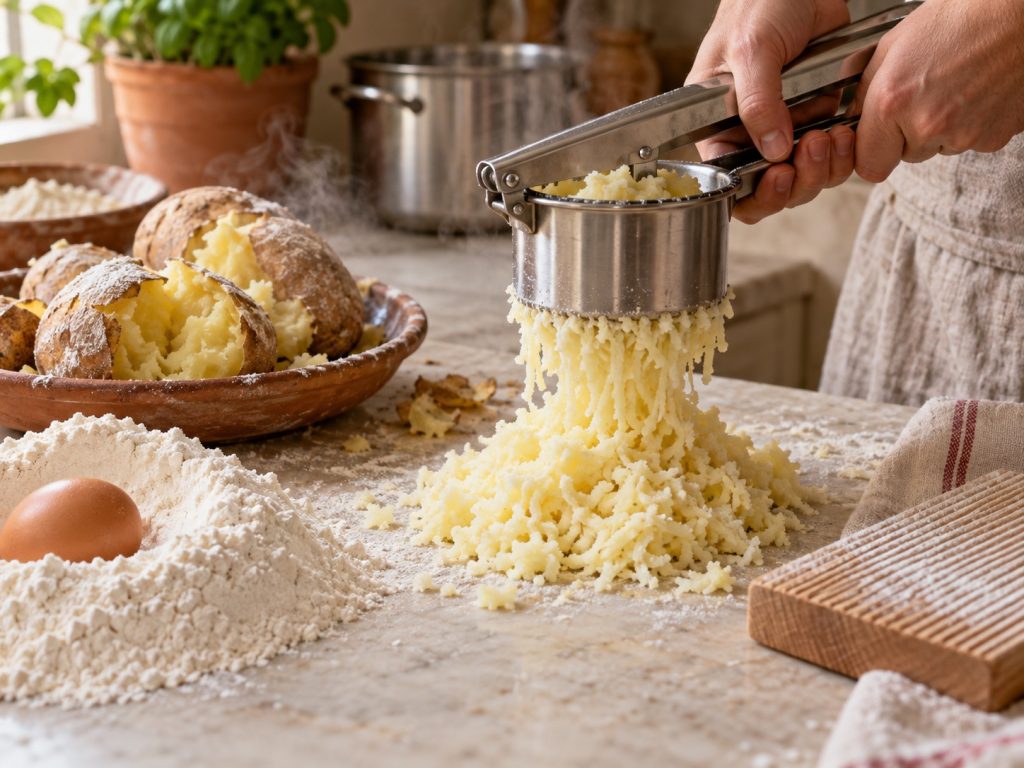
    Bake potatoes at 400°F for 50–65 minutes until a knife meets no resistance. Split hot, scoop, and rice onto the counter; let steam escape 5 minutes.

    Step-by-step method

    1. Bake and rice the potatoes

    Bake potatoes at 400°F for 50–65 minutes until a knife meets no resistance. Split hot, scoop, and rice onto the counter; let steam escape 5 minutes.

    2. Bring the dough together gently

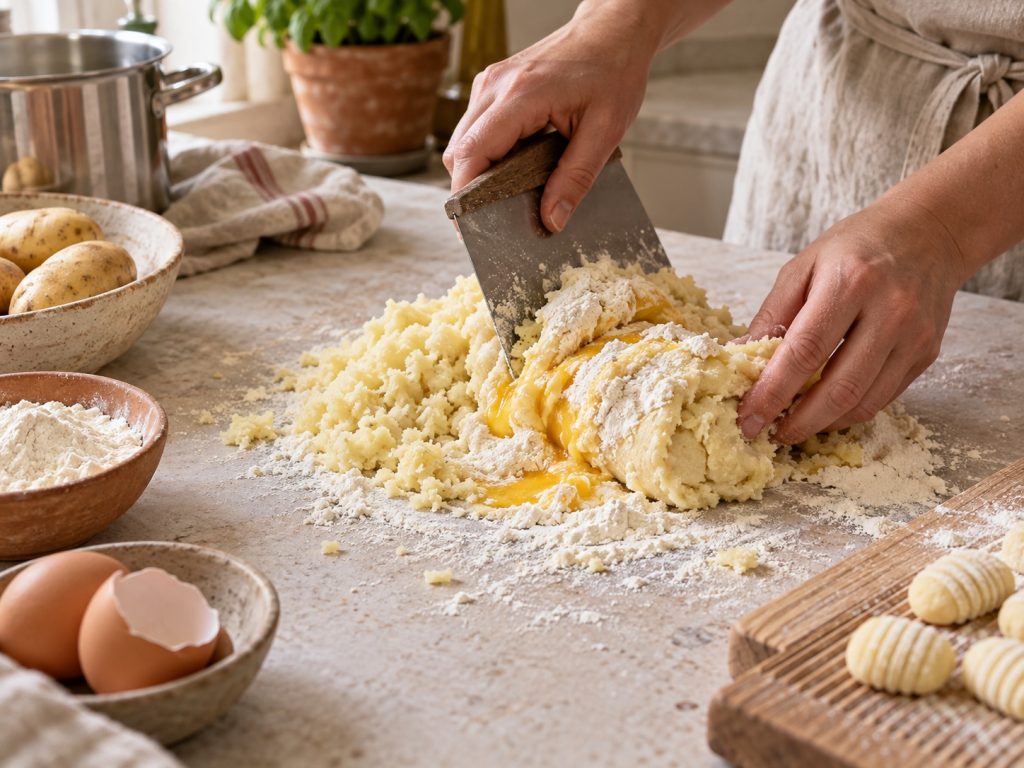
    Scatter 180 g flour over potato. Add egg and salt; fold with a scraper only 60–90 seconds until combined. If sticky, add remaining flour 1 tablespoon at a time.

    Bring the dough together gently
    Scatter 180 g flour over potato. Add egg and salt; fold with a scraper only 60–90 seconds until combined. If sticky, add remaining flour 1 tablespoon at a time.

    3. Cut and shape the ridges

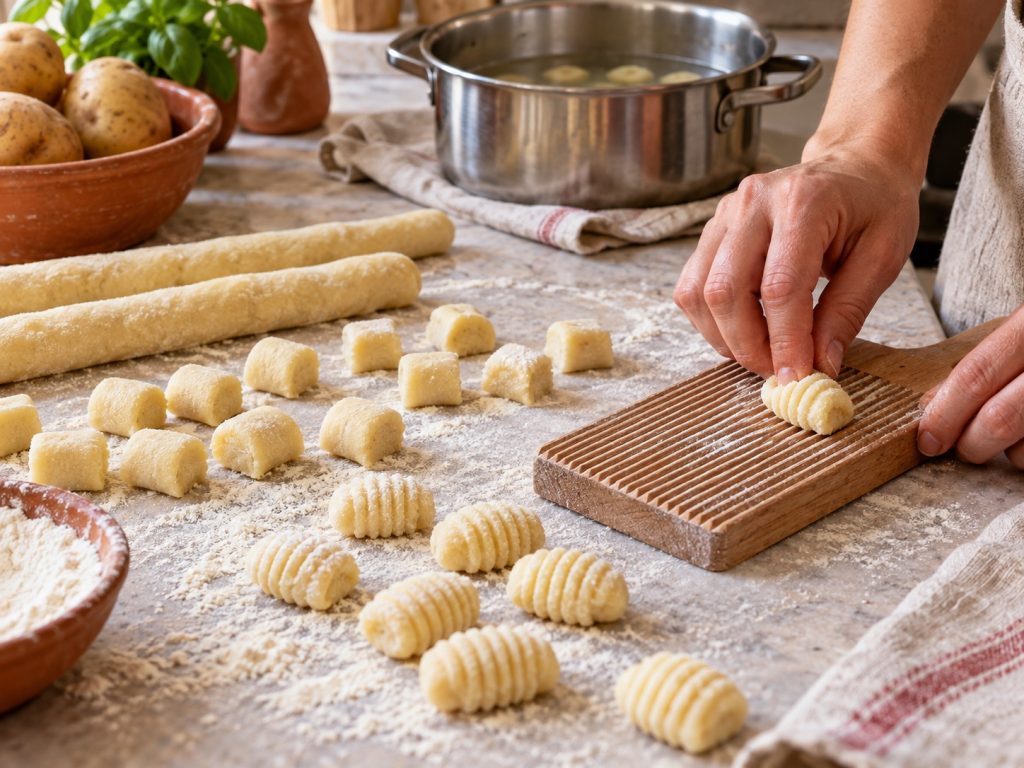
    Boil one test piece; if it breaks, fold 1 tablespoon flour into the dough. Divide into four, roll ¾-inch ropes, cut 1-inch pieces, and lightly ridge on a fork or board.

    Cut and shape the ridges
    Boil one test piece; if it breaks, fold 1 tablespoon flour into the dough. Divide into four, roll ¾-inch ropes, cut 1-inch pieces, and lightly ridge on a fork or board.

    4. Cook in batches and sauce

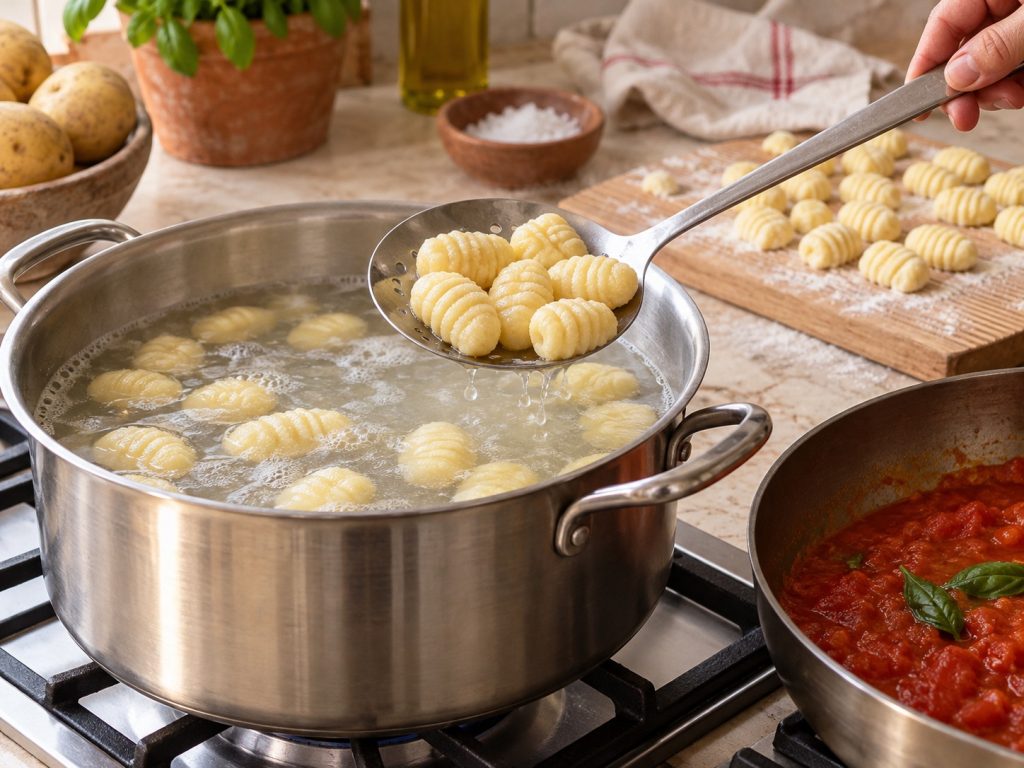
    Simmer passata with oil and crushed garlic for 15 minutes. Cook gnocchi in small batches in gently boiling salted water; 30–60 seconds after they float, lift into sauce and toss gently with basil.

    Cook in batches and sauce
    Simmer passata with oil and crushed garlic for 15 minutes. Cook gnocchi in small batches in gently boiling salted water; 30–60 seconds after they float, lift into sauce and toss gently with basil.

    Texture and doneness cues

    Dough is soft and slightly tacky but not smearing; cooked gnocchi float, hold shape, and feel pillowy rather than dense or rubbery.

    Mistakes, substitutions, and measurements

    Egg can be omitted; very dry potatoes may need 20–40 g extra flour. If volume is unavoidable, 1 cup flour is about 125 g. Contains gluten and egg; optional cheese adds dairy.

    Serving, storage, and allergens

    Serve with tomato-basil or brown butter and sage. Cool cooked gnocchi within 2 hours and refrigerate up to 2 days. Tray-freeze raw pieces, bag for 2 months, and boil from frozen.

    Frequently asked questions

    Why are they gummy?

    Too much flour or mixing developed structure; use dry potatoes and fold briefly.

    Why did they fall apart?

    Potatoes were wet or binding was low; add flour by tablespoons after the test piece.

    Can I make them ahead?

    Freeze raw gnocchi immediately on a tray rather than resting; boil from frozen.

  • Palak Paneer: Creamy Spinach Curry That Stays Green

    Palak Paneer: Creamy Spinach Curry That Stays Green

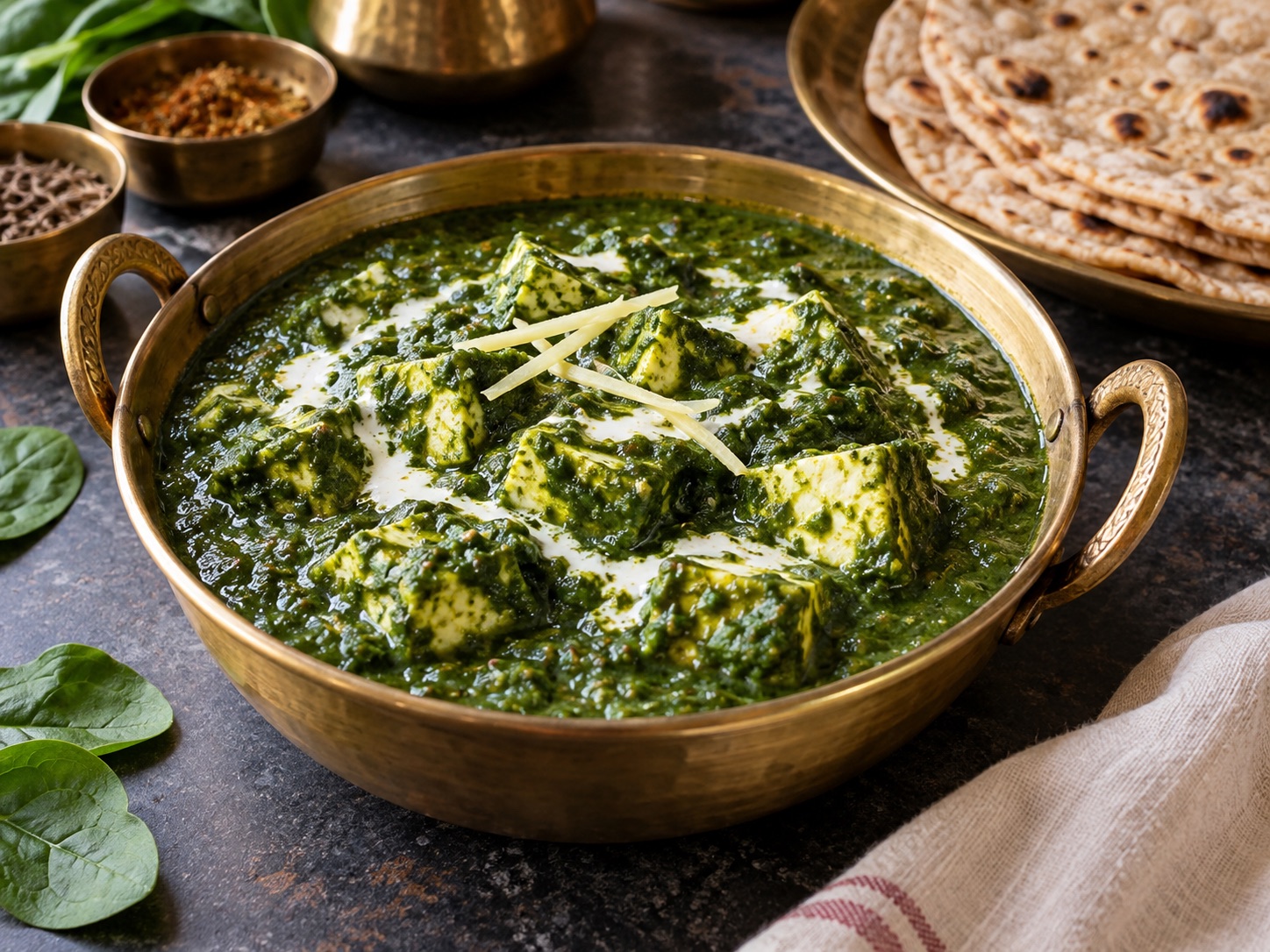
    Palak paneer is a North Indian main combining spinach purée with fresh non-melting paneer, commonly served with roti, naan, or rice.

    This version uses no artificial color: brief blanching, ice water, and a short simmer preserve the natural green.

    Why this method works

    • Brief blanching removes raw flavor without fading the spinach too far.
    • Cooking the onion-tomato base separately avoids a long simmer of the purée.
    • Adding paneer only at the end keeps it tender.

    Before you start

    Use a wide pot, ice-water bowl, blender, and lidded skillet or kadai.

    Wash spinach in several changes of water until no grit remains.

    Do not seal hot purée in a full blender; cool briefly and vent steam.

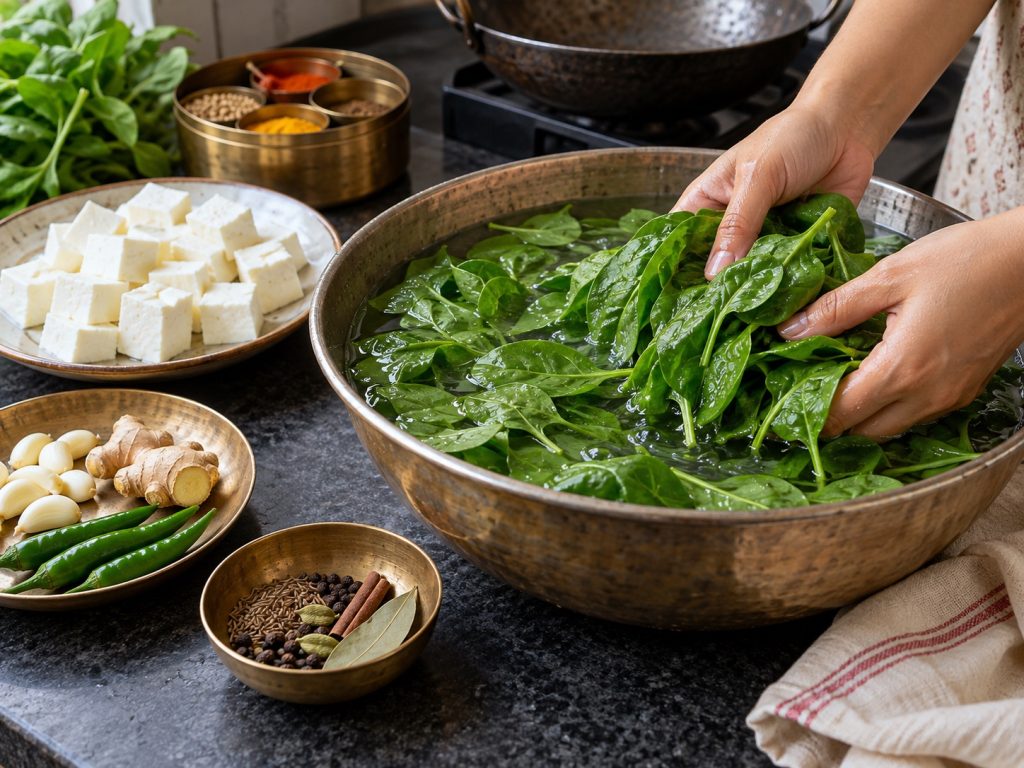
    Wash the spinach thoroughly
    Wash spinach in three changes of water, letting grit settle and lifting leaves out. Cut paneer into ¾-inch cubes. Finely chop ginger, garlic, and chile.

    Step-by-step method

    1. Wash the spinach thoroughly

    Wash spinach in three changes of water, letting grit settle and lifting leaves out. Cut paneer into ¾-inch cubes. Finely chop ginger, garlic, and chile.

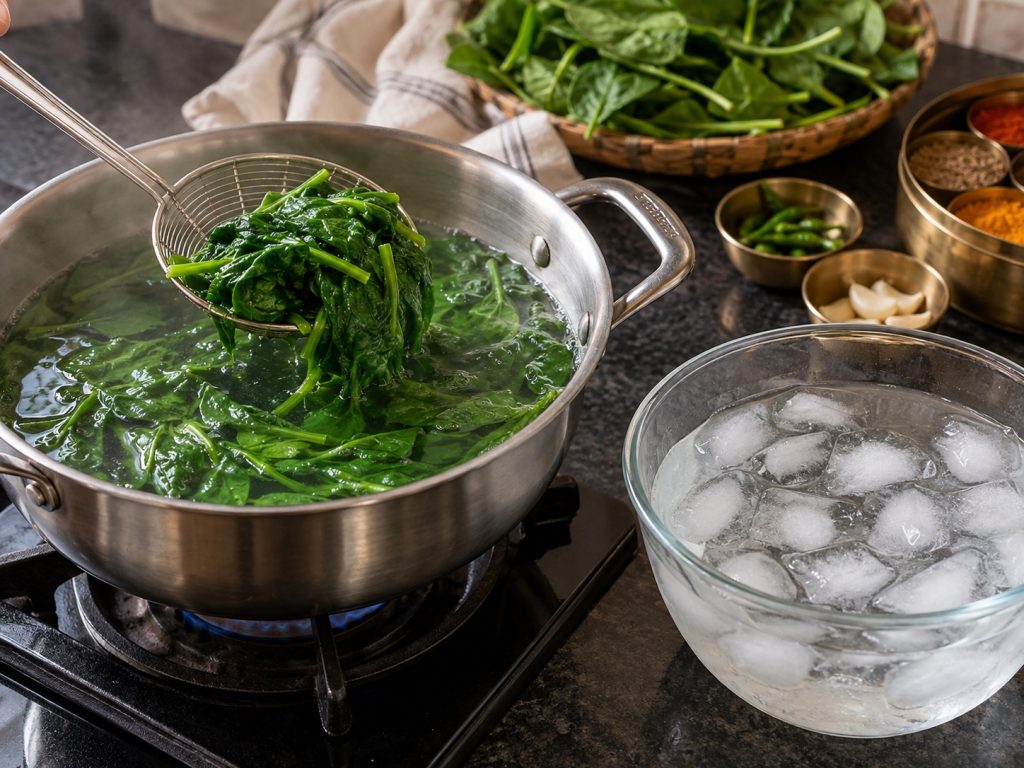
    2. Blanch briefly and chill

    Boil a large pot of water. Blanch spinach 60–90 seconds, only until collapsed and bright green; move immediately to ice water. Drain without squeezing and blend smooth with ¼ cup water.

    Blanch briefly and chill
    Boil a large pot of water. Blanch spinach 60–90 seconds, only until collapsed and bright green; move immediately to ice water. Drain without squeezing and blend smooth with ¼ cup water.

    3. Cook the spiced base

    Heat oil over medium. Stir cumin 20 seconds; soften onion 7–9 minutes. Cook ginger, garlic, and chile 1 minute; add tomato, coriander, and turmeric and cook 6–8 minutes until thick.

    Cook the spiced base
    Heat oil over medium. Stir cumin 20 seconds; soften onion 7–9 minutes. Cook ginger, garlic, and chile 1 minute; add tomato, coriander, and turmeric and cook 6–8 minutes until thick.

    4. Combine purée, paneer, and cream

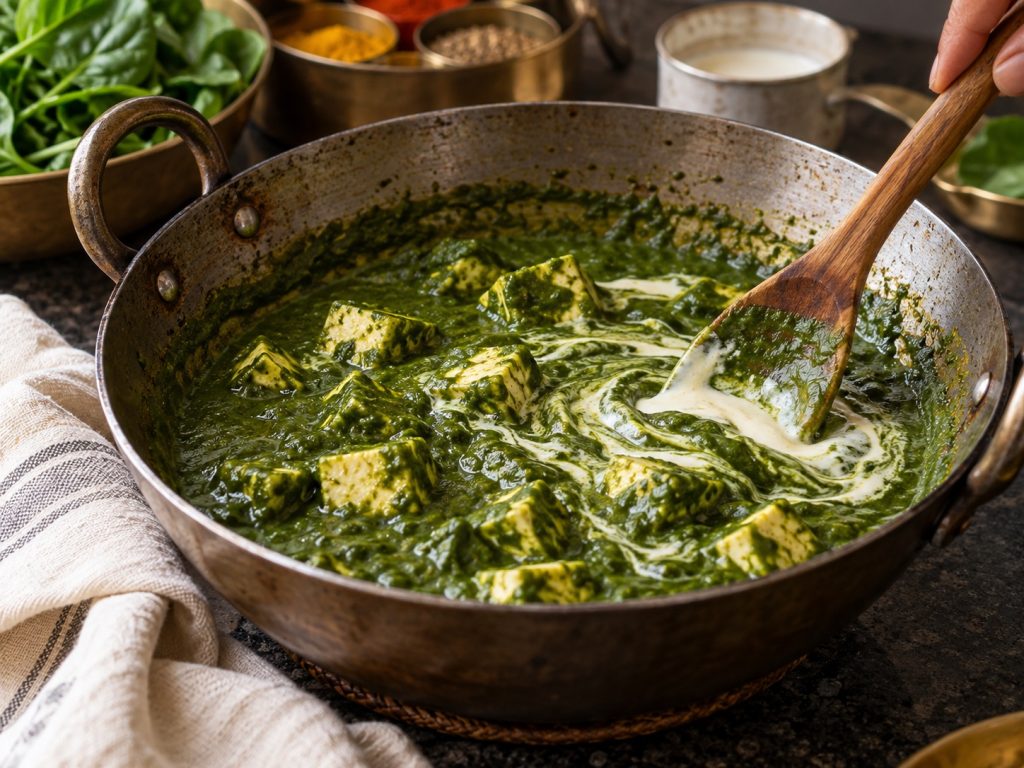
    Add spinach purée and salt; simmer gently 5 minutes, loosening with remaining water as needed. Add paneer for 3–4 minutes. Turn off heat and stir in garam masala and cream; do not hard-boil.

    Combine purée, paneer, and cream
    Add spinach purée and salt; simmer gently 5 minutes, loosening with remaining water as needed. Add paneer for 3–4 minutes. Turn off heat and stir in garam masala and cream; do not hard-boil.

    Texture and doneness cues

    Sauce should coat a spoon, stay naturally deep green, and show no oil puddles; paneer is hot but not spongy or rubbery.

    Mistakes, substitutions, and measurements

    Well-drained firm tofu can replace paneer as an adaptation. For frozen spinach, thaw, squeeze, and skip blanching. Full-fat yogurt can replace cream if stirred in off heat. Contains dairy. 1 cup=240 ml.

    Serving, storage, and allergens

    Serve with roti, naan, or basmati rice. Cool in a shallow container within 2 hours, refrigerate 3–4 days, and reheat gently to 165°F. Freeze up to 1 month, expecting texture changes.

    Frequently asked questions

    Why did it turn dark?

    Spinach was over-blanched or purée simmered too long; blanch 60–90 seconds and simmer only 5 minutes.

    Why is paneer rubbery?

    It hard-boiled too long; add it for only the final 3–4 minutes.

    Why does the spinach taste bitter?

    Mature stems or burnt spices may be responsible; remove thick stems and bloom spices briefly over medium heat.

  • Chinese Scallion Pancakes: Crisp, Flaky Cong You Bing

    Chinese Scallion Pancakes: Crisp, Flaky Cong You Bing

    Cong you bing is a Chinese wheat pancake layered with scallions; thickness and folds vary by region.

    Hot water tenderizes the dough while a spiral roll creates distinct flaky layers.

    Why this method works

    • Boiling water limits some gluten and makes rolling easier.
    • Flour-oil paste separates the layers.
    • Medium heat cooks the center before the crust burns.

    Before you start

    Use a skillet, rolling pin, brush, and lid; rest dough at least 30 minutes.

    Slice scallions very thin and dry; wet scallions make layers slip.

    Keep your face away from the pan to avoid oil splatter.

    Make and rest hot-water dough
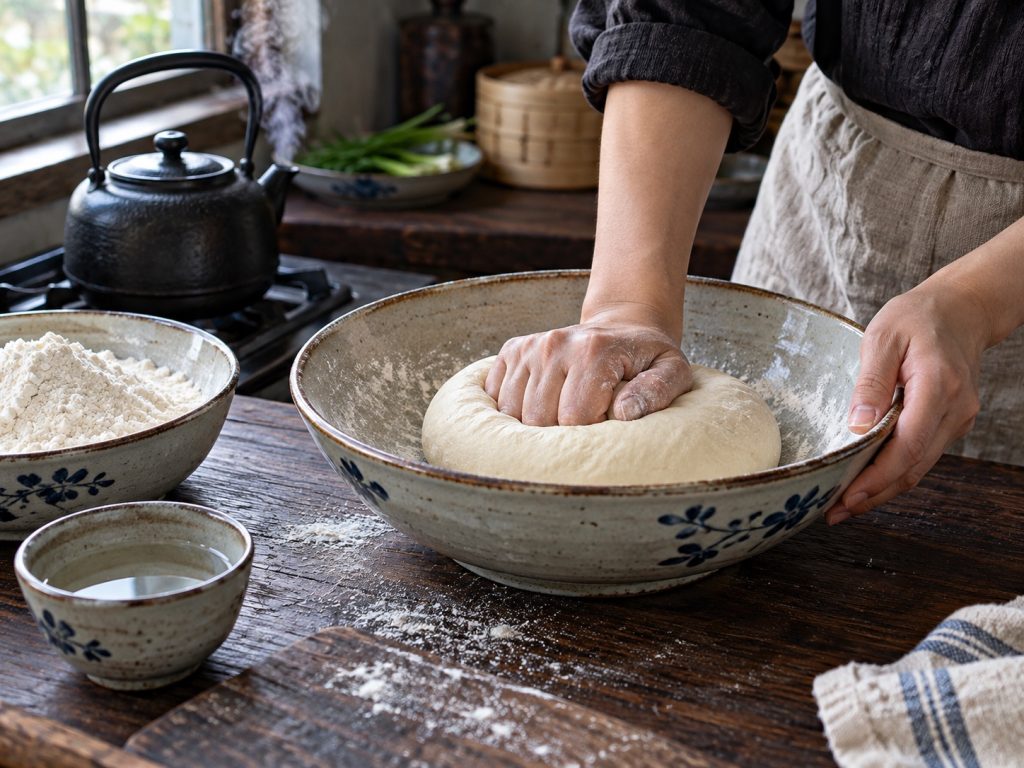
    Stir boiling water into flour, add cold water, and knead 5 minutes. Cover and rest 30 minutes. Mix ¼ cup flour, 3 tbsp oil, and salt into a smooth paste.

    Step-by-step method

    1. Make and rest hot-water dough

    Stir boiling water into flour, add cold water, and knead 5 minutes. Cover and rest 30 minutes. Mix ¼ cup flour, 3 tbsp oil, and salt into a smooth paste.

    2. Roll thin layers

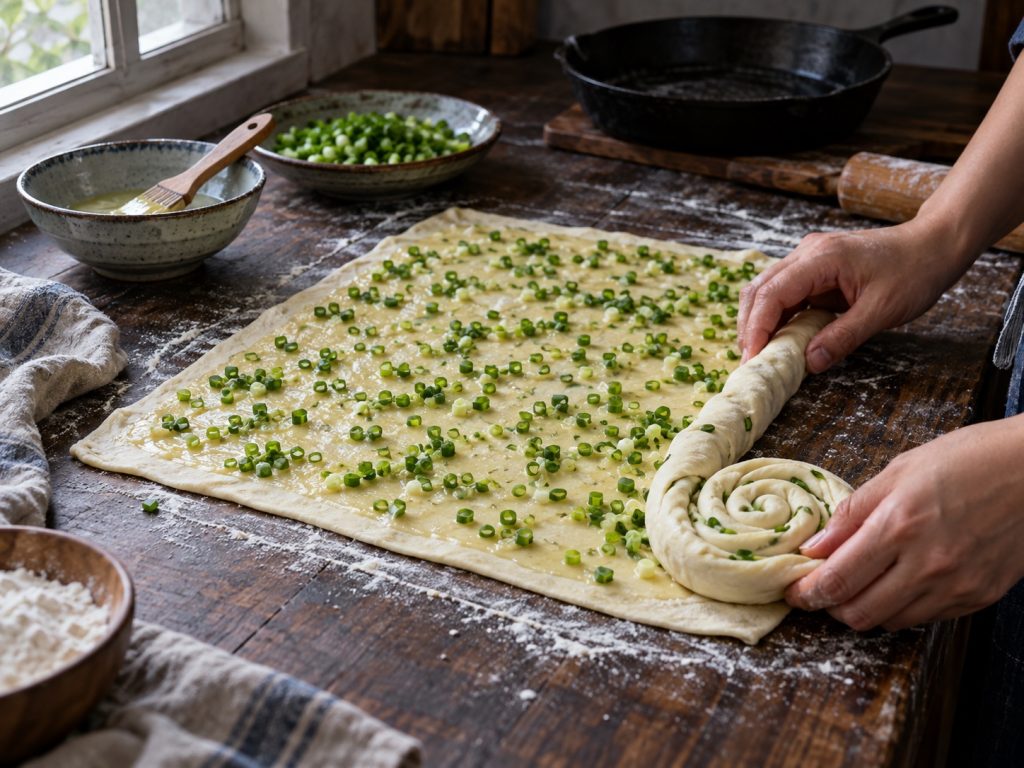
    Divide dough into 8. Roll each into a thin rectangle, brush with a very thin paste layer, scatter scallions, roll into a rope, then coil. Rest 10 minutes.

    Roll thin layers
    Divide dough into 8. Roll each into a thin rectangle, brush with a very thin paste layer, scatter scallions, roll into a rope, then coil. Rest 10 minutes.

    3. Flatten the spirals

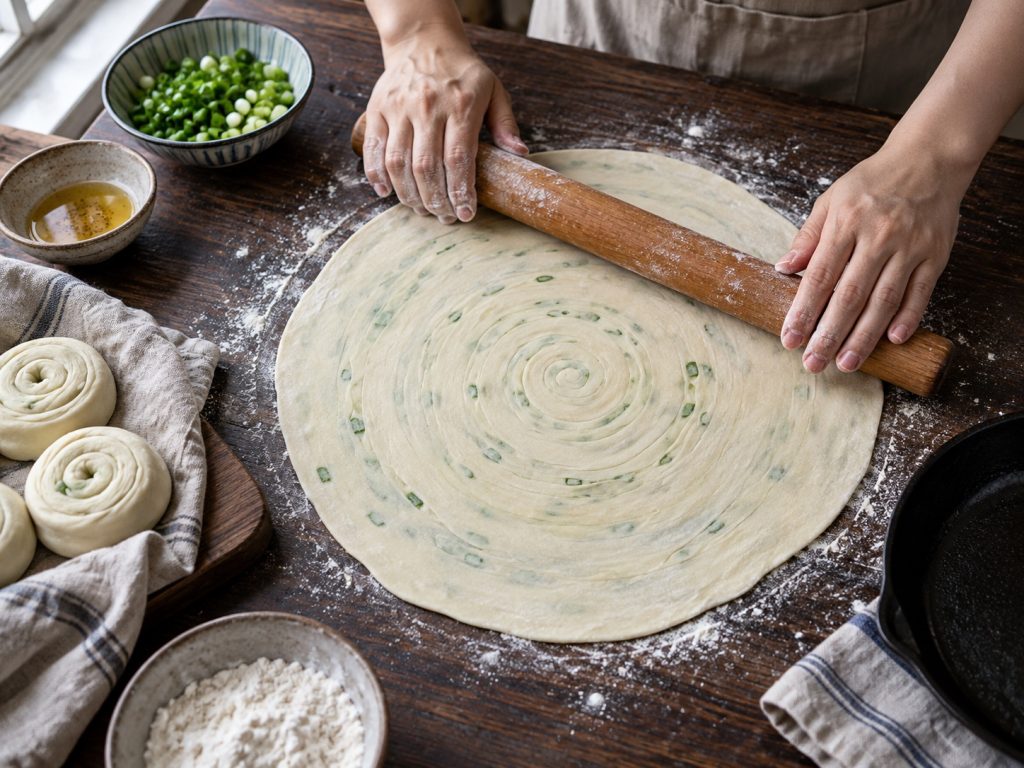
    Gently roll each coil into a 6–7-inch round. Use short center-out strokes so the layers stay distinct.

    Flatten the spirals
    Gently roll each coil into a 6–7-inch round. Use short center-out strokes so the layers stay distinct.

    4. Pan-fry over medium heat

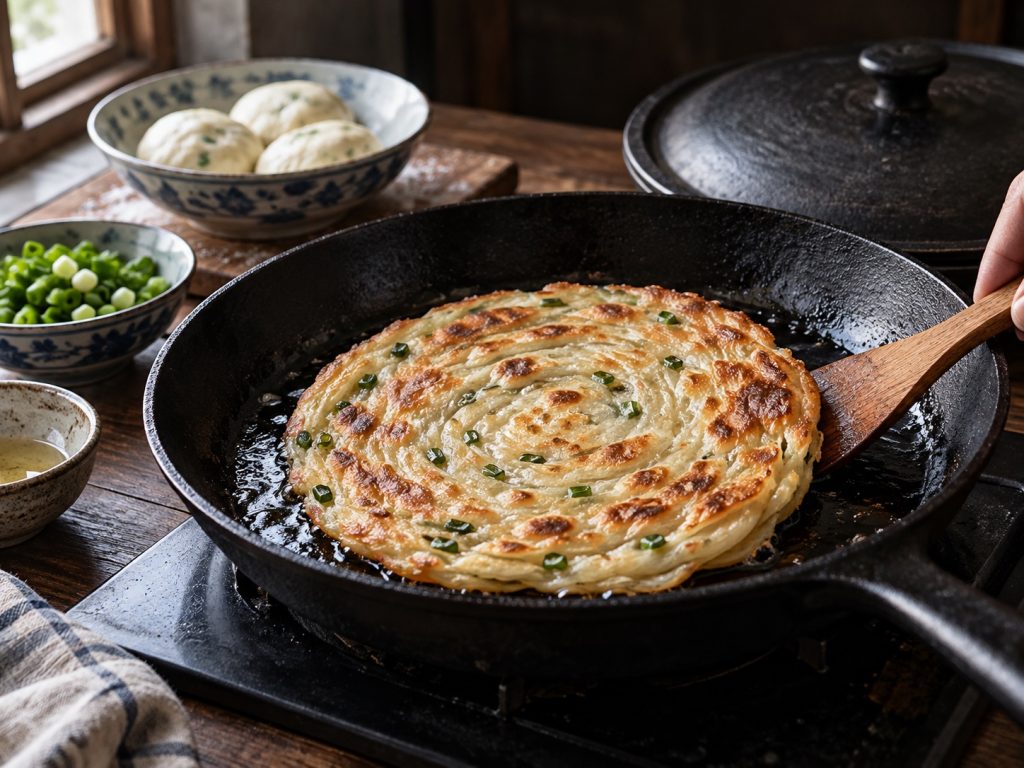
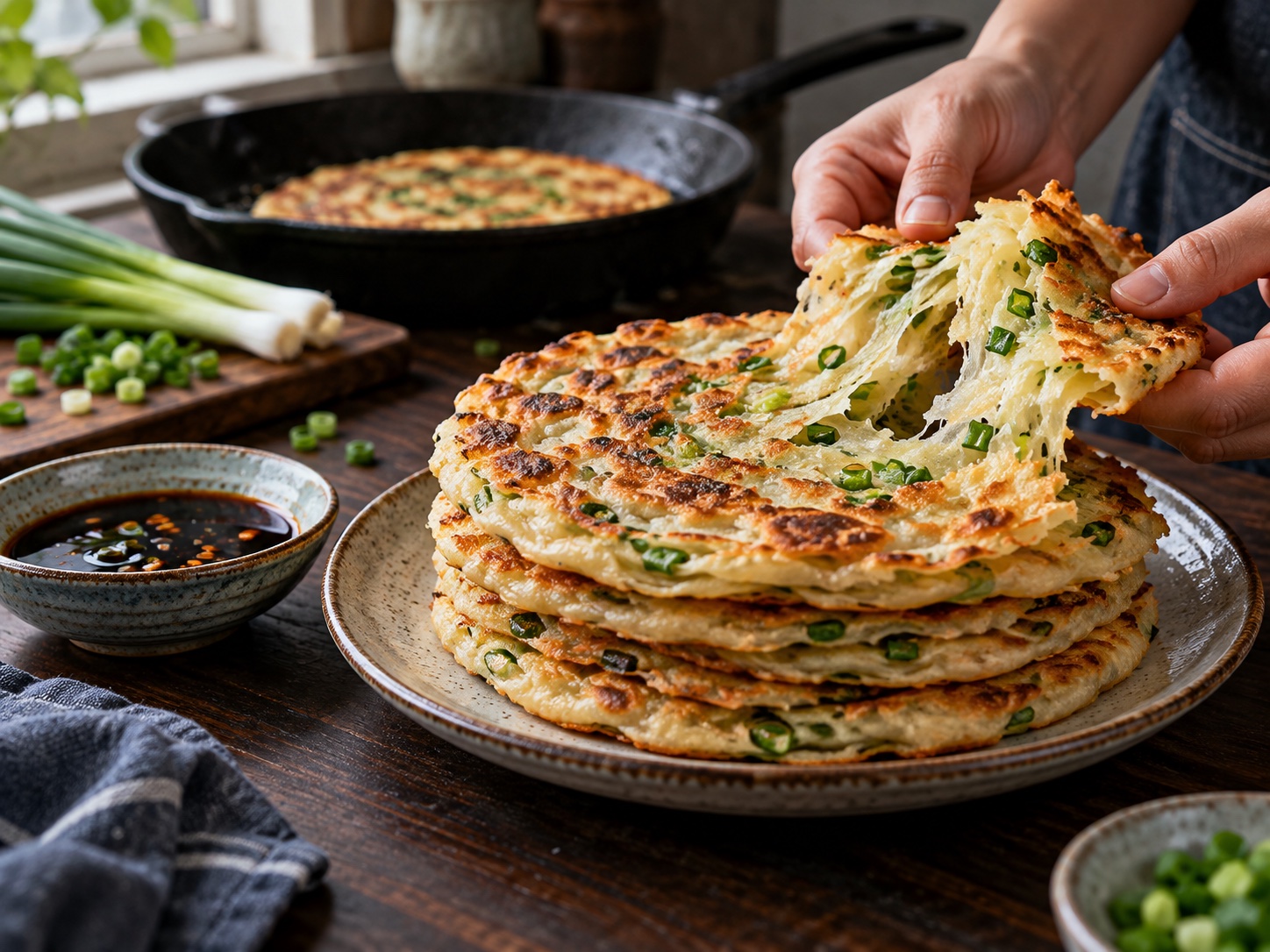
    Heat remaining oil in a skillet over medium. Cook covered 2 minutes, flip, then cook uncovered 2–3 minutes until both sides are golden and crisp; gently fluff the edge.

    Pan-fry over medium heat
    Heat remaining oil in a skillet over medium. Cook covered 2 minutes, flip, then cook uncovered 2–3 minutes until both sides are golden and crisp; gently fluff the edge.

    Texture and doneness cues

    Surface is mottled gold, edges crisp, center flexible but not doughy, and layers pull apart.

    Mistakes, substitutions, and measurements

    Chives can replace scallions; sesame oil is optional. Contains gluten. 1 cup=240 ml.

    Serving, storage, and allergens

    Serve with soy-vinegar dip. Cool within 2 hours; refrigerate 3 days or freeze cooked pancakes 2 months. Re-crisp in a dry skillet.

    Frequently asked questions

    Why are there no layers?

    The paste may be too thick or coils were rolled without resting.

    Why is the center raw?

    Heat was too high or pancake too thick; use medium heat and cover first.

    Can I make ahead?

    Chill coils 24 hours or freeze cooked pancakes 2 months.

  • Venezuelan Arepas: Crisp Outside, Soft Pocket

    Venezuelan Arepas: Crisp Outside, Soft Pocket

    Arepas are everyday Venezuelan corn breads with Indigenous roots, served hot and split for many fillings.

    This method requires precooked white cornmeal; polenta or standard cornmeal will not hydrate the same way.

    Why this method works

    • Adding flour to water reduces lumps.
    • A 10-minute rest evens hydration.
    • The skillet builds crust; the oven sets the pocket.

    Before you start

    Use precooked cornmeal, bowl, skillet, and sheet; preheat to 400°F.

    Dough should feel like soft modeling clay; seal edge cracks with wet fingers.

    For gluten-free service, verify certified flour and fillings.

    Mix in the right order
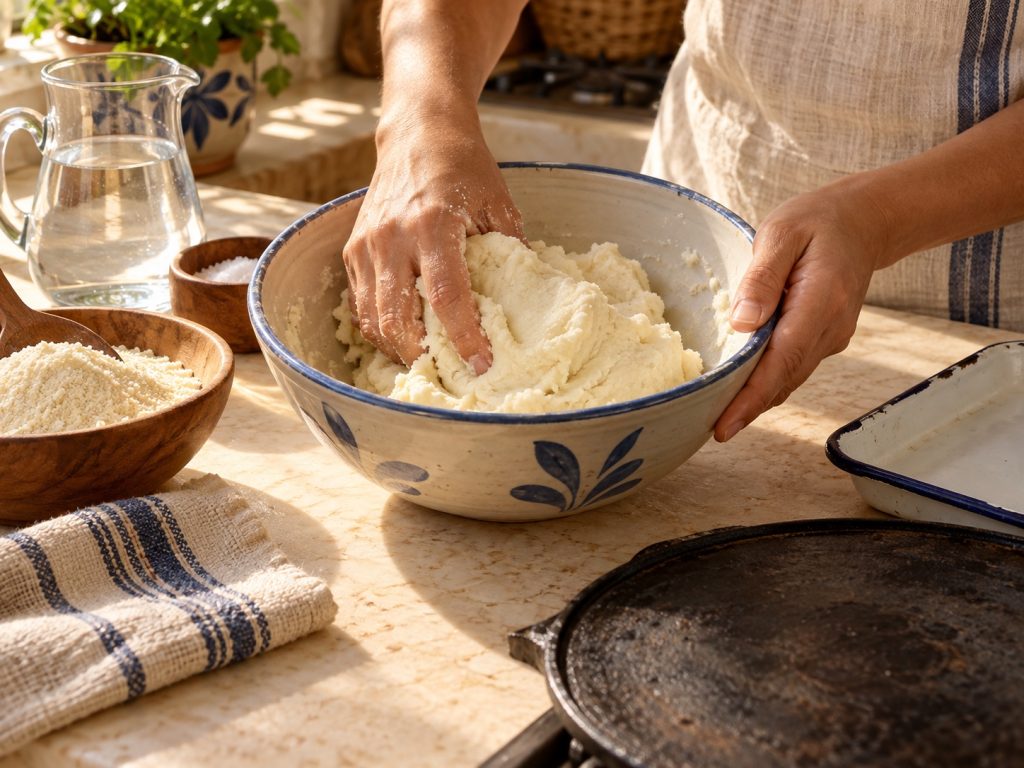
    Mix water and salt. Rain in the flour while mixing by hand; once no dry flour remains, rest 10 minutes.

    Step-by-step method

    1. Mix in the right order

    Mix water and salt. Rain in the flour while mixing by hand; once no dry flour remains, rest 10 minutes.

    2. Shape crack-free disks

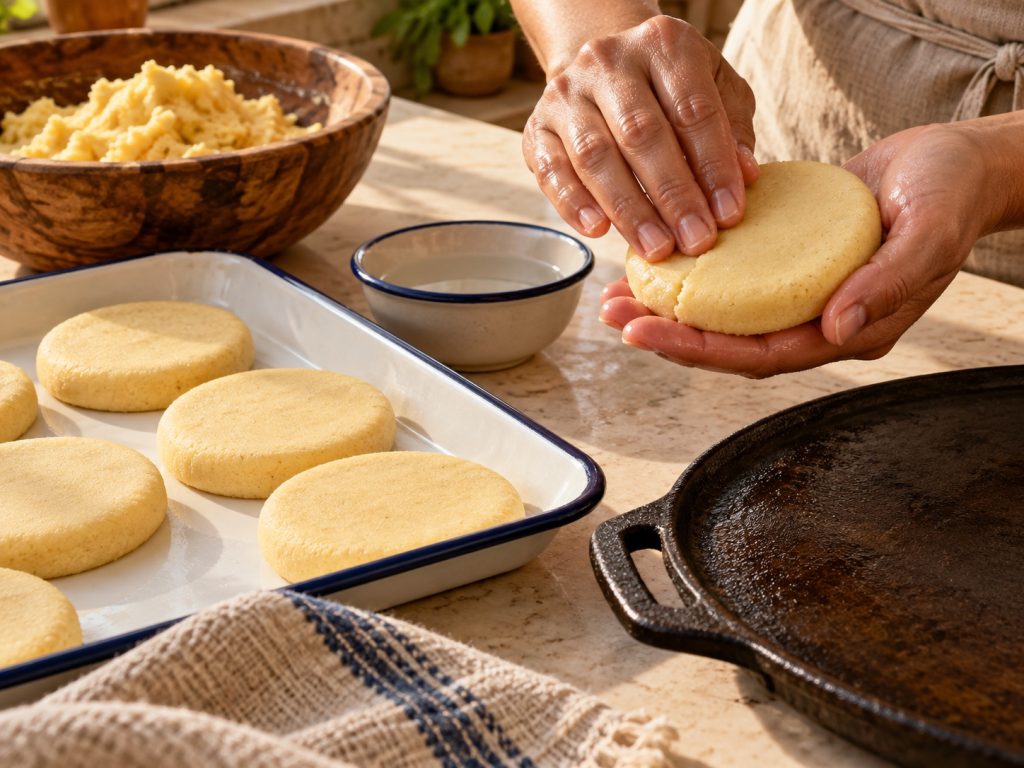
    Make 8 equal balls. Pat into 4-inch disks about ⅝ inch thick; seal cracks with wet fingers.

    Shape crack-free disks
    Make 8 equal balls. Pat into 4-inch disks about ⅝ inch thick; seal cracks with wet fingers.

    3. Build a skillet crust

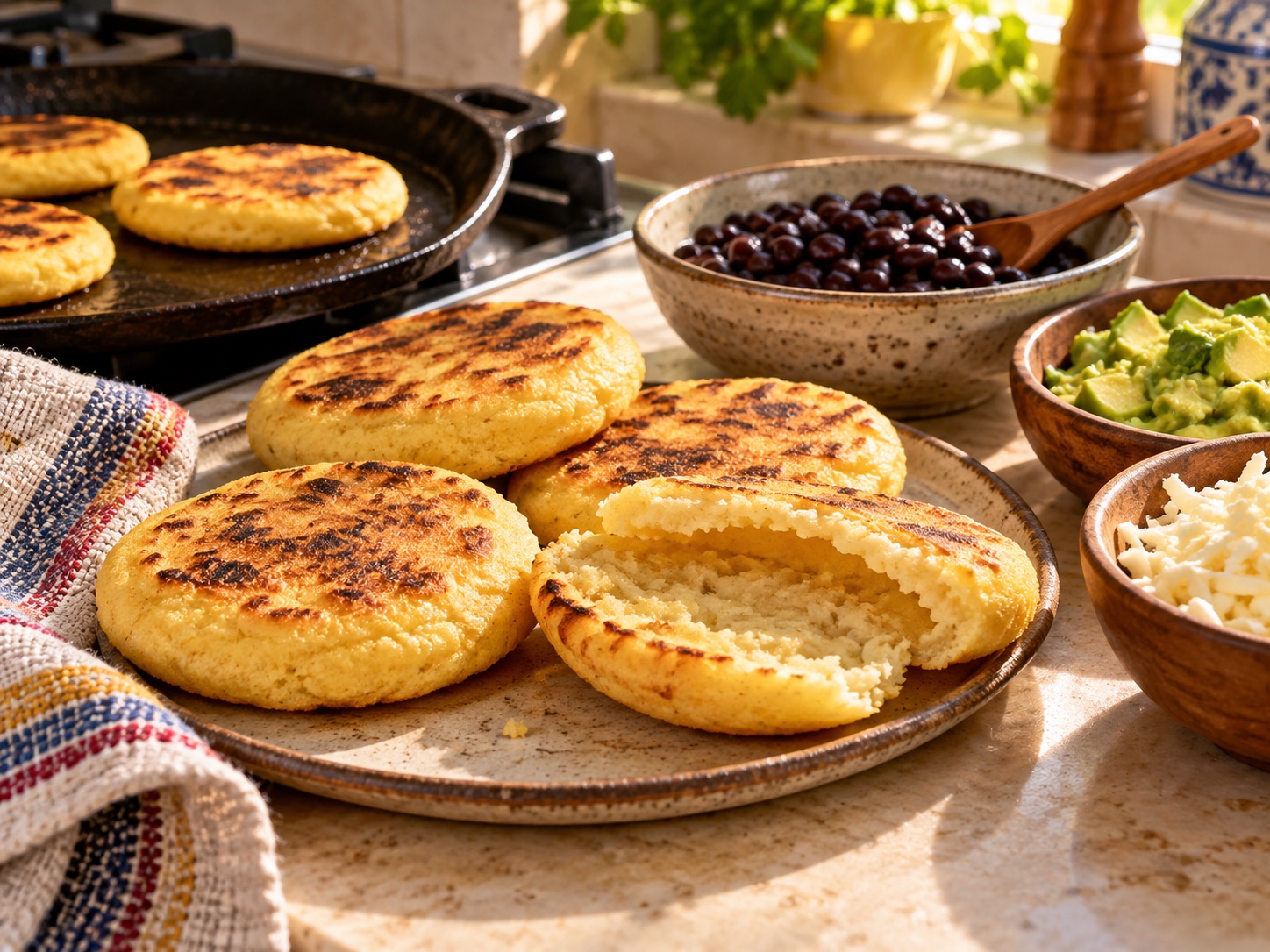
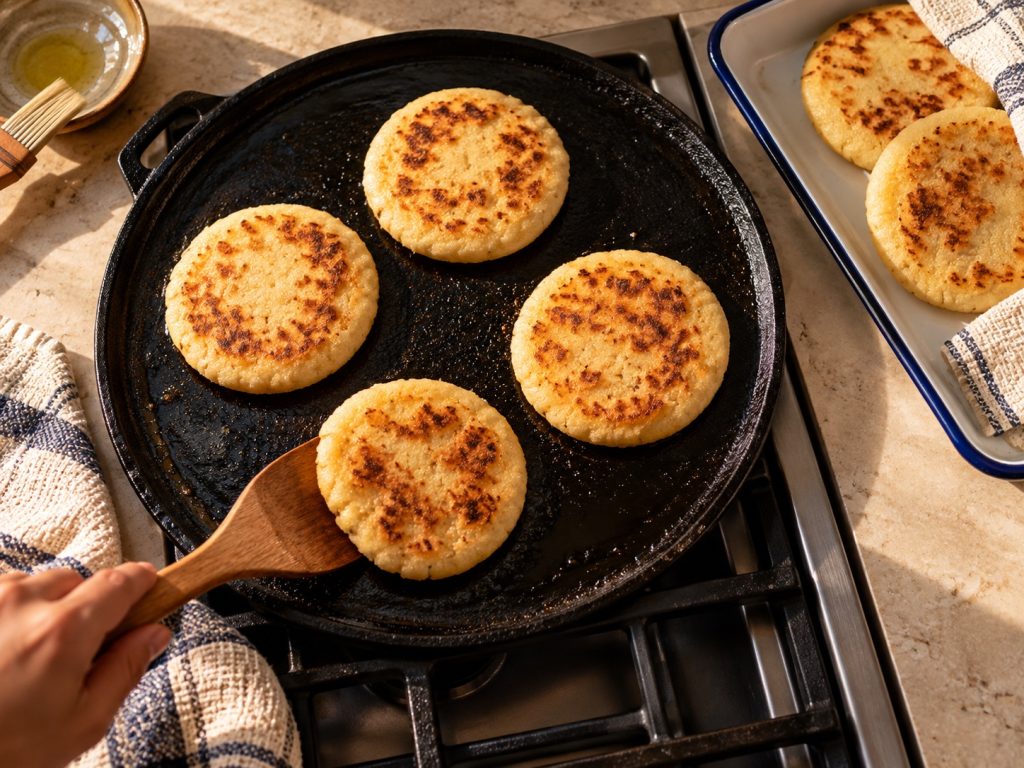
    Cook in a lightly oiled skillet over medium heat 4–5 minutes per side until a deep golden crust forms.

    Build a skillet crust
    Cook in a lightly oiled skillet over medium heat 4–5 minutes per side until a deep golden crust forms.

    4. Finish in the oven and rest

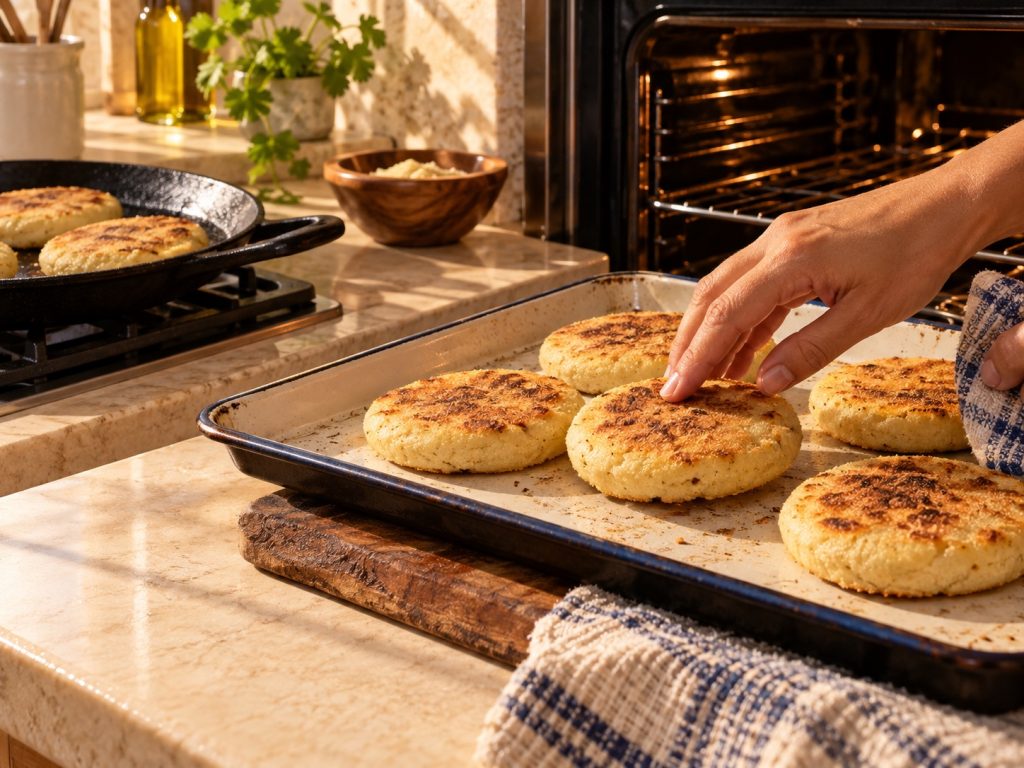
    Transfer to a sheet and bake at 400°F for 15–18 minutes. They should sound slightly hollow when tapped. Rest 5 minutes, then split into pockets.

    Finish in the oven and rest
    Transfer to a sheet and bake at 400°F for 15–18 minutes. They should sound slightly hollow when tapped. Rest 5 minutes, then split into pockets.

    Texture and doneness cues

    Outside is dry and golden, inside moist but not sticky, and it splits without crumbling.

    Mistakes, substitutions, and measurements

    Use only precooked cornmeal; yellow gives stronger corn flavor. Naturally dairy- and egg-free.

    Serving, storage, and allergens

    Fill with cheese, black beans, avocado, or chicken. Cool within 2 hours; refrigerate 3 days or freeze 2 months. Reheat at 375°F for 8–10 minutes.

    Frequently asked questions

    Why did they crack?

    Dough was dry or unrested; add water by the tablespoon.

    Why is the middle sticky?

    Disks were thick or underbaked; shape evenly.

    Can I use only a skillet?

    Yes, with lower heat and longer cooking; oven finishing is more even.