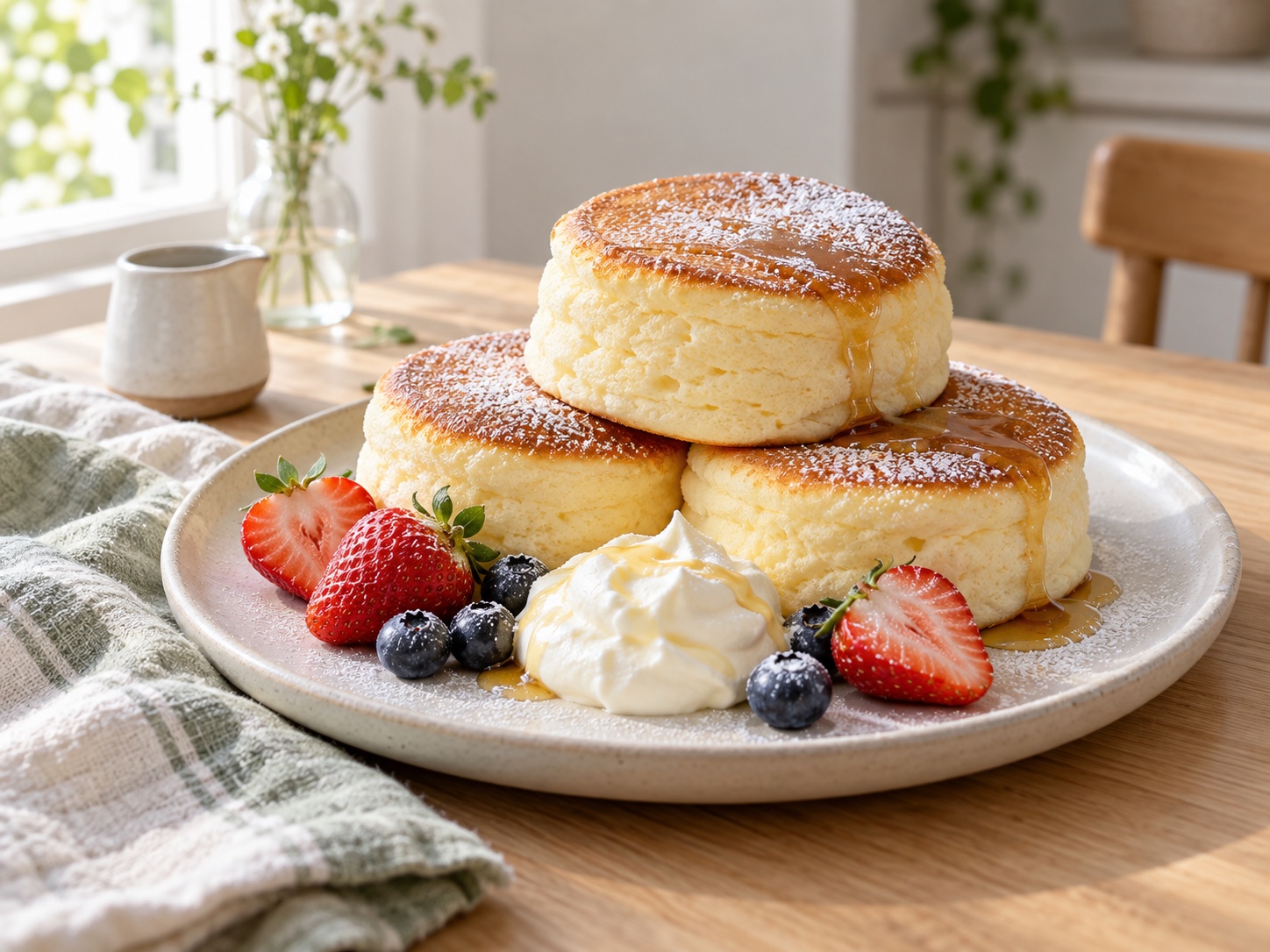
Japanese café-style soufflé pancakes rise mainly from air trapped in a well-made meringue, not from baking powder alone. This recipe builds four small pancakes in two layers, so you can get height without specialty ring molds.
The center should be moist but fully cooked, with a light, springy crumb rather than a standard pancake texture. This recipe is not presented as personally kitchen-tested; use the visual doneness cues and food-safety check below.
Why this method works
- A little lemon juice helps stabilize the egg-white foam, while adding sugar gradually creates a fine, glossy meringue.
- Mounding the batter in two layers builds height without ring molds. If it spreads immediately, the meringue is too soft or the batter was over-folded.
- A pan near 300°F/150°C cooks the center without burning the outside. A covered pan plus a small splash of water creates gentle steam and keeps the surface supple.
Before you start: tools and conversions
You need a 10–11-inch nonstick skillet with a tight lid, an electric mixer, two grease-free dry bowls, a fine sieve, silicone spatula, wide turner, and a cookie scoop or piping bag.
For 45 g cake flour, substitute 40 g all-purpose flour plus 5 g cornstarch and sift twice. 30 ml milk equals 2 tablespoons; 36 g sugar is about 3 level tablespoons.
Eggs separate more cleanly while cold. Chill the whites for 10–15 minutes; even a trace of yolk or grease can keep them from whipping properly.
How to make Japanese soufflé pancakes
1. 1. Make the yolk batter
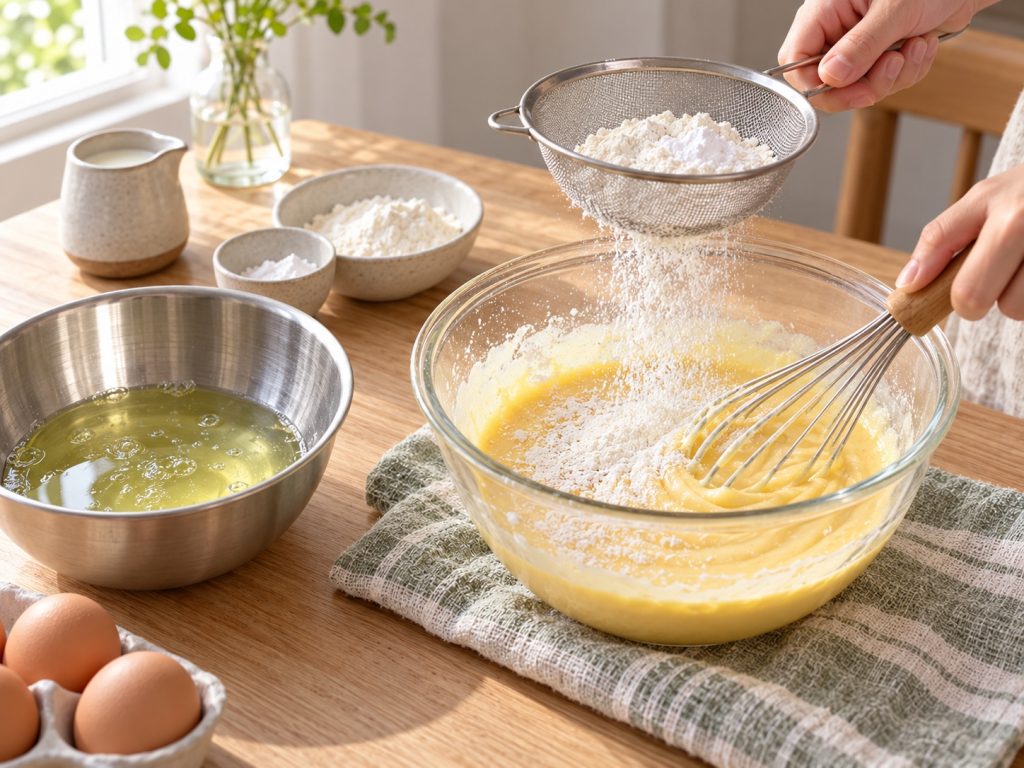
Whisk the yolks with milk and vanilla until smooth. Sift in the cake flour and baking powder, then mix only until the lumps disappear. Keep the egg-white bowl spotless and dry.
2. 2. Whip a stable meringue
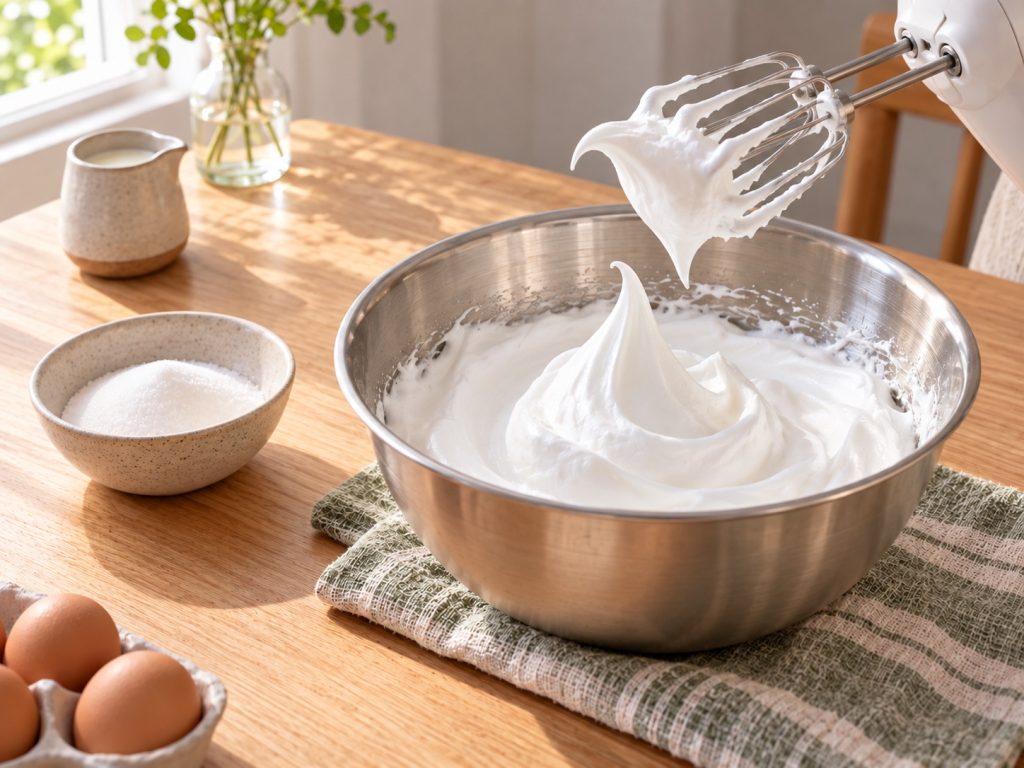
Add lemon juice to the chilled whites. Beat on medium until foamy, then add the sugar in three additions. Stop when the meringue is glossy and fine-textured and the whisk leaves a peak that stands upright with only its tip bending. A dry, clumpy look means it is over-whipped.
3. 3. Fold without losing the air
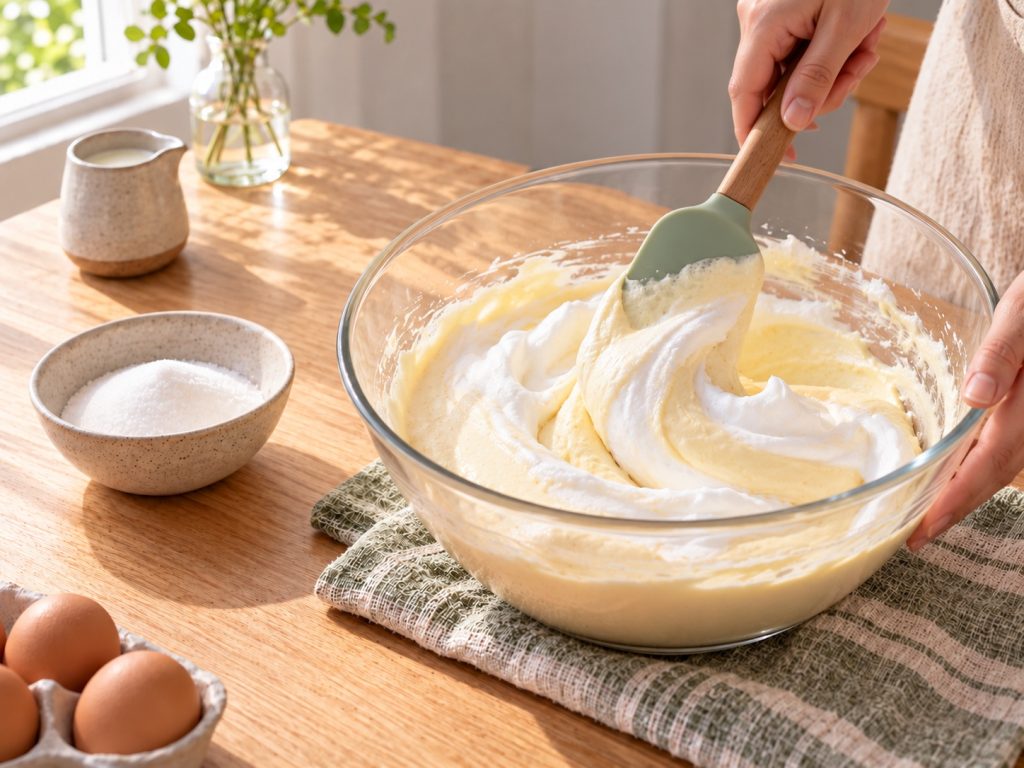
Stir one-third of the meringue into the yolk batter to lighten it. Add the rest in two batches, sweeping the spatula underneath and folding upward while rotating the bowl. Stop as soon as no white streaks remain. The batter should mound on a spoon instead of flowing flat.
4. 4. Cover and cook low and slow
Preheat the skillet on the lowest setting for 3 minutes and wipe on an almost invisible film of oil. Add four tall scoops; after 1 minute, pile a second scoop on each. Drip 1 tablespoon water into empty areas, cover, and cook 6–7 minutes. Once the bottoms are golden and edges set, turn with a gentle rolling motion. Add the remaining water, cover, and cook 4–5 minutes. The center should spring back with no wet batter; if using a thermometer, reach at least 160°F/71°C. Serve immediately.
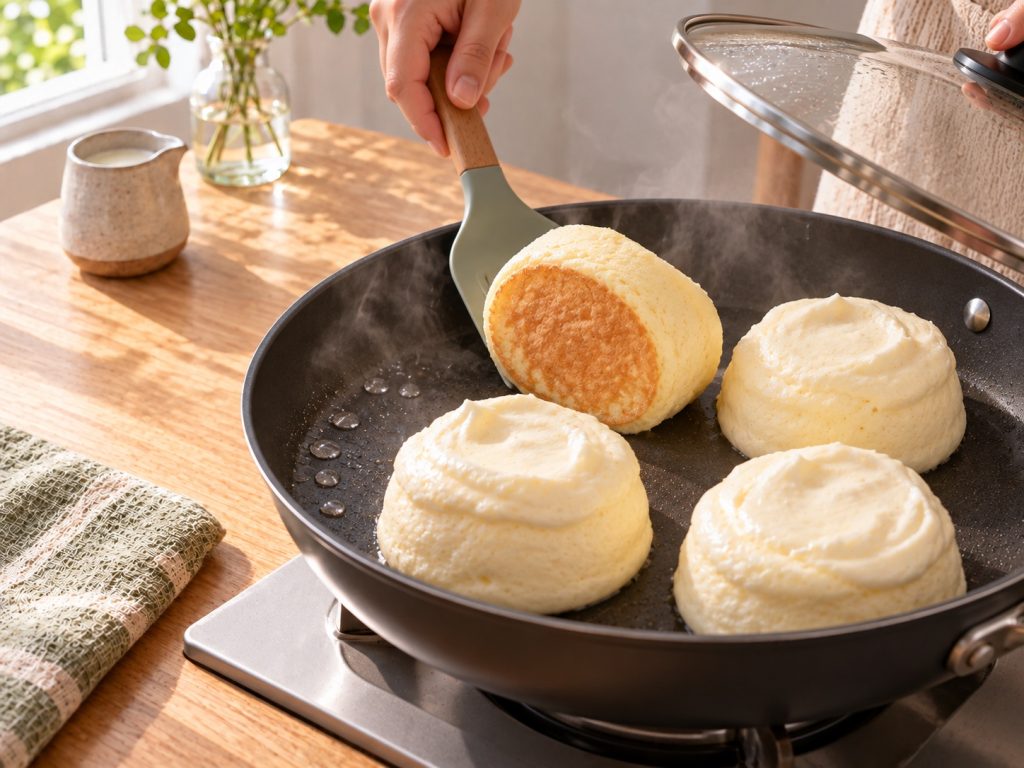
Japanese Soufflé Pancakes Without Molds
Fluffy Japanese café-style pancakes made with stable meringue, two-layer mounding, and a covered low-heat method—no ring molds needed.
Ingredients
- 3 large eggs — separated
- 45 g cake flour — or 40 g all-purpose flour plus 5 g cornstarch
- 30 ml whole milk — 2 tablespoons
- 36 g superfine sugar — about 3 level tablespoons
- 3/4 teaspoon baking powder
- 1/2 teaspoon vanilla extract
- 1 teaspoon lemon juice — or 1/4 teaspoon cream of tartar
- 1 pinch fine salt
- 1 teaspoon neutral oil — for a very thin pan coating
- 2 tablespoons water — for steaming; keep away from batter
- as desired berries, whipped cream, or maple syrup — for serving
Instructions
- Whisk yolks, milk, and vanilla. Sift in cake flour and baking powder and mix until smooth.
- Beat chilled whites with lemon juice until foamy. Add sugar in three stages and whip to glossy, firm—not dry—peaks.
- Lighten the yolk batter with one-third of the meringue, then gently fold in the rest in two batches.
- Mound batter in two layers in a lightly oiled skillet over very low heat. Add water at the edge; cook covered 6–7 minutes, flip, then cook covered 4–5 minutes. Bring the center to at least 160°F/71°C and serve at once.
Notes
- Common causes of collapse are weak or over-whipped meringue, aggressive folding, excessive heat, and flipping before the center has set.
- If the bottoms brown too fast, remove the skillet from heat and set it on a damp towel for 20–30 seconds, then return to the lowest heat.
- A non-dairy drink can replace milk, but different protein and fat levels may slightly change the result. Do not replace baking powder with baking soda.
- Allergens: egg, milk, and wheat/gluten. Check the labels of any toppings as well.
How to tell when the texture is right
Raw batter should stand in a small mound on the scoop. A cooked pancake has matte sides, an evenly golden base, and a center that springs back when gently pressed. If wet batter shows through a crack, cover and cook 1–2 minutes longer.
Common problems and quick fixes
If the meringue is loose with large bubbles, whip a little longer; if it is dry, clumpy, and broken, starting again with fresh whites is safest. If the batter spreads in the pan, it lost too much air—make smaller pancakes. A dark outside with a wet center means the heat is too high.
Serving, storing, and reheating
Serve straight from the pan because the airy structure settles within minutes. Cool leftovers fully and refrigerate airtight for up to 2 days. Reheat in a covered skillet over the lowest heat with a few drops of water for 2–3 minutes. Freezing is not recommended because it damages the sponge-like texture.
Frequently asked questions
Why do Japanese soufflé pancakes deflate?
A little settling is normal. Major collapse usually comes from under- or over-whipped meringue, over-folding, high heat, or an undercooked center.
Can they really be tall without ring molds?
Yes. Firm, glossy meringue plus mounding the batter twice creates height. Making three pancakes instead of four gives each one even more height.
What can I use instead of cake flour?
Replace 45 g cake flour with 40 g all-purpose flour plus 5 g cornstarch, mixed and sifted twice.
How do I know the center is cooked?
The top should spring back and no wet batter should show in a crack. The most reliable check is at least 160°F/71°C in the center.
Leave a Reply